
Polarsteps for Food: A Travel Diary for Everything You Eat
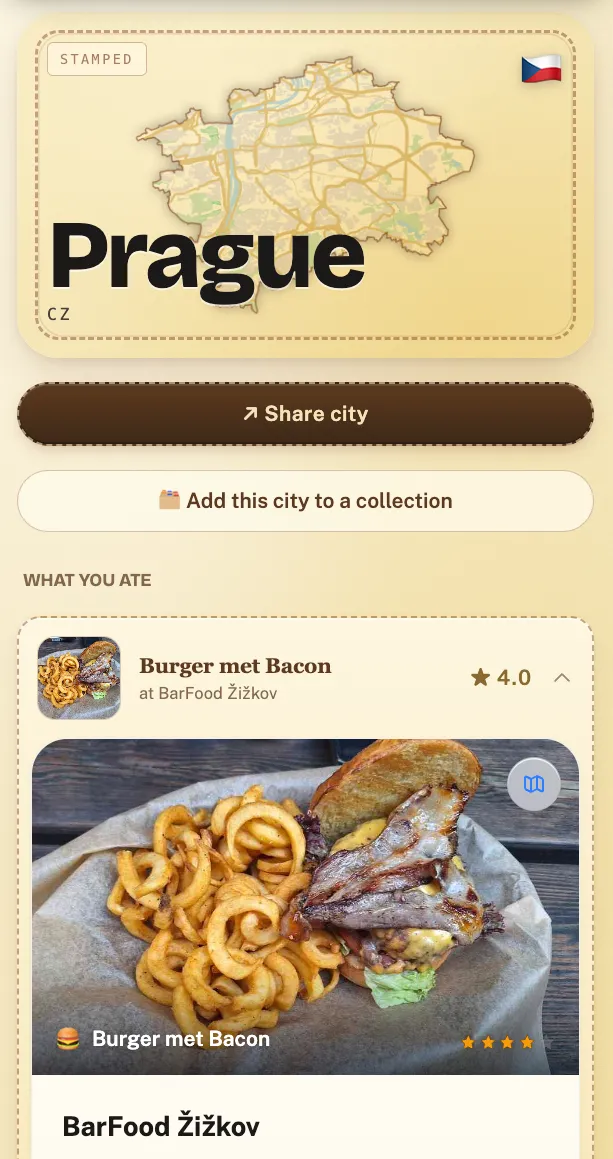
"Polarsteps but for food" is a request that almost writes itself. Polarsteps nailed something rare: it turned a trip into a keepsake without making you work for it — a route on a map, a diary that fills as you go, a printed book at the end, friends following along from home. If you've ever finished an unforgettable meal abroad and wished it landed somewhere as lovingly as your Polarsteps timeline, you already understand the product. This guide takes the Polarsteps loop apart piece by piece and shows what each part looks like when the subject is what you ate — plus an honest note on where Polarsteps still wins.
Why Polarsteps is the muse
Polarsteps didn't win because it logged GPS coordinates accurately. It won because it closed a loop that turns a holiday into something you keep:
- Trips track themselves. You don't file every stop by hand — the trip assembles in the background while you're busy actually travelling.
- The route becomes a map. Your journey isn't a list of place names, it's a line across the world you can scroll along later.
- The timeline is a diary. Photos and notes land in order, so the trip reads as a story instead of a shuffled camera roll.
- The travel book is the payoff. Months of moments compressed into one object you actually want on the shelf.
- Friends follow along. The people who care about your trip get to watch it unfold — no public broadcast, just your circle.
Every piece of that loop has a one-to-one translation to food. Eating on the road is geographic, chronological, photogenic, and worth keeping — the same raw material, a different layer of the same trip.
The Polarsteps loop, translated to food
| Polarsteps | The food equivalent | In Crumble |
|---|---|---|
| Auto-tracked trips | The meals from one journey, grouped together | Trips — reviews logged away from home cluster into one browsable unit |
| The route map | Every spot you ate, pinned where it happened | Map-first reviews — your food history is the map itself |
| The timeline / diary | Your meals in order, with photos and ratings | Reviews in sequence: photos + per-dish half-star ratings (0.5–5) |
| The travel book / year recap | The trip's food story as a keepsake | City recaps + the food passport stamping countries and cities |
| Friends following along | Your circle seeing your spots as you log them | Friends-only shared map and reviews — no public feed |
Auto-tracked trips → trips that group themselves
The magic of Polarsteps is that you don't manage it. Crumble does the same for food: reviews you log away from home cluster into trips automatically — no "create trip" admin, no folders to maintain. A two-week holiday becomes one browsable unit you can scroll later, the same way a Polarsteps trip assembles itself while you're out living it. If you want the full system for the road, our guide on tracking food on your travels walks through the habits that survive a real holiday.
The route map → your food map
A Polarsteps route is a line across the world. Crumble's version is every meal pinned where you ate it — the stall you found by accident, the restaurant a local pointed you to, the bakery you passed once. A few trips in, your map reads like a Polarsteps route drawn entirely in dinners: the cluster around the old town, the line down a coastline, the one outlier from a detour that turned out to be the best thing you ate all year.
The timeline / diary → your reviews in order
Polarsteps' timeline works because photos and notes land in sequence and the trip reads as a story. Crumble's reviews do the same for food: each one carries photos and per-dish half-star ratings (0.5–5), and in a trip they sit in order — the breakfast, the long lunch, the late dinner you'll still be talking about next year. It's the food diary half of your travel diary, written one entry at a time while the bill arrives.
The travel book → city recaps and the food passport
The travel book is the part people frame. Crumble's payoff comes in two pieces: every city you eat through gets a shareable recap — the trip's food story in one link, no dumping forty photos on the group chat — and your food passport stamps a country and city the first time you review somewhere new. It's the year-recap energy of Polarsteps, except it accrues meal by meal instead of arriving once a year.
Friends following along → friends-only sharing
Polarsteps lets the people who care watch your trip unfold without broadcasting it to the world. Crumble keeps that intimacy: your friends see your new spots appear on the shared map as you log them — filtered to places they haven't tried — so the friend heading to Lisbon next month inherits your hit list automatically. There's no public feed underneath it. Your circle is the whole audience.
The souvenir that builds itself: the food passport
Eat in a new country and it unlocks that country's flag. Eat in a new city and that city stamps too. Over years of trips, your passport becomes a collectible map of everywhere you've ever eaten — the dense home region, the row of flags from one big summer, the single far-flung stamp from a layover that turned into the meal of the decade. You don't curate it. You don't sit down at the end of a trip and assemble it. You just eat, and the souvenir builds itself in the background — a Polarsteps book that's always one meal further along, never finished, always worth opening.
That's the part that compounds. The first trip looks like a few stamps. The tenth looks like a life you can scroll across a world map.
Where Polarsteps still wins — and why they pair
To be clear: this isn't a "switch away from Polarsteps" pitch. Polarsteps is the better tool for the journey — the route, the kilometres, the trains and flights and the place you slept, the timeline of the whole adventure and the printed book at the end. Crumble is the better tool for the food layer of that same trip: the meals, the dishes, the ratings, and the passport that records which countries and cities you've eaten in. They're answering different questions about the same holiday.
The clean split most travellers land on: keep Polarsteps for the trip, run Crumble alongside it for everything you put in your mouth. The route tells you where you went; the food map tells you what you'd go back for.
The honest landscape: other apps in the race
- Polarsteps itself, as above, is the muse and the complement — unbeatable for the journey, not built for per-dish food memory. Use it for the trip and add the food layer separately.
- Beli is ranking-first: compare places head-to-head to build a personal top-100, with leaderboards and a big public community. If what you want is the competitive, public side of food tracking rather than a private travel diary, Beli is the closer match. We compare it in depth in our guide to the best restaurant tracking apps.
- Yummi is a photo-first food diary — meals logged as geotagged photos, organized into a calendar and map. More scrapbook than trip diary; pick it if memory-keeping matters more to you than trips, recaps, and a passport.
Crumble's lane is the Polarsteps shape applied to food, with a private default: trips, a food map, a photo timeline, city recaps, and a passport — all friends-only, no ads, no data sales, EU-hosted and GDPR-compliant. The free core covers all of it, including a wishlist with folders you create ("Madrid trip", "Tokyo 2027") and the tasting-journal add-ons for coffee, tea, matcha, wine, whisky, and beer. Crumble Plus (€1.99/week, €4.99/month, or €29.99/year) adds AI food scan, AI label scan, and an unlimited wishlist on top.
Start your food passport
Polarsteps proved that a trip, a map, and a diary that fills itself can turn a holiday into something you keep forever. The food deserves the same treatment — it was half the reason you went. Crumble runs as a PWA at crumble.me on iPhone, Android, and desktop: no download, two taps to the home screen, and your first stamp is one meal away.
More from the Crumble guides hub: how to track food on your travels and the best restaurant tracking apps compared.
Frequently asked questions
Is there a Polarsteps for food?
Yes — Crumble is the closest equivalent for the food layer. Reviews you log away from home group themselves into trips, every spot you ate gets pinned to your map, your reviews read as a photo timeline with per-dish half-star ratings, and each city you eat through gets a shareable recap. The travel-book moment is your food passport: it stamps a country and city the first time you review there. Polarsteps is still the better tool for the journey itself — they complement each other.
What is the best travel food diary app?
It depends what you want from the diary. Crumble is the pick if you want the Polarsteps shape applied to eating — a map of every meal, trips that organize themselves, per-dish ratings and photos, city recaps, and a food passport that fills as you travel. Beli leans into public rankings and leaderboards; Yummi is a photo-first food scrapbook. For the journey alongside the food, keep Polarsteps and let Crumble handle the meals.
Is there an app to remember the meals from a trip?
Crumble is built for exactly that. Log each place the day you eat there — name, one rating, one line about what you ordered — and a two-week holiday becomes a single browsable trip with its own map instead of forty loose photos. The food passport quietly records every new country and city you've eaten in, so the trip survives long after the camera roll blurs together.
Is Crumble free?
The core app is free: the map, unlimited reviews with per-dish half-star ratings, photos, friends, reactions and comments, trips, the food passport with country and city unlocks, city recaps, the daily Crumb Hunt quiz, and the tasting-journal add-ons (coffee, tea, matcha, wine, whisky, beer). Crumble Plus (€1.99/week, €4.99/month, or €29.99/year) adds AI food scan, AI label scan, and an unlimited wishlist.
Do I need to download an app to use Crumble?
No — Crumble is a Progressive Web App at crumble.me. It runs in the browser on iPhone, Android, and desktop, and installs to your home screen in two taps. No app store account, no download size, no waiting for updates — which is exactly what you want the night before a flight.