
The 7 Best Restaurant Tracking Apps in 2026
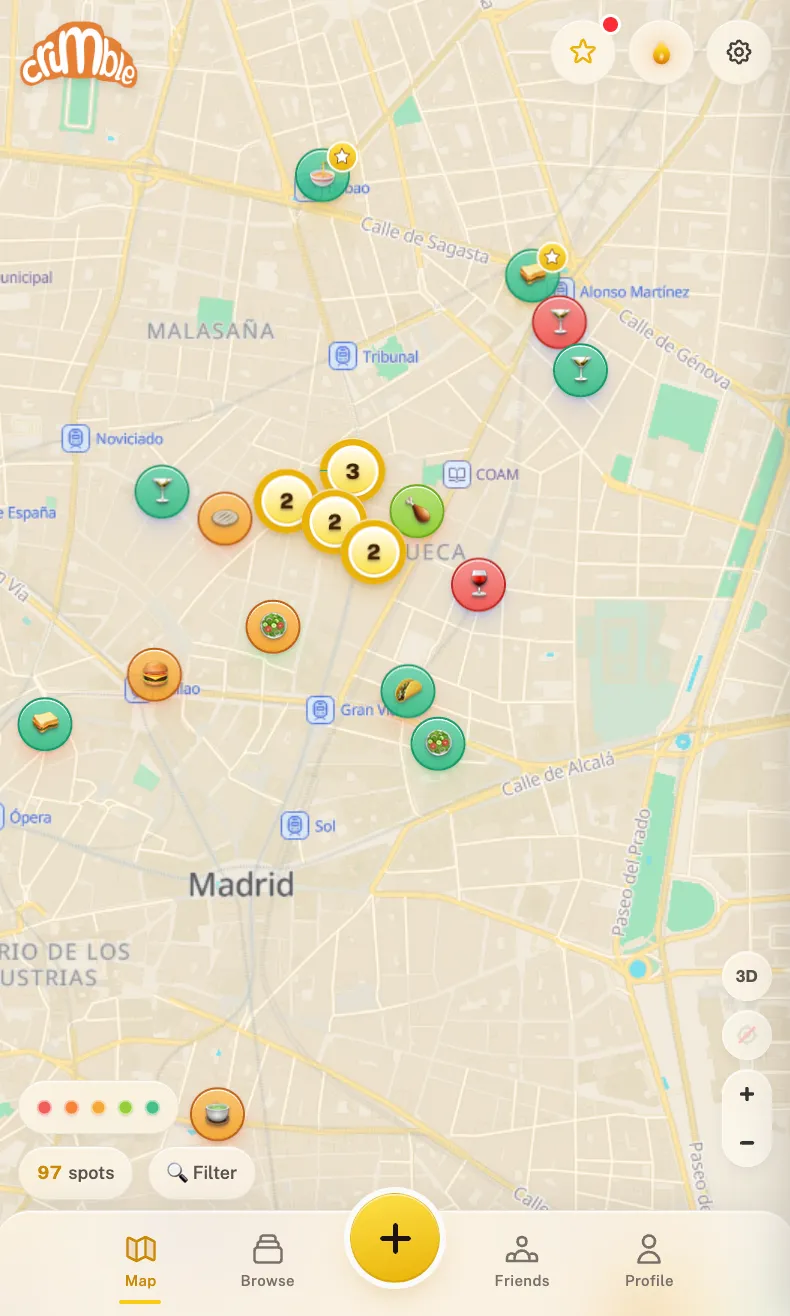
A restaurant tracking app is a personal app that records every restaurant you've been to, what you ordered there, your own rating for each place, and a wishlist of spots you still want to try — your private dining history, searchable on a map. Here's why you'd want one: you've eaten at hundreds of restaurants and remember maybe twelve of them. The pasta place from that trip two summers ago? Somewhere in a camera roll of 4,000 photos, between a screenshot and a parking ticket. A tracker replaces that with one searchable record of everywhere you've eaten and whether it was worth going back.
This guide compares the restaurant trackers people actually use in 2026 — what each one is best at, where it falls short, and which type of eater it fits.
The picks at a glance
| App | Best for | Platforms | Privacy model | Price |
|---|---|---|---|---|
| Crumble | Per-dish ratings with a private friend circle | Web app (installs on iOS, Android, desktop) | Friends-only by default | Free (optional Plus tier) |
| Beli | Ranked lists and a big foodie community | iOS, Android | Social feed, leaderboards | Free |
| Yummi | Photo-first food diary | iOS, Android | Personal diary + optional sharing | Free |
| Truffle | Simple social restaurant journal | iOS | Friends-oriented | Free |
| Mapstr | Saving places of every kind, not just food | iOS, Android | Private map + optional sharing | Free |
| Memolli | Offline-friendly restaurant history | Mobile | Personal-first | Free |
| Google Maps lists | Zero-setup starring of places | Everywhere | Private lists, optional sharing | Free |
Already know what you want? Open Crumble — no install needed
1. Crumble — best for tracking every dish with your friends
Crumble is a social food map: an app to keep track of the restaurants you've been to, the dishes you ordered there, and the places you still want to try — shared with the friends you actually eat with, and nobody else.
What sets it apart:
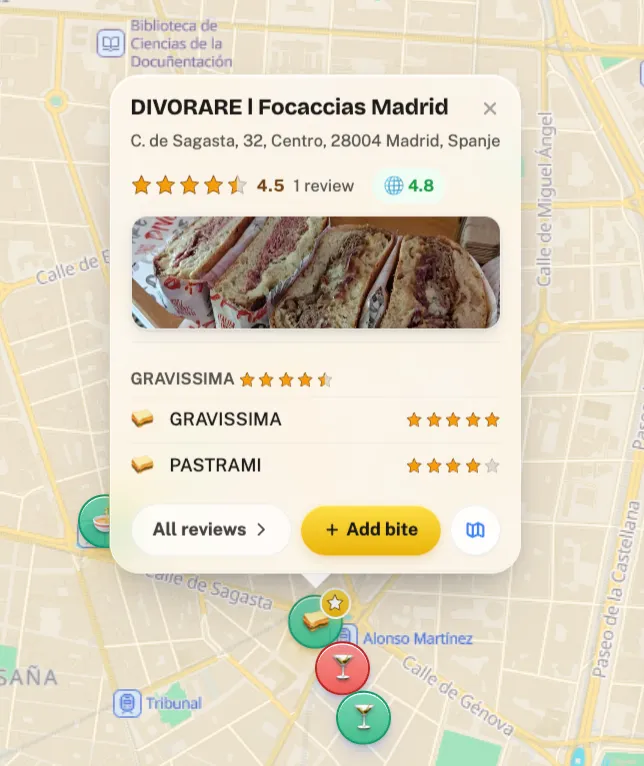
- Per-dish ratings. Most trackers stop at "this restaurant: 4 stars". Crumble rates every dish you ordered with half-star precision, so next visit you know to get the ramen and skip the gyoza.
- A wishlist that cleans itself. Save places you want to try; the moment you log a review there, the wishlist entry clears automatically. (More on why that matters in our restaurant wishlist app guide.)
- Three rating signals per place. Every spot shows a Friends average (you plus people you follow), a Crumble-wide average, and public Foursquare data for context — so you can tell "my friends love it" apart from "the internet loves it".
- A shared friends map. Your friends' rated spots appear on your map, filtered to hide places you've already been — so the map always shows something new.
- Private by default. Strangers can't see your reviews, your spots, or that you exist. No public feed, no leaderboard, no ads. EU-hosted and GDPR-compliant.
- No install required. It's a Progressive Web App — open crumble.me in any browser, add it to your home screen, done.
Beyond restaurants, the free tier also includes six-axis tasting journals for coffee, tea, matcha, wine, whisky, and beer — with imports for existing Untappd check-ins and Vivino wine lists — plus XP, levels, and a daily food-geography quiz called Crumb Hunt. The optional Crumble Plus tier (from €1.99) adds an AI food scanner, AI label scanning for the tasting journals, an unlimited wishlist, and uncapped Crumb Hunt rounds; nothing about the core tracking is paywalled.
Where it's not for you: if you want a large public community, rankings against strangers, or restaurant discovery driven by crowd data, Beli's network is much bigger. Crumble is deliberately small-circle.
Installing takes two taps: open crumble.me in your phone's browser, hit Share (iOS) or the ⋮ menu (Android), then "Add to Home Screen". It behaves like a native app from then on — no app store, no download wait.
2. Beli — best for ranked lists and a large community
Beli is the most established name in restaurant tracking. Its signature mechanic is the ranked list: you never assign a score directly. Instead you pick "I liked it!", "It was fine", or "I didn't like it", then Beli asks you to compare the place against restaurants already on your list and computes a score out of 10 from those head-to-head calls, producing a personal top-100.
On top of that sit the social layers: friend activity, leaderboards, a "compatibility" score predicting how much your palate overlaps with each friend's, a Taste Profile summarizing your rankings by cuisine and city, and recommendation scores for places you haven't been (one from Beli's algorithm, one from your friends' rankings). It's on iOS and Android and has a genuinely large, active user base, densest in big US cities. If the ranking mechanic itself is what draws you, we compared it against its rivals in our restaurant ranking apps guide.
Trade-offs: the experience is built around the social graph — leaderboards, streaks, and a feed. If that motivates you, it's the strongest pick on the list. If you want a quieter, more private record, or dish-level detail rather than restaurant-level ranking, look at Crumble or Yummi.
3. Yummi — best photo-first food diary
Yummi approaches tracking from the food photo angle: you log meals by uploading photos, which become geotagged "Foodprints" organized automatically into a calendar and a map. Timestamps are backdated to when you actually ate, so batch-uploading last month's photos still produces an accurate timeline. It works for home cooking as well as restaurants, which makes it closer to a general food diary than a restaurant tracker.
Yummi also layers discovery on top of the diary: you can follow friends and food-focused accounts, browse their Foodprints, and get AI-curated restaurant and dish recommendations based on what you've logged. Privacy is toggleable per account or per individual Foodprint, so the diary can stay fully private while you still browse. It's available on both iOS and Android.
Trade-offs: the photo-first model is great for memory-keeping, less sharp for "should I go back, and what should I order?" — ratings and structured reviews take a back seat to the visual timeline.
4. Truffle — best simple social journal (iOS)
Truffle markets itself as the social restaurant tracking app — its own pitch is "Strava for running, Letterboxd for movies, Goodreads for books, but for restaurants" (an analogy we've explored ourselves in Letterboxd for restaurants). Connect with foodie friends or use it solo as a restaurant journal: log where you ate, see everyone's tracked restaurants on the shared Truffle map, with a deliberate non-ranking system and no pressure to post photos or write reviews.
Its standout feature is automation: Truffle can sync with your credit card to auto-log every restaurant you visit, auto-track places you tag in Instagram Stories, and import existing lists from Google Maps, Yelp, Notes, and spreadsheets — the lowest-effort logging on this list.
Trade-offs: iOS-only (iOS 15.1+), so mixed-platform friend groups are out, and the feature set is intentionally minimal — no dish-level ratings or structured scores.
5. Mapstr — best for saving every kind of place
Mapstr is a private place-saving app rather than a food tracker specifically: restaurants, bars, shops, viewpoints, anything pinnable. Tags and colors are freeform and unlimited ("Sushi", "for a date", "sunset spot"), each place takes notes, photos, and a rating, and you can share selections with friends. The French-made app has been at this for a decade and it shows in the polish: AI semantic search ("Italian with a terrace for a birthday"), proximity alerts when you walk near a saved spot, batch-editing tags across many places, and offline access to your whole map.
Trade-offs: because it tracks everything, it has no food-specific structure — no dish ratings, no visited-versus-wishlist logic. Great bookmark drawer, thin as a dining record. If you like the Mapstr model but want a food-shaped one, we wrote up the best Mapstr alternatives separately.
6. Memolli — best offline-friendly option
Memolli pitches itself as a private, visual-first journal for food, drinks, and restaurants — "your own personal Yelp", browsable on a map. It works entirely offline: you can log entries with no connection and they sync when you're back online, which is genuinely handy for travel where roaming data is precious. No account is required — the journal lives on your device — and AI-assisted reviews can fill in name, location, and category from your photos.
It also stretches beyond restaurants with structured review templates for wine, beer, whiskey, coffee, and tea — the same territory as Crumble's tasting journals, but single-player.
Trade-offs: a smaller, newer app with a correspondingly small community; it's a personal record more than a social one, so there's no friends map to compare notes on.
7. Google Maps saved lists — best zero-setup fallback
Already on your phone, free forever: star a place, drop it into a "Want to go", "Favorites", or custom list, share a list with a friend. Custom lists take an emoji icon and a short note per place, collaborative lists let a group add spots together, and everything shows up as pins on the map you already navigate with. For many people this is where restaurant tracking starts — and for a handful of places, it's honestly enough.
Trade-offs: it's a bookmark system, not a tracker. No rating scale of your own, no notes structure, no dish history, and friend sharing means manually sending list links. When lists outgrow themselves — usually around the fiftieth star — people move to a dedicated app.
How to choose
- You eat out with the same circle of friends → Crumble. The shared map plus dish ratings is built for exactly this.
- You want a big community and love ranking things → Beli.
- Your camera roll is already a food diary → Yummi.
- You want one private map of everything, food and beyond → Mapstr.
- You just need to remember a handful of places → Google Maps lists, then upgrade when it stops scaling.
Whichever you pick, the habit matters more than the app: log the visit before you leave the table. Thirty seconds while you wait for the bill beats trying to reconstruct a meal three weeks later. For more on building the habit, see our guide on how to keep track of restaurants you've been to.
What's the best restaurant app for keeping track of where you've eaten?
Search for "best restaurant app" and most of what comes back isn't for you — it's for restaurant owners. POS systems, reservation management, staff scheduling, inventory tools: all real software, none of it capable of remembering that the tonkotsu at that place in Lisbon was worth the queue. There's a second cluster that's closer but still different: discovery and review apps like Google Maps, Yelp, and TheFork, which are built for reading strangers' opinions about places you haven't been. What foodies actually asking this question want is a third thing: a personal diary of places they have been — a memory tool, not a marketing tool.
So the plain answer: for keeping track of where you've eaten, use a personal tracker like Crumble or Beli — that's the entire job they're built for. For finding somewhere new tonight, Google Maps or Yelp will serve you better. And for running a restaurant, none of the apps in this guide are what you're looking for.
Restaurant tracker, diary, or journal — same thing?
Mostly, yes. "Restaurant tracker", "restaurant diary app", and "restaurant journal app" all describe the same category — an app to track restaurants you've been to — and every app in this guide answers all three. The words do carry a slant: "tracker" suggests structure (ratings, lists, a map), "diary" suggests chronology and photos (Yummi's calendar view), "journal" suggests written notes (Truffle and Memolli both use the word). If you're choosing by label, don't — choose by the features in the table above.
The one real split within the category is the wishlist half: some apps focus on where you've been, others on where you want to go — including saving restaurants you find on TikTok before they vanish into your likes. The best trackers, Crumble included, treat "been" and "want to try" as two sides of the same map.
How we chose these apps
We build a restaurant tracker ourselves, which means two things: we know this category from the inside, and we have an obvious conflict of interest. To keep the list honest, every competitor description is drawn from the app's own published feature set — its website, App Store or Play Store listing — not from our opinion of it. We included an app when it (a) records restaurants you've personally visited, (b) attaches your own rating, note, or photo to each one, and (c) offers a usable free tier. We excluded pure discovery and review-aggregation apps (Yelp, TheFork, Google Maps as a review platform) because reading strangers' reviews is a different job from remembering your own meals. Where an app is the better choice for a certain kind of eater — Beli's community, Yummi's photo diary — we say so by name in its section.
Frequently asked questions
What is the best app to keep track of restaurants you've been to?
It depends on how you eat. If you want per-dish ratings and a private map shared only with friends, Crumble fits best. If you want ranked top-lists and a large social community, Beli is the most established. If you think in food photos rather than restaurants, Yummi's photo-diary approach works well.
Is there a free restaurant tracking app?
Yes. Crumble is free to use (tracking, ratings, wishlist, and the shared friends map), and it runs in the browser as a Progressive Web App, so there is nothing to install. Beli, Yummi, Truffle, and Mapstr also offer free tiers from their app stores.
Can I track restaurants without making my reviews public?
Yes — this is where the apps differ most. Crumble is friends-only by default: strangers cannot see your spots, reviews, or profile. Most other restaurant trackers are built around a public or semi-public feed, with private modes as an option.
What about just using Google Maps saved lists?
Google Maps lists are a fine zero-effort start, but they only store a star — no rating scale, no per-dish notes, no separation between 'been there' and 'want to try', and no friend layer. A dedicated restaurant tracker adds exactly those pieces.
What's the difference between a restaurant tracker and a food diary?
A restaurant tracker is organized around places: which restaurants you visited, how you rated them, and which ones are still on the wishlist. A food diary is organized around meals — often including home cooking — with photos and dates but less structure per venue. Crumble and Beli are trackers; Yummi leans diary. In practice the categories overlap, and Crumble records both the place and every dish you ate there.
Do restaurant tracking apps work in Europe?
Yes. Crumble is built in Europe, EU-hosted, and GDPR-compliant, with place search that works worldwide. Beli, Yummi, Truffle, Mapstr, and Memolli are all global apps too — Mapstr is French-made — though some, like Beli, have their densest communities in US cities.
Start your restaurant map today
Crumble is free, private by default, and runs in the browser you already have. Your first spot takes under a minute to log.