
Strava for Food: The Social Map of Everything You Eat
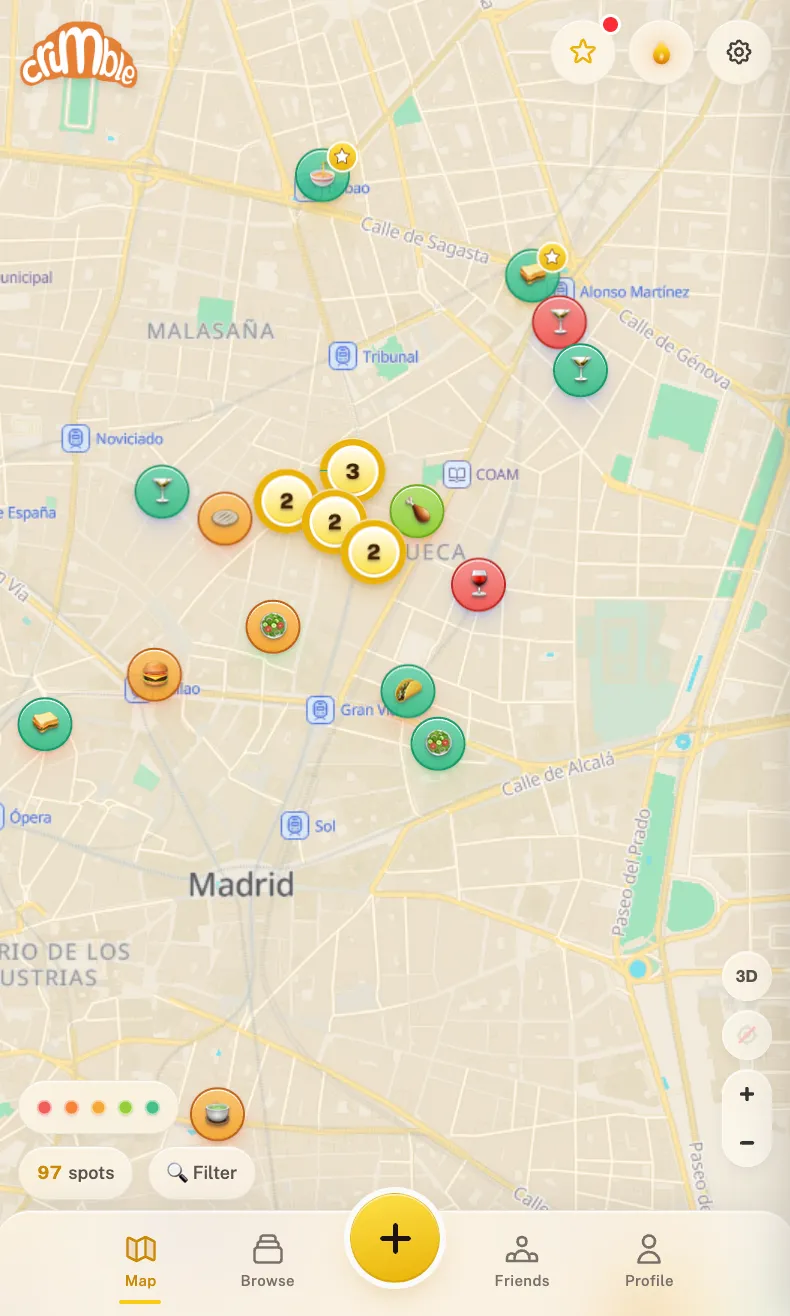
"Strava but for food" is one of the most natural app requests there is — and one of the most searched. If you've ever finished a great meal and wished you could log it the way you log a run, see it land on your map, and have your friends give it the food equivalent of kudos, you already understand the product. This guide takes the Strava loop apart piece by piece and shows what each part looks like when the activity is eating — plus an honest look at which apps actually deliver it.
Why Strava is the muse
Strava didn't win because it measured runs more accurately than a stopwatch. It won because it closed a loop that keeps people coming back:
- Every activity lands on a map. A run isn't a number, it's a line through a real place. Your history becomes territory.
- Your friends' activity is the feed. Not influencers, not strangers — the people you actually ride with, doing things you can react to.
- Kudos make logging social. A one-tap acknowledgment is enough. Nobody has to write a comment for the loop to feel alive.
- Streaks and stats reward consistency. Weekly totals, yearly distance, training logs — the system notices that you showed up.
- Segments and exploring turn the world into a game. There's always a climb you haven't done, a route a friend found first.
- The yearly recap is the victory lap. Twelve months of effort compressed into something you actually want to share.
Every piece of that loop has a one-to-one translation to food. Eating is geographic, social, habitual, and exploratory — the same raw material, different fuel.
The Strava loop, translated to food
| Strava | The food equivalent | In Crumble |
|---|---|---|
| Activities on a map | Every meal pinned where you ate it | Map-first reviews — your food history is the map itself |
| Friends' activity feed | Friends' new spots appearing as they log | Friends-only shared map + their reviews, no strangers |
| Kudos | One-tap reactions on a friend's meal | Emoji reactions and comments on friends' reviews |
| Streaks & training stats | Logging consistency, levels, daily habits | XP, levels, streaks, and the daily Crumb Hunt quiz |
| Segments & explore | Places friends found that you haven't tried | Friends' spots in your city, filtered to where you haven't been |
| Yearly recap | Your eating year, summarized and shareable | City recaps, trips, and the food passport |
Activities on a map → every meal on your food map
The map is the whole point. In Crumble, a review isn't a row in a list — it's a pin where the meal happened, with per-dish half-star ratings (0.5–5) attached. Six months in, your map reads like a Strava heatmap of your eating life: the dense cluster around home, the line of pins down a coastline from last summer, the one outlier from that detour that turned out to be the best meal of the trip.
Friends' feed → a friends-only map
Strava's feed works because it's people you know. Crumble takes that further: your friends' spots appear directly on your map — filtered to places you haven't tried — so a friend's great Tuesday dinner becomes your Saturday plan without anyone sending a link. There is no public feed underneath it. Your circle is the whole audience.
Kudos → emoji reactions
The genius of kudos is the low floor: one tap says "I saw this, nice one." Crumble's emoji reactions do the same job on friends' reviews — a 🤤 on the ramen photo, a 🔥 on the 5-star find — with comments there when you actually have something to say ("ordering this when we go Friday").
Streaks and stats → XP, levels, and the daily Crumb Hunt
Strava's quiet trick is making consistency visible. Crumble's version: reviews earn XP, XP builds levels, streaks reward showing up, and the daily Crumb Hunt quiz — guess where dishes come from on a world map — gives you a two-minute habit even on days you cook at home. It's the training log for your palate.
Segments and explore → your friends' city
Strava turns a city into routes you haven't ridden. Crumble turns it into tables you haven't sat at: every friend's spot you haven't visited is sitting on your map as an open invitation, and your wishlist — organized into folders you create — is the list of segments you're still chasing.
Yearly recap → city recaps, trips, and the food passport
The recap energy is strongest when you travel. Crumble groups travel reviews into trips, gives every city you eat through a shareable recap, and stamps your food passport with a country flag the first time you review somewhere new. If that's your favourite part, our guide on tracking food on your travels goes deep on it.
The part Strava users care about most: privacy
Strava's community also taught the internet a hard lesson. Public heatmaps exposed military bases; default-public activities let strangers work out where users lived and when they were out running. Strava added privacy zones and hidden start points, but the underlying model — public by default, opt out if you think of it — is exactly what you don't want when the data is where you eat dinner every week.
Crumble inverts the default:
- Friends-only by default. No public feed, no leaderboards, no profile discovery by strangers. Your reviews are visible to accepted friends, full stop.
- No ads, no data sales. Your eating patterns aren't the product. EU-hosted and GDPR-compliant.
- Home stays hidden. Logged a homemade meal? The coordinates of homemade spots are hidden from everyone but you — the food-app equivalent of Strava's privacy zone, except it's on by default and can't leak.
If the heatmap saga made you cautious about mapping your life, this is the difference that matters more than any feature.
The honest landscape: other apps in the race
- Beli is ranking-first: compare places head-to-head to build a personal top-100, with leaderboards and a big public community. If what you want from "Strava for food" is specifically the competitive energy — public stats, rankings, a large feed — Beli is the closest match and the right choice. We compare it in depth in our guide to the best restaurant tracking apps.
- Yummi is a photo-first food diary — meals logged as geotagged photos, organized into a calendar and map. More scrapbook than feed; pick it if memory-keeping matters more to you than the social loop.
- Google Maps lists are the zero-setup fallback: star places, share a list link. No ratings history, no reactions, no streaks — but if all you need is shared bookmarks, it's already on your phone.
Crumble's lane is the full loop with the private default: map, friends, reactions, streaks, recaps — without the public exposure. The free core covers all of it, including the tasting-journal add-ons for coffee, tea, matcha, wine, whisky, and beer. Crumble Plus (€1.99/week, €4.99/month, or €29.99/year) adds AI food scan, AI label scan, and an unlimited wishlist on top.
Start your food map
Strava proved that a map, a circle of friends, and a little structure can turn an everyday activity into something you're proud to look back on. You already eat every day — the loop is sitting there waiting to be closed. Crumble runs as a PWA at crumble.me on iPhone, Android, and desktop: no download, two taps to the home screen, and your first pin is thirty seconds away.
More from the Crumble guides hub: how to track food on your travels and the best restaurant tracking apps compared.
Frequently asked questions
Is there a Strava for food?
Yes — Crumble is the closest equivalent: every meal you review gets pinned to your personal food map, your friends see your new spots on a shared map, reactions work like kudos, and XP, streaks, and city recaps cover the stats side. The key difference from Strava is privacy: Crumble is friends-only by default, with no public feed and no strangers.
Is there a Strava but for restaurants or eating?
Yes — the loop translates one-to-one: log the activity (a meal out), it lands on your map, friends react like giving kudos. Crumble applies it to restaurants specifically — each review pins the spot, friends' shared maps update automatically, and XP, streaks, and city recaps stand in for segments and PRs.
What is the best social food map app?
It depends on the social model you want. Crumble puts a friends-only map at the centre — you and your accepted friends see each other's spots and react to each other's reviews. Beli is the pick if you want a large public community with rankings and leaderboards; Yummi if you want a photo-first diary that's more scrapbook than feed.
Is there an app to share restaurants with friends?
Crumble is built for exactly that: your reviews appear on your friends' maps automatically (filtered to places they haven't tried), they can react with emoji and comment, and your want-to-try wishlist keeps the group's recommendations in one place. Sharing stays inside your accepted friend circle — nothing is public.
Is Crumble free?
The core app is free: the map, unlimited reviews with per-dish half-star ratings, friends, reactions and comments, trips, the food passport, city recaps, the daily Crumb Hunt quiz, and the tasting-journal add-ons (coffee, tea, matcha, wine, whisky, beer). Crumble Plus (€1.99/week, €4.99/month, or €29.99/year) adds AI food scan, AI label scan, and an unlimited wishlist.
Do I need to download an app to use Crumble?
No — Crumble is a Progressive Web App at crumble.me. It runs in the browser on iPhone, Android, and desktop, and installs to your home screen in two taps. No app store account, no download size, no waiting for updates.