
Goodreads for Food: Track Restaurants Like You Track Books
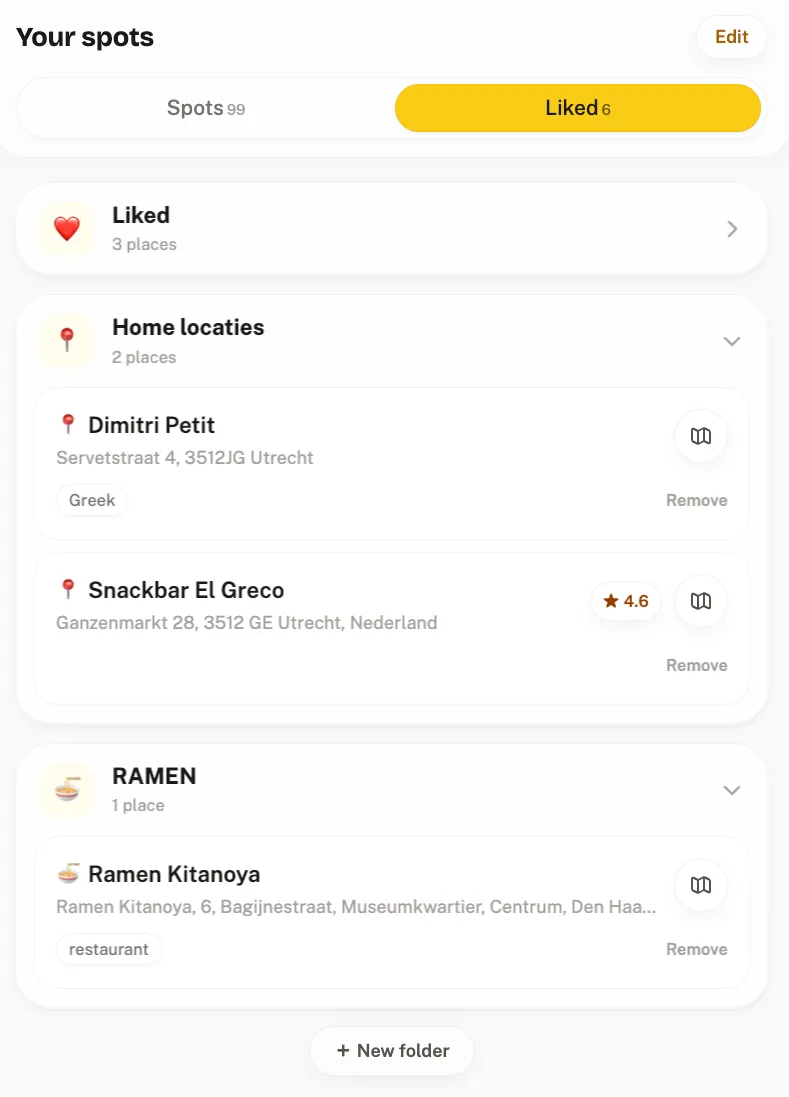
A "Goodreads for food" is an app that gives restaurants the Goodreads treatment: a personal want-to-try shelf, star ratings that are yours rather than a stranger aggregate, and friends whose shelves you can browse before picking a place. If you've ever typed that phrase — or "Goodreads but for restaurants" — into a search box, you already know what you want: not a review site averaging ten thousand tourists, but a personal shelf system, maybe even with a yearly challenge to keep you exploring. The good news: that app category exists. This guide maps the Goodreads loop onto food tracking, piece by piece, and is honest about which app fits which kind of eater.
Why Goodreads is the right muse
Goodreads endures because it nailed a simple loop that most apps overcomplicate:
- The want-to-read shelf. A frictionless place to park intent. See a book recommended, shelve it in two taps, trust it'll be there when you're ready.
- The read shelf. A permanent record of everything you've finished — your reading life, browsable years later.
- Star ratings and reviews. Your own opinion, captured while it's fresh, searchable forever.
- Friends' shelves. The best book recommendations come from people whose taste you know — not from a global average.
- The yearly reading challenge. A gentle goal ("52 books this year") that turns logging into momentum.
Notice what's not in that list: professional critics, business listings, booking widgets. Goodreads is about your relationship with books. A "Goodreads for restaurants" should be about your relationship with eating out — which is why Yelp and Google reviews never scratch this itch. They're directories of other people's opinions; you want a journal of your own.
The Goodreads-to-food translation table
Here's how each piece of the Goodreads loop maps onto food tracking — using Crumble as the worked example, since it covers the whole loop:
| Goodreads | Food equivalent | In Crumble |
|---|---|---|
| Want-to-read shelf | Want-to-try list | Wishlist with folders you create — per city, per trip, per mood |
| Read shelf | Places you've eaten | Your reviewed spots, plotted on a map instead of a grid of covers |
| Star ratings + reviews | Dish ratings + notes | Tenth-of-a-star ratings (0–5) on every individual dish, plus review text and photos |
| Friends' shelves | Friends' food maps | Friends-only map and feed — accepted friends only, no public profile |
| Reading challenge | Eating challenges | XP and streaks, the daily Crumb Hunt quiz, country and city unlocks in the food passport |
Goodreads for restaurants: shelves, but for eating out
The shelf is the heart of the metaphor, so it deserves a closer look. On Goodreads, shelves do double duty: they track status (want-to-read → currently reading → read) and they organize ("sci-fi", "beach reads", "gifts for mum"). A food tracker needs both jobs too.
In Crumble, the status half is automatic: a place lives on your wishlist until you visit and review it, at which point it moves to your map — the food version of sliding a book from want-to-read to read. No manual housekeeping, no stale entries.
The organizing half is wishlist folders, and they are shelves in everything but name. You create them yourself, around how you actually eat:
- "Madrid trip" — every tapas bar your friends raved about, ready before you land.
- "Date nights" — the places worth a reservation, separated from the quick-lunch noise.
- "Ramen quest" — a single-genre shelf, the food equivalent of "every Murakami".
Anyone who has curated a Goodreads shelf knows the quiet satisfaction of this. The difference is that a finished book stays a memory, while a finished shelf entry becomes a pin on your map you'll navigate back to. Trips and city recaps then play the role of Goodreads' "Your Year in Books" — a look back at what your eating year actually looked like, city by city, stamped into your food passport.
The challenge layer: from reading goals to Crumb Hunts
The Goodreads reading challenge works because it's a goal you set against yourself, not a leaderboard against strangers. Crumble's gamification follows the same philosophy: reviews earn XP, consistency builds streaks, the daily Crumb Hunt food quiz gives you a 30-second ritual, and eating your way into a new country or city unlocks it in your food passport. There are no public leaderboards by design — the challenge is between you and your appetite, the way the reading challenge is between you and your nightstand pile.
And just as Goodreads eventually grew shelves for everything you read, Crumble's free tasting-journal add-ons extend the system beyond restaurants: dedicated journals for coffee, tea, matcha, wine, whisky, and beer, each with a six-axis flavor radar. The genre shelves of drinking, essentially.
The honest landscape: which "Goodreads for food" fits you?
Crumble isn't the only app borrowing from the Goodreads playbook, and it isn't the right one for everybody. The quick sort:
- Beli — Goodreads with the community dial turned to eleven. Ranked top-100 lists, leaderboards, an energetic public feed, and a large user base powering recommendations. If what you loved about Goodreads was the social scale — comparing shelves with thousands of readers — Beli is the closest match in food. If that energy is what made you leave Goodreads, it'll wear on you here too.
- Yummi — the photo diary. Less shelf system, more scrapbook: log meals as geotagged photos that organize themselves into a calendar and map. Right if your real goal is memory-keeping rather than ratings and lists.
- Google Maps saved lists — the free fallback. "Want to go" plus custom lists gives you a serviceable want-to-read shelf with zero setup. But there's no read shelf with your opinions, no dish history, no friend layer. It's a bookmark drawer, not a Goodreads.
- Crumble — the full loop, kept private. Shelves (wishlist folders), a map-first read shelf, per-dish tenth-of-a-star ratings with text and photos, friends' maps, and a challenge layer — friends-only by default, with no paid ads, no data sales, and EU hosting under GDPR. The fit if you want the Goodreads system without the Goodreads crowd.
Still weighing options? Our guide to the best restaurant tracking apps compares the whole category, and if you're starting from zero, how to keep track of restaurants you've been to covers simpler systems too. The rest of our guides live here.
Start your shelves
The core of Crumble is free: the map, the wishlist with folders, per-dish ratings, friends, trips, the food passport, the Crumb Hunt, and all six tasting journals. An optional Crumble Plus tier (€1.99/week, €4.99/month, or €29.99/year) adds AI food scan, AI label scan, and an unlimited wishlist. It runs as a Progressive Web App at crumble.me on iPhone, Android, and desktop — no app store, no download, just a URL that becomes your food library.
If Goodreads taught you anything, it's that the habit starts with the first shelf. Make it "want to try".
Frequently asked questions
Is there a Goodreads for restaurants?
Yes — restaurant tracker apps fill the same role. Crumble is the closest structural match: a want-to-try wishlist with folders (shelves), per-dish tenth-of-a-star ratings with review text and photos (your read shelf), a friends-only map and feed (friends' shelves), and XP, streaks, and a food passport standing in for the yearly reading challenge.
What app is like Goodreads but for food?
Crumble, Beli, and Yummi all borrow parts of the Goodreads model. Crumble mirrors the full loop privately (shelves, ratings, friends, challenges); Beli emphasizes ranked lists and a large public community; Yummi is a photo-first food diary. Google Maps saved lists cover the 'want to read shelf' part only, with no ratings or social layer.
Is there an app for a want-to-try restaurant list?
Crumble's wishlist is exactly that — a want-to-try list you can organize into folders you create yourself, like 'Madrid trip' or 'date nights'. When you visit a saved place and review it, it moves off the wishlist automatically, the same way a book moves from want-to-read to read.
Is Crumble free like Goodreads?
Yes — the core app is free: the map, wishlist with folders, per-dish ratings, friends, trips, the food passport, the daily Crumb Hunt quiz, and the tasting-journal add-ons (coffee, tea, matcha, wine, whisky, beer). An optional Crumble Plus tier (€1.99/week, €4.99/month, or €29.99/year) adds AI food scan, AI label scan, and an unlimited wishlist.
Does a Goodreads-style food app need to be public?
No. Goodreads itself defaults to public shelves, but the loop works just as well privately. Crumble is friends-only by default — no public feed, no public leaderboards, no paid ads, no data sales, EU-hosted and GDPR-compliant — so your shelves are visible to the people you actually eat with and nobody else.