
TripAdvisor Alternatives for Remembering Where You Ate
Here's a strange experience: you know you reviewed that little seafood place. You remember writing it: the grilled octopus, the four bubbles, the "would return" line. That was two years ago, on TripAdvisor, somewhere in Lisbon. And now, standing in Lisbon again, you cannot find it. Was it under the restaurant's Portuguese name? Did you review it from your partner's account? You scroll your own contribution history, a list optimized for helping other travelers, and realize the awkward truth: your entire eating history lives inside a platform that was never built to give it back to you.
That's the gap this guide covers. If you're searching for a TripAdvisor alternative because you want better public reviews, this isn't that list; Yelp and Google already fight over that ground. This is for the other search: an app to remember the restaurants you've been to, keep a running map of them, and share that map with the handful of people you actually eat with.
Reviewing for strangers vs. remembering for yourself
TripAdvisor is a public review economy. You contribute a review; thousands of strangers planning trips benefit; the platform aggregates it all into rankings and booking funnels. That's a genuinely useful machine, but notice who it's for. Your review of that octopus place primarily helps people you'll never meet. What you get back is a contribution count and a badge.
A personal food tracker inverts the arrow. The record exists for you first: where you've eaten, what you ordered, what it deserved, what's still on the list. Sharing, where it exists at all, goes to friends rather than to the open internet. The design consequences are big: dish-level detail instead of establishment-level prose, private maps instead of ranked city pages, a wishlist instead of a booking widget. Neither model replaces the other; they answer different questions. TripAdvisor answers "where should a stranger eat in Lisbon?" A tracker answers "where did I eat in Lisbon, and what should I order when I go back?"
The alternatives at a glance
| App | Built for | Private by default | Dish-level detail | Free |
|---|---|---|---|---|
| Crumble | Personal food memory shared with friends | Yes (friends-only, no public feed) | Yes (tenth-of-a-star per dish) | Yes |
| Beli | Ranked lists in a foodie community | No (community-oriented) | No (restaurant-level ranks) | Yes |
| Google Maps saved lists | Zero-setup bookmarks | Yes (lists private unless shared) | No | Yes |
| Mapstr | Saving any kind of place with tags | Yes (private map) | No (tags, not ratings) | Yes |
| Yummi | Photo-first meal diary | Yes (personal diary) | Photos, not structured ratings | Yes |
| Memolli | Offline personal restaurant record | Yes (personal-first) | Reviews per place | Yes |
How to choose: three questions
The six apps below solve the memory problem in different shapes. Before the list, three questions narrow it down fast:
- Do you want an audience or a circle? If comparing lists with a big community motivates you to keep logging, Beli's social energy is a feature. If you'd rather five close friends see your map and nobody else, pick a friends-only tracker like Crumble or a fully private one like Mapstr.
- How much detail do you want back later? A pin on a map answers "have I been here?" Dish-level ratings answer "what do I order when I return?" If the second question is the one you keep asking, restaurant-level bookmarks will disappoint you.
- Where will you actually log? Native apps require everyone in your friend group to be on the right platform. A web app works from any browser: phone at the table, laptop when you're writing up a trip. Our guide to keeping track of restaurants digs into which logging habit actually survives past week two.
1. Crumble: a food memory that belongs to you and your friends
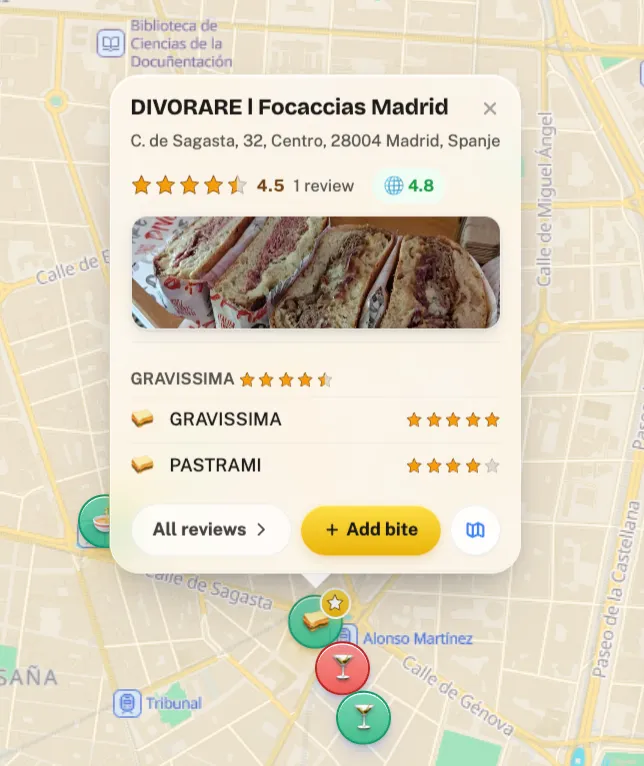
Crumble is the closest thing on this list to a direct answer to the Lisbon problem. Every place you review lands on your personal visited map, and every dish you ordered gets its own tenth-of-a-star rating from 0 to 5, so two years later the record says not just "went there, liked it" but exactly what was worth reordering.
- Friends-only by default. There is no public feed. Your reviews are visible to accepted friends and nobody else. Friends spots show up on your map filtered to places you haven't tried yet, which quietly turns your circle's history into your discovery layer.
- Three rating signals per place. For any spot you can see your friends average, the Crumble community average, and a public score pulled from external Foursquare data for context. You always know whether a number comes from people you trust or from the internet at large: the distinction TripAdvisor flattens.
- Built for the long game. A wishlist that auto-clears when you finally review a saved place, a food passport, trip grouping, and city recaps that summarize what you ate somewhere. XP, weekly challenges, and country unlocks keep logging from feeling like a chore.
- Runs anywhere, respects your data. Crumble is a free Progressive Web App at crumble.me: it works in the browser on iPhone, Android, and desktop, and installs to your home screen. It's EU-hosted, GDPR-compliant, shows no paid ads, and strips GPS metadata from uploaded photos so a shared picture never leaks your location. The six-axis tasting journals are free; a planned Plus tier, not on sale yet, will add an AI scanner and an unlimited wishlist.
Honest limits: there are no native app-store builds, no TripAdvisor import, and it needs a connection; this is not an offline tool.
2. Beli: the social ranking take
Beli approaches the memory problem through competition: instead of rating places on a scale, you rank them against each other, building a personal top list, with leaderboards and an active community around it. If TripAdvisor's badges and contribution levels were the part you secretly enjoyed, Beli gives you that energy aimed at your own history instead of a city's. The trade-off is the mirror image of its strength: it's community-oriented rather than private, and ranks live at the restaurant level, not the dish level.
3. Google Maps saved lists: the zero-setup fallback
You almost certainly already have this. Star places into "Want to go," build custom lists like "Lisbon 2026," share a list link with travel companions. It's free, it syncs everywhere, and it requires no new account. What it doesn't give you is any of the memory layer: no personal ratings history, no dish detail, no automatic friend map. As a bridge while you decide on a real tracker (or as a planning companion), it's unbeatable for the price of nothing.
4. Mapstr: the private map for every kind of place
Mapstr isn't food-specific: it's a personal map for saving any place (restaurants, bars, bakeries, viewpoints), organized with freeform tags and shareable with chosen people. If your TripAdvisor habit was really "bookmarking places I might return to," Mapstr does that job for your whole life, not just meals. It doesn't do structured ratings, so it answers "where was that place?" better than "was it any good, and what did I order?"
5. Yummi: the photo diary
Yummi treats food memory as a scrapbook: you log meals as geotagged photos that organize themselves into a calendar and a map, home cooking included. For people whose camera roll is already an accidental food diary, Yummi formalizes the habit with almost no extra effort. It's less structured than a ratings-based tracker: you get the visual memory back, not a queryable record of scores.
6. Memolli: the offline personal record
Memolli focuses on the personal record with an offline-friendly design: your restaurant history on a map with reviews per place, usable where connectivity is bad. That makes it a practical pick for travel-heavy eaters logging from places with spotty data. It's personal-first with a smaller community, which is either a limitation or exactly the point, depending on what you're escaping from.
When TripAdvisor is still the right tool
None of the apps above should be your research tool in an unfamiliar city, and pretending otherwise would be dishonest. TripAdvisor's core asset (an enormous public database of reviews from millions of travelers) is precisely what personal trackers deliberately don't have. Landing somewhere you know nobody, checking what's open and decent near your hotel, reading recent reviews before committing to a two-hour dinner: that's TripAdvisor's home turf, and if contributing reviews to help other travelers matters to you, that's a genuinely good reason to keep doing it there.
The workable setup for most people is both: research on TripAdvisor before the meal, log the memory in a personal tracker after it. Our guide on how to track food on your travels walks through that exact workflow, and if you want the full category comparison beyond the TripAdvisor angle, see the best restaurant tracking apps roundup.
Frequently asked questions
What is a good TripAdvisor alternative for tracking restaurants you’ve been to?
Crumble is built specifically for that: it keeps a private map of every place you’ve eaten, with tenth-of-a-star ratings on each dish, a wishlist, and sharing limited to accepted friends. Beli, Mapstr, and Google Maps saved lists also work, depending on whether you want rankings, general place-saving, or zero setup.
Can I import my TripAdvisor reviews into these apps?
No. There’s no standard export from TripAdvisor into personal food trackers, and none of the apps in this guide (including Crumble) offer a TripAdvisor import. Most people re-log their 20–30 most important places in an evening and let the rest go; the places you’d actually return to are a short list.
Is there a free TripAdvisor alternative that works without downloading an app?
Crumble runs as a Progressive Web App at crumble.me: it works in the browser on iPhone, Android, and desktop, and can be installed to your home screen without an app store. Google Maps saved lists also work everywhere you’re already signed in to Google.
Do these apps replace TripAdvisor for planning a trip?
Mostly no, and that’s by design. TripAdvisor’s huge public review database is still the better tool for researching an unfamiliar city. Personal trackers shine after you’ve eaten somewhere: they keep the record for you and your friends instead of publishing it to strangers. Many people use both.
Which TripAdvisor alternative is the most private?
Crumble is friends-only by default: no public feed, no discovery by strangers, GPS metadata stripped from uploaded photos, EU hosting under GDPR, and no paid ads. Mapstr also defaults to private maps. Memolli keeps a personal record with an offline focus.