
How to Pour Beer Properly (Bottle, Can or Tap)
To pour a beer properly, hold a clean, cold-rinsed glass at a 45° angle, let the beer run down the side until the glass is about half full, then straighten the glass and pour the rest into the middle, so a head of roughly 2.5 cm (an inch, about two fingers) forms on top. That one motion works for a bottle, a can and a tap. A few styles need a tweak, and they are covered below.
How do you pour a beer properly, step by step?
These steps follow the Brewers Association's free Draught Beer Quality Manual, written for bars. It describes a tap, but the motion is the same for a bottle or a can.
- Start with a beer-clean glass. Give it a quick rinse in cold water right before you pour (more on clean glasses below).
- Tilt the glass to 45°. Aim the stream at the middle of the inside wall, not the bottom.
- Pour steadily. From a tap, open it fully in one movement; a half-open tap churns the beer into foam. From a bottle or can, keep the flow even rather than glugging.
- Straighten at about the halfway point. The manual says to tilt the glass upright gradually once the beer is about halfway up.
- Finish in the middle. Pouring straight down into the beer releases carbon dioxide and builds the head.
- Stop at the right head. About 2.5 cm of foam for most beers. Close the tap quickly, and never let the nozzle touch the glass or dip into the beer.
Why it works: beer that slides down a tilted wall keeps its carbonation in solution, while beer that falls into the middle of an upright glass turns into foam. Tilting first and straightening later lets you decide when the foam happens.
How much head should a beer have, and why?
Most sources land on a head of about 1 to 3 cm. The Cicerone blog calls a half inch to one inch (1–3 cm) typical for many styles; the Brewers Association's manual asks for about a one-inch collar. Dutch bars skim the head of a pils: Heineken's Dutch bar training, as described in Entree Magazine, has you skim once while the foam still domes over the rim.
The head is not decoration. The Brewers Association's manual says the release of CO2 while pouring builds the foam and releases flavors and aromas. Its consumer site CraftBeer.com adds that a good head keeps oxygen out and aroma in. The manual points out that foam is 25 to 33% beer, so a proper head does not cost you much beer.
What is a beer-clean glass?
A beer-clean glass has no film of grease, soap or rinse aid on it. The tell-tale sign of a dirty glass is bubbles clinging to the inside walls below the surface, because residue gives the gas somewhere to collect. The Draught Beer Quality Manual lists three simple checks:
- Sheeting test: dip the glass in water. On a clean glass the water coats it evenly; on a filmy glass it breaks into droplets.
- Salt test: sprinkle salt inside a wet glass. It sticks evenly to a clean surface and skips the greasy patches.
- Lacing test: pour a beer. In a clean glass the foam leaves rings on the wall after each sip; in a dirty one it leaves a random pattern or none at all.
At home: wash beer glasses on their own, let them air-dry rather than rubbing them with a towel, and rinse with cold water just before pouring. Skip the frosted glass from the freezer. The manual warns that ice on the glass makes beer foam as it lands.
How do you pour beer from a can or a bottle?
Use the same 45°, straighten, finish-in-the-middle motion. The difference is that you control the flow with your wrist rather than a tap, so the common mistake is pouring too timidly. A trickle down a tilted glass gives a flat beer with no head, so pour at a steady, confident rate and straighten up when the glass is half full.
Always pour a can into a glass rather than drinking from it. The Cicerone Certification Program gives the reasons: you can see the beer and its head, you can smell it before you sip, and some of the carbonation escapes, so you drink less gas.
Bottle-conditioned beers are different. They have live yeast in the bottle and a layer of sediment at the bottom. Orval's serving instructions say to pour slowly without shaking the bottle, straighten the glass in one flowing movement, and stop when about 1 cm is left in the bottle. Wheat beer is the exception: its yeast is meant to go in (see below).
How should you pour each style of beer?
Most beers take the standard pour. These are the ones that differ; the sources are linked in the sections above and below.
| Style | How to pour |
|---|---|
| Lager / pilsner | Rinse cold, 45°, straighten at half, finish in the middle; on tap, Dutch bars skim once |
| Wheat beer (Weizen) | Tilt about 45° until almost full, swirl the yeast loose, pour it in upright |
| Stout on nitro (Guinness) | Two-part pour: 45° to the harp, settle, top up straight |
| IPA and pale ale | Standard pour; keep the head, it carries the hop aroma |
| Belgian bottle-conditioned (e.g. Orval) | Slowly, without shaking; leave about 1 cm of yeast in the bottle |
How do you pour a Guinness?
Draught Guinness is served with nitrogen as well as CO2, which gives the slow cascading surge and the dense head. Pour it in two parts. The Guinness Storehouse's pouring guide sets it out like this:
- Use a clean, dry, cool tulip pint glass. The Storehouse says the beer itself should be at 5–7 °C.
- Hold the glass at 45°, aim the nozzle at the harp logo, and pour until you reach the top of the harp.
- Set it down and let it surge and settle, about 60–80 seconds by the Storehouse's count.
- Top it up with the glass held straight until the foam forms a slight dome over the rim.
For the can with the widget, Guinness's at-home page describes two accepted methods: the classic 45° pour into the glass in one go, then letting it settle; or the hard pour, flipping the can upside down into the glass and lifting it out slowly as the beer rises.
How do you pour a wheat beer?
Bavarian wheat beer (Weissbier or Hefeweizen) is cloudy because of its yeast, and the yeast is part of the drink. The Bavarian brewery Kapuziner pours it like this: rinse the tall wheat glass with cold water, hold the wet glass at about 45° and pour slowly until it is nearly full, swirl the last of the beer in the bottle to loosen the settled yeast, then pour it into the upright glass. It recommends serving at 5–7 °C. Straightening too early is how a wheat beer ends up as a glass of foam.
How do you pour beer from a tap or a home kegerator?
The pour is the same; most tap problems come from the setup. Basics from the Draught Beer Quality Manual, scaled down to a home setup:
- Chill the keg first. The manual wants beer kept at 34–38 °F (about 1–3 °C) all the way from keg to glass. Heineken's quick-reference card for its BLADE home tap says to pre-cool the keg in the fridge for at least 16 hours.
- Open the tap fully, in one movement. Half-open taps create turbulence and foam.
- Let the first splash go. Dutch bar training, as Bierista describes it, lets the first spurt from the tap fall outside the glass before you pour.
- Keep the lines clean. The manual recommends cleaning draft lines every two weeks.
- Skim with a wet skimmer, as Heineken's card says.
If a well-chilled keg still pours mostly foam, check the gas pressure and line balance; the manual covers both.
Why is my beer all foam, or flat?
| What you see | Likely cause | Fix |
|---|---|---|
| All foam | Glass upright too soon, warm beer, frosted glass, or a half-open tap | Stay at 45° until half full; chill the beer, not the glass; open the tap fully |
| Flat, no head | Tilted the whole way, or pouring too timidly | Straighten earlier, so the last third lands in the middle |
| Head collapses in a minute | Greasy or soapy glass | Wash glasses on their own, air-dry, rinse cold before pouring |
| Cloudy bottle beer that should be clear | Poured the yeast sediment | Pour slowly without shaking, leave the last centimeter in the bottle |
Can you practice pouring a beer on your phone?
Yes. Crumble's Pour a beer lesson models a pils tapped the Dutch and Belgian way into a 25 cl glass, drawn in 3D with the tap, the beer and its head. It has two modes:
- Watch the pour plays a good pour in seven steps (rinse, tilt to 45°, slide down the side, straighten as it fills, crown the foam just over the rim, close the tap, skim), with a slow-motion option.
- Phone as the glass uses your phone's motion sensor: tip the phone sideways and the glass tips with it. Open the tap, straighten as it fills while a gauge shows the target angle, close it, then swipe across the top to skim. On iPhone the browser asks for motion access first; without a sensor, or if you say no, a slider sets the glass angle instead.
On Android phones that support vibration, the phone rumbles harder the rougher the beer lands. Every phone gets sound: a real recorded beer pour (by visionear on Freesound) that gets brighter when the beer lands roughly and rises in pitch as the glass fills. On iPhone, where web pages can't vibrate, the sound is your cue. The verdict tells you how many fingers of head you poured, with fixes such as "Thin head: straighten up a little sooner" or "Mostly foam: stay at 45° for longer". A full glass with about two fingers of head, skimmed and not spilled, earns "Two fingers. Proost!"
A simulator trains the angle and the timing of the straighten. It can't teach you how a real beer, glass or tap behaves, so a few real pours, or a bartender showing you, still beat it.
And the brew day, while you are there
A companion lesson, Brew beer, plays a small home brew day in 3D: mash the grain at 66 °C, rinse it, boil for an hour, chill to 18 °C, pitch the yeast, ferment for about two weeks, bottle with a little sugar, and pour. Pick a pilsner, pale ale, amber or stout, and scrub through three weeks in the fermenter as the gravity drops. It is an explainer only; nothing is saved.
Where do you keep track of the beers you pour?
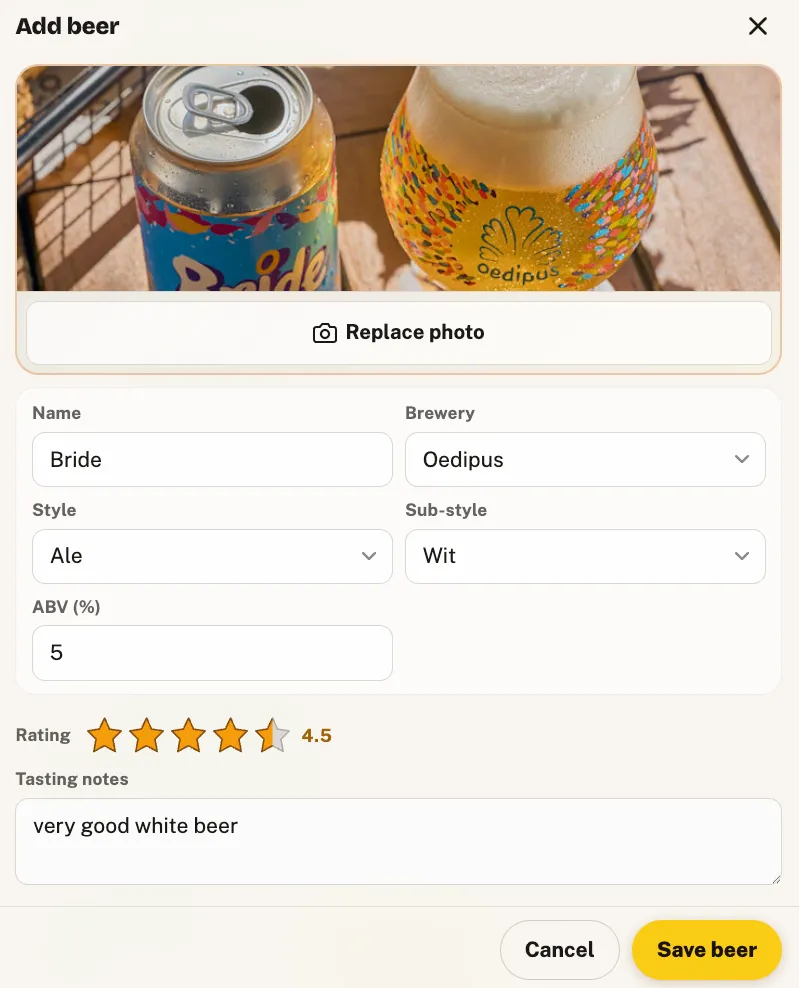
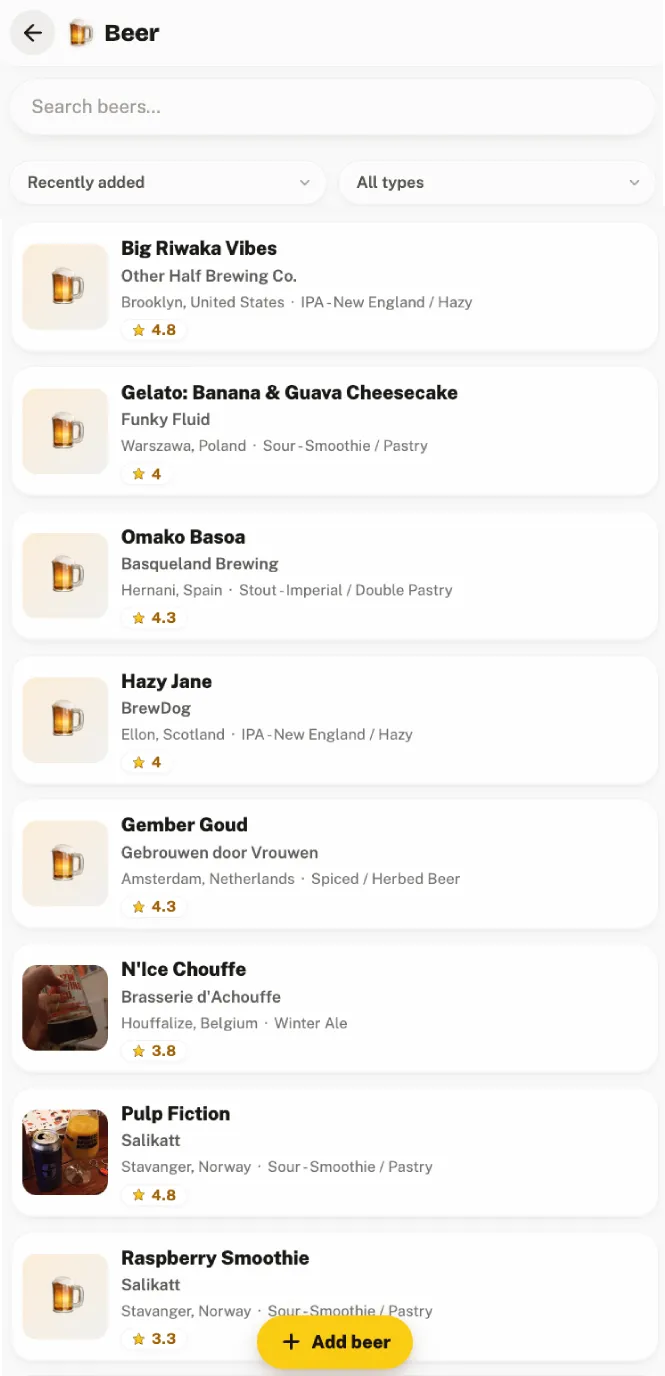
Both lessons open from the Learn sheet in Crumble's free beer journal. Log the beer with its brewery, style, sub-style and ABV, rate it from 0 to 5 in tenth-of-a-star steps with your tasting notes, and log each later pour under it with a rating and a note. Our guide to tracking beer covers the habit, and if you are coming from another app, the Untappd alternative and RateBeer alternative comparisons say where each app is the better pick. (An AI label scan is planned for Crumble Plus, which is not available yet.)
Want somewhere worth pouring from? Our roundups of Belgian breweries and Dutch craft breweries are a good start, and beer tracking apps compares the wider field. Enjoy it, and drink responsibly.
Frequently asked questions
What angle should you pour beer at?
Start with the glass at 45° so the beer runs down the side, then straighten it gradually once the glass is about half full and finish pouring into the middle. That is the method in the Brewers Association's Draught Beer Quality Manual and the Cicerone pouring guide.
How do you pour beer without foam?
Keep the glass at 45° for longer and pour steadily down the side, straightening only at the end. Use a cold-rinsed, beer-clean glass (not a frosted one) and cold beer. From a tap, open it fully in one go. You still want 1–3 cm of head, which carries the aroma.
How many fingers of head should a beer have?
Roughly two fingers, which is about an inch or 2.5–3 cm. US sources such as the Brewers Association ask for a one-inch collar; Dutch bars let the foam dome over the rim of a pils and then skim it off flat.
Should you rinse a beer glass before pouring?
Yes, with cold water just before you pour. The wheat-beer brewery Kapuziner explains that specks of dust give CO2 bubbles somewhere to form, and Heineken's Dutch bar training also starts with a cold rinse.
Should you pour beer down the side of the glass?
For the first half, yes: at 45° down the side. Then straighten the glass and pour the rest into the middle to build about 2.5 cm of head. Pouring down the side the whole way leaves you with little or no head, so more of the gas stays in the beer you drink.
Do you pour the yeast from a bottle-conditioned beer?
Usually not. For most Belgian bottle-conditioned beers you pour gently and leave the last centimeter in the bottle, as Orval's own serving instructions describe. Wheat beer is the exception: swirl the last of the bottle and pour the yeast in.
Is the Crumble beer-pour lesson free?
Yes. It is part of the free beer journal and needs a free Crumble account. It runs in the browser on your phone. With a motion sensor, the phone becomes the glass; without one, a slider sets the angle.