
Letterboxd for Food: The App for Logging Every Meal
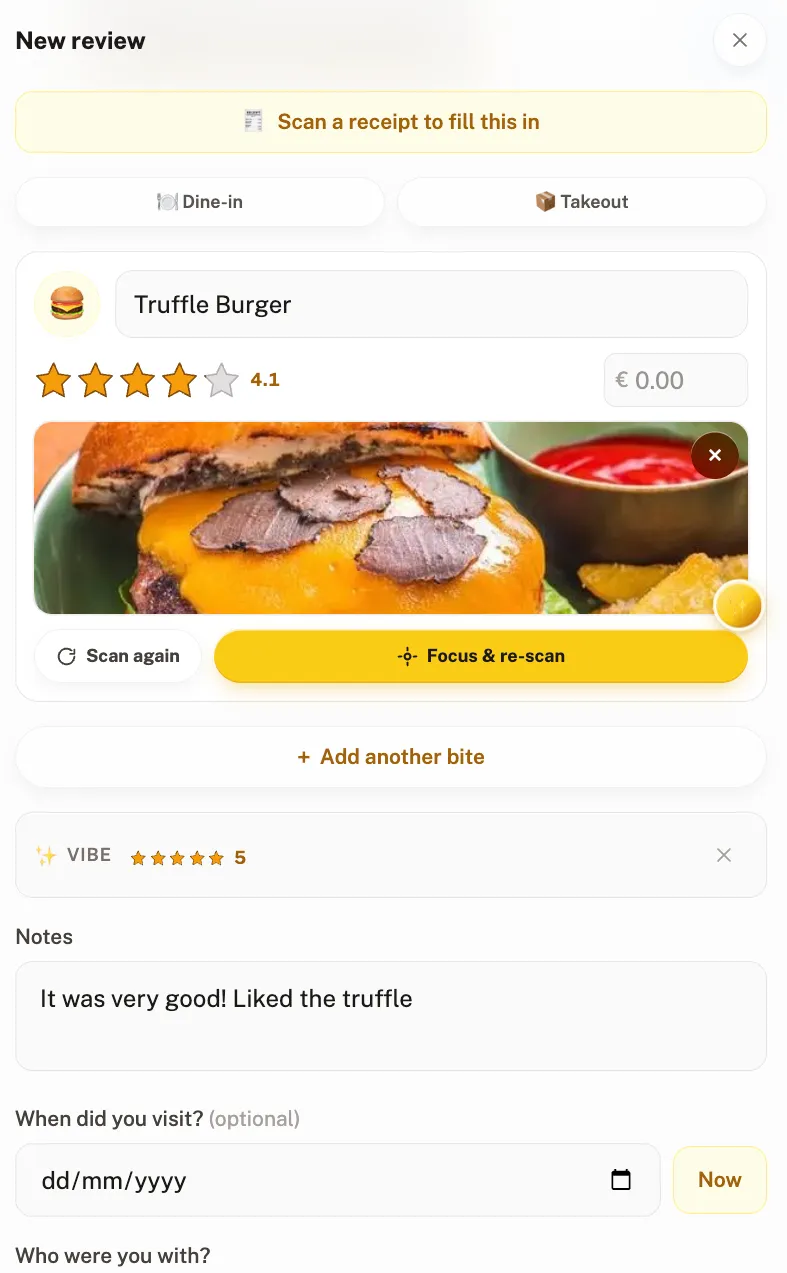
"I want a Letterboxd for food" is one of the most precise app requests ever uttered, because Letterboxd nailed something most apps never find: the joy of logging for its own sake. You watch a film, you give it three and a half stars, you write one wry sentence, and the diary quietly becomes a portrait of your taste. The lists. The half-stars. The feed that's only people whose opinions you actually care about. The end-of-year wrap-up that knows you better than you know yourself. None of it is about being an influencer — it's a journal that happens to be social.
Food deserves exactly that. You eat roughly a thousand meals a year — far more than anyone watches films — and almost all of them vanish unrecorded. The ramen place that changed your mind about broth, the birthday dinner, the airport sandwich of legend: gone. This guide maps each Letterboxd habit to its food equivalent, points to where Crumble fills the role, and is honest about the other apps in the lane and the one thing that doesn't translate.
The translation table
| Letterboxd | The food equivalent | In Crumble |
|---|---|---|
| Films | Restaurants — and the dishes inside them | Spots on your map, each holding rated dishes |
| The diary | A food map: where you ate, when, what you thought | Every log is a pin; the map is the diary |
| Half-star ratings | The same 0.5–5 half-star scale, per dish | Identical scale to Letterboxd's, one level deeper |
| Lists | Want-to-try lists you can organize | Wishlist folders — "Madrid trip", "date nights" |
| Friends' activity | What people you trust are eating | Friends-only feed and shared map, no public anything |
| Year in review | Your eating year, summarized | City recaps + the food passport |
The diary becomes a map
Letterboxd's diary is a timeline because films happen in time. Meals happen in time and space, which is why the food version of the diary is a map. On Crumble, every log drops a pin: zoom out and your eating history is laid over the city — the neighborhood you've eaten through, the district you've somehow never touched, the cluster of pins around your old apartment like a geological record. Scrolling your Letterboxd diary is nostalgia; panning your food map is nostalgia with coordinates. It also answers the question the timeline can't: "we're in this part of town, where did we like again?"
Half-stars, but per dish
Letterboxd's 0.5–5 half-star scale is quietly one of its best decisions — fine enough to mean something, coarse enough that you never agonize. Crumble uses the exact same scale, deliberately, with one upgrade for the medium: you rate each dish, not just the restaurant. A film is one work; a restaurant is an anthology. The tonkotsu can be a 5 while the gyoza limps in at 2.5, and six months later your own history tells you what to order — something a single restaurant-level score can never do. If you've internalized the difference between a 3.5 and a 4, your instincts transfer on day one.
Lists become wishlist folders
Half of Letterboxd's charm is the lists — "films to watch with my dad", "everything from that one director's hot streak". The food equivalent is the wishlist: every restaurant someone recommends, every place from a screenshot you'd otherwise lose. Crumble lets you sort it into folders you create yourself — "Madrid trip", "cheap lunches near work", "anniversary candidates" — and when you finally visit and log a saved place, it clears off the wishlist automatically. The list completes itself, which is a small pleasure Letterboxd users will recognize from watching a watchlist shrink.
The friends graph, minus the noise
What makes Letterboxd's social layer work is that it's opt-in taste, not algorithmic reach. Crumble takes that further: it's friends-only by default. There is no public feed, no leaderboards, no discovery of your profile by strangers — your reviews are visible to accepted friends, full stop. No ads, no data sales, EU-hosted and GDPR-compliant. Your friends' finds appear on your own map, so "my most trusted critic loved this" stops being a post you scroll past and becomes a pin you can walk to.
Year wrapped becomes the food passport
The Letterboxd year-in-review is the feature everyone screenshots. Crumble's analogue comes in two parts: city recaps, which roll a trip or a city's worth of eating into a summary, and the food passport, which tracks the countries and cities your stomach has visited. Trips group automatically, so a week of eating through Lisbon becomes its own chapter — the travel-tracking guide covers that side in full. And where Letterboxd has streaks of habit, Crumble has the daily Crumb Hunt food quiz with XP and streaks — the small daily reason to open the app even on a night you cooked at home.
The other apps in this lane
Honesty corner: "Letterboxd for food" means slightly different things to different people, and the right pick depends on which part of Letterboxd you're actually missing.
- Beli is ranking-driven: every restaurant slots into a personal top-100 via head-to-head comparisons, with leaderboards and big community energy. If your favorite part of Letterboxd is arguing about rankings, Beli leans into that harder than anyone. If it's the quiet diary, less so — our Beli alternatives guide goes deep on the difference.
- Yummi is a photo diary: meals logged as geotagged photos, home cooking included. More scrapbook than star rating — closer to a camera roll with a map than to Letterboxd's structured log.
- Untappd genuinely is the Letterboxd of its niche — but the niche is beer, with check-ins, badges, and a huge community database. For beer specifically it's excellent; it just won't log your dinner. (Crumble's free beer add-on covers the quieter, friends-only version of that job, alongside coffee, tea, matcha, wine, and whisky journals with a six-axis flavor radar.)
For the whole category side by side, see our guide to the best restaurant tracking apps or browse all the guides.
The one thing that doesn't translate
Letterboxd sits on top of a complete catalog: every film that exists is already in the database, waiting for your half-stars. Food has no such canon — nobody has indexed every dish at every restaurant on earth, and nobody ever will, because tonight's special dies at closing time. So a food log can't be a checklist of someone else's catalog; you build your own canon. Restaurants are searchable, but the dishes, the ratings, the one-line verdicts — that's authorship, not annotation. Honestly, it's the better deal: your Letterboxd profile is your taste in other people's work, while your food log is a record only you could have written. Nobody else ate your year.
Start your food diary
The core of Crumble is free: the map, per-dish half-star ratings, wishlist folders, the friends feed, trips, the passport, recaps, the daily quiz, and all six tasting journals. Crumble Plus (€1.99/week, €4.99/month, or €29.99/year) adds AI food scan, AI label scan, and an unlimited wishlist. It runs as a PWA at crumble.me on iPhone, Android, and desktop — no app-store download, just add it to your home screen. Four films a month built you a taste profile on Letterboxd. Imagine what a thousand meals a year will do.
Frequently asked questions
Is there a Letterboxd for food?
Yes — the closest match is Crumble, a free social food-tracking app built around the same habits: log every meal, rate dishes on the identical 0.5–5 half-star scale Letterboxd uses for films, keep lists (wishlist folders), and follow a friends-only feed of what people you trust are eating. It runs as a web app at crumble.me on iPhone, Android, and desktop.
Is there a Letterboxd for restaurants?
Several apps play in this lane. Crumble is the most Letterboxd-shaped: a private diary-style log with half-star ratings, lists, and a friends graph. Beli is closer to a ranked leaderboard than a diary, and Yummi is a photo journal. If the diary, the half-stars, and the small trusted circle are what you love about Letterboxd, Crumble is the direct translation.
Does Crumble have half-star ratings like Letterboxd?
Yes — the exact same scale: 0.5 to 5 in half-star steps. The difference is granularity: Crumble applies it per dish, not just per restaurant, so a place can hold a 5-star ramen and a 2.5-star gyoza in the same entry, the way a director can hold a masterpiece and a misfire.
Is the Letterboxd-for-food app free?
The core of Crumble is free: logging, half-star dish ratings, the map, wishlist folders, the friends feed, trips, the food passport, city recaps, the daily Crumb Hunt quiz, and all six tasting-journal add-ons. Crumble Plus (€1.99/week, €4.99/month, or €29.99/year) adds AI food scan, AI label scan, and an unlimited wishlist — optional, like a Pro tier.
Does it have a year-in-review like Letterboxd?
Crumble's version is the food passport and city recaps: your eating history rolled up by city and trip — countries unlocked, spots logged, your taste in summary. It's the Letterboxd year-wrapped instinct applied to where and what you ate, not just how much.