
4 Best Delectable Alternatives in 2026
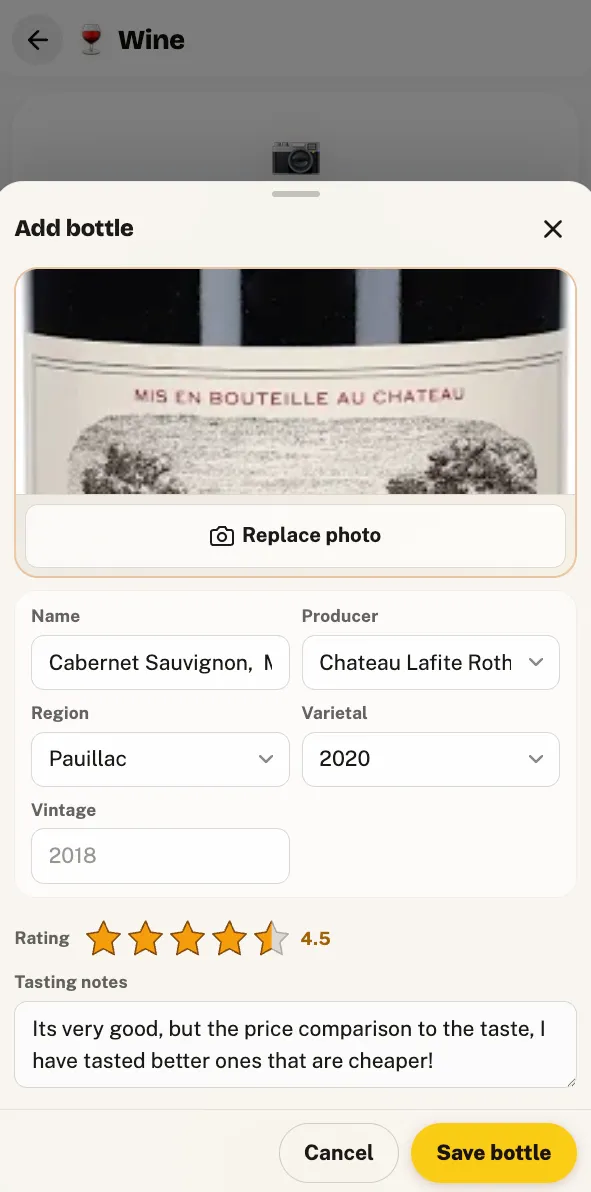
Delectable was acquired by Vinous (announced December 2016) and moved towards paid professional criticism, which is why people are looking. The replacements split by what you used it for: Crumble for a free private journal, Vivino for label scanning, CellarTracker for a cellar.
Delectable earned its reputation on one very good idea: photograph a label, and see what sommeliers, winemakers and critics thought of that exact wine. Not a crowd average: named professionals whose palates you could learn to trust or discount. For a certain kind of drinker that was the whole product.
In December 2016 the app was bought by Vinous, the publication run by critic Antonio Galloni. The integration pushed the app further towards professional criticism and moved useful capability behind payment, and long-time users have described it since as quieter than it was. If your reason for searching is "it used to be free and now it is not", that is the change you are reacting to.
The alternatives at a glance
| Tool | Best for | Rating | Who sees it | Price |
|---|---|---|---|---|
| Crumble | A private wine journal shared with friends | Six flavour axes and a 0–5 score | Friends only | Free, wine add-on is free |
| Vivino | Scanning a label you know nothing about | 5-point | Public | Free (paid tier) |
| CellarTracker | Managing a real cellar | 100-point | Public notes | Free (paid tiers) |
| Delectable | Reading named critics on a wine | 5-point | Public | Free tier, paid features |
| A spreadsheet | Data nobody can take away | Yours | Nobody | Free |
1. Crumble: best free private wine journal
Crumble answers a different question from Delectable. Delectable tells you what an expert thought; Crumble records what you thought, in enough structure to still mean something in three years.
- Six flavour axes per wine (sweetness, acidity, tannin, body, fruit and oak) plus an overall 0–5 rating in tenth-of-a-star steps. That is the vocabulary a critic uses, applied to your own palate rather than borrowed from someone else's.
- Free, and not the kind of free that changes. Every drink add-on is free. Nothing about a wine journal will sit behind the planned Plus tier.
- Friends, not followers. Your shelf is visible to people you have accepted and nobody else: EU-hosted, GDPR-compliant, no ads, no data selling. Four friends whose taste you know beats a leaderboard of strangers.
- The bottle and the table together. The wine you drank with dinner attaches to the restaurant you drank it in, on the same map as your food, something no wine-only app does.
- Vintages accumulate rather than overwrite. Sessions hang off the wine, so the 2019 and the 2020 sit side by side. Method in full: how to track wine.
Where Delectable wins: there is no critic layer in Crumble. If what you valued was reading Galloni or a named sommelier on a specific bottle, nothing here replaces that, and Vinous is where that material now lives.
2. Vivino: best label scanner
Vivino is the closest like-for-like on the feature that got people using Delectable in the first place: point a camera at a label, get a rating. Its label database is the largest in wine and the scan works on supermarket bottles that no critic has ever written about.
Trade-offs: it is a marketplace as well as an app, so what surfaces is shaped by what is for sale, and community averages compress into a narrow band around 3.8. Detail in Vivino alternatives.
3. CellarTracker: best if you actually own a cellar
CellarTracker holds around 13.6 million community tasting notes and, unlike anything else here, proper inventory: what you own, where it is stored, and when to drink it. If the Delectable habit you are trying to replace was note-reading on specific vintages, this has more of those notes than Delectable ever did.
Trade-offs: it is dense, desktop-shaped, and overkill if you do not age wine. See CellarTracker alternatives for the other direction of that trade.
4. A spreadsheet: the lesson of an acquisition
An app you rely on being bought and changing its pricing is the standard argument for keeping your own copy. Producer, wine, vintage, region, date, score and note in seven columns will outlive every company here.
Trade-offs: no scanning, no map, no friends, and typing a producer name on a phone at a restaurant table is the friction that kills the habit. Best used as an annual export from whatever app you land on.
Critic scores and your own palate
The Delectable question underneath all of this is worth naming: how much should someone else's score shape what you think? Three things we have learned keeping our own shelf.
- Score before you look anything up. Reading a 96 first makes it nearly impossible to write down a 3.4, and you end up with an archive of other people's opinions in your own handwriting. Write your number, then read the critic.
- A critic is a calibration tool, not an answer. Their value is in the gap: once you know you consistently score oaked whites a point below a given reviewer, their notes become genuinely predictive for you. That only works if your own numbers were honest to begin with.
- The wines you reread are the ones you drank. Two years in, nobody goes back to a professional tasting note on a bottle they had once at a wedding. They go back to their own line about it, which is why the journal matters more than the criticism.
This is also the argument for a scale with room in it. On a 5-point scale nearly everything drinkable lands on 4, so the ranking collapses; tenth-of-a-star steps let a 3.9 and a 4.2 be different wines a year later.
Getting your wine history out
Before leaving any wine app, export. Then, in Crumble, the migration path depends on the file you have.
- A Vivino export imports directly: the importer auto-detects the format, in CSV or JSON, and reads up to 2,000 rows in one pass: wine, winery, vintage, region, your rating, your review and the date.
- Any other export, Delectable's included, needs its column headers renamed first. Headers are matched case-insensitively, so
wine name,winery,vintage,region,country,your ratingandyour revieware the names to use. - Ratings are not rescaled. The importer reads them as 0–5 and caps anything above 5, so convert a 100-point or 10-point score in the spreadsheet before you upload.
There is no one-click Delectable importer and we would rather say so than imply otherwise. Renaming seven columns in a spreadsheet takes about two minutes.
How we compared these
We keep our own wine shelf in Crumble and have scored several hundred bottles across the six axes, so the observations about scale compression and vintage comparison come from use rather than theory. Each alternative was assessed on four questions: whose palate does it record; what does it cost, and can that change; who can see your notes; and can you export them. Competitor features come from published material and store listings, checked in August 2026; anything unverifiable was left out rather than guessed.
When Delectable is still the right app
If you drink at a level where a named critic's view on a specific bottle changes your decision (buying at release, cellaring seriously, chasing producers rather than styles), Delectable under Vinous is aimed squarely at you and the paid tier is doing something a free app cannot. Nothing on this page reproduces professional criticism.
Leave when you realise the notes you actually reread are your own.
Frequently asked questions
Is Delectable still free?
Delectable still runs and still has a free tier, but after Vinous acquired it (announced December 2016, with a paid tier from 2017) some capability moved behind payment and the app leans harder on professional criticism than it used to. Long-time users describe it as quieter since the change. If you want a wine journal that is free without conditions, Crumble's wine add-on costs nothing: every drink add-on is free.
What happened to the Delectable app?
Vinous, the wine publication run by critic Antonio Galloni, acquired Delectable in a deal announced in December 2016. The app continues to operate, with a stronger focus on expert reviews from Vinous critics, and some features moved to paid tiers. It has not shut down, unlike RateBeer, which closed entirely in February 2025.
What is the best free alternative to Delectable?
Crumble for a private journal: six flavour axes per wine (sweetness, acidity, tannin, body, fruit and oak) plus an overall 0 to 5 rating in tenth-of-a-star steps, shared only with friends you have accepted, with the wine add-on free. Vivino for label scanning, which is the Delectable feature most people are actually trying to replace.
Can I move my Delectable notes to another app?
Export your data from Delectable first. Crumble auto-detects Vivino and Untappd exports but not Delectable's, so you rename the column headers before importing: wine name, winery, vintage, region, country, your rating and your review. Headers are matched case-insensitively and up to 2,000 rows load in one pass.
Which wine app has the most tasting notes?
CellarTracker, by a wide margin: roughly 13.6 million ratings and tasting notes from about 8.8 million users, accumulated over two decades. Vivino has the largest label database for scanning. Delectable's distinction was never volume but the professional standing of the people writing the notes.