
Steepster Alternatives in 2026: An App, a Blog, a Notebook and a Spreadsheet
Steepster is a public tea community with a very large catalogue: around 416,000 tasting notes across some 91,000 teas. If you want the catalogue, stay. If you want a private journal that scores each session and survives whatever happens to any one website, the alternatives below are the honest options.
Steepster has been running for well over a decade and its database is the reason to be there: roughly 91,000 teas from close to 8,900 companies, with hundreds of thousands of community tasting notes attached. For finding out whether a particular Yunnan gold is worth ordering, it remains genuinely useful.
The reasons people search for Steepster alternatives are consistent, and none of them is that the catalogue is bad:
- It is a website, in a category that happens in a kitchen. Tea logging is a phone activity (kettle in one hand, timer running) and a desktop-shaped site is friction at exactly the wrong moment.
- Notes are public by design. Some people want a community; others want a private record and are surprised to find their notes are a contribution rather than a diary.
- Multiple steeps have nowhere obvious to live. The same oolong at steep one and steep five are genuinely different drinks, which is the whole point of gongfu brewing and awkward to record as a single note.
- Longevity. Steepster has had visible downtime over the years, and a decade of notes on a site you do not control is a known risk: one that RateBeer's closure in 2025 made concrete for the beer world.
The alternatives at a glance
| Option | Best for | Rating | Privacy | Price |
|---|---|---|---|---|
| Crumble | A private scored tea journal on your phone | Six flavour axes and a 0–5 score | Friends only | Free |
| TeaDB and tea blogs | Reading deeply about specific teas | Editorial | Public | Free |
| Steepster | The catalogue and the community | 100-point | Public | Free |
| A paper notebook | Focus, no screen at the tea table | Yours | Total | Free |
| A spreadsheet | Data you fully control | Yours | Total | Free |
1. Crumble: best private tea journal
Crumble treats tea the way it treats whisky and coffee: a shelf of leaf, and sessions that hang off it. You add a tea once (type, origin, vendor, harvest year) and every time you brew it that becomes another scored session under the same entry.
- Six flavour axes per session (sweetness, astringency, body, aroma, umami and finish) plus an overall 0–5 in tenth-of-a-star steps. Astringency and umami as separate axes matter enormously for tea and are exactly what a single star rating flattens away.
- Steeps accumulate instead of overwriting. Brew the same oolong three times across a year and you get three comparable sessions, not three duplicate entries, which is the record gongfu drinkers actually want.
- Private by default. Friends-only, EU-hosted, GDPR-compliant, no ads, no data selling. The opposite posture to a public community site.
- Tea houses on the map. The shop where you drank it is a place you can rate too, on the same map as your restaurants, something no tea-only tool does.
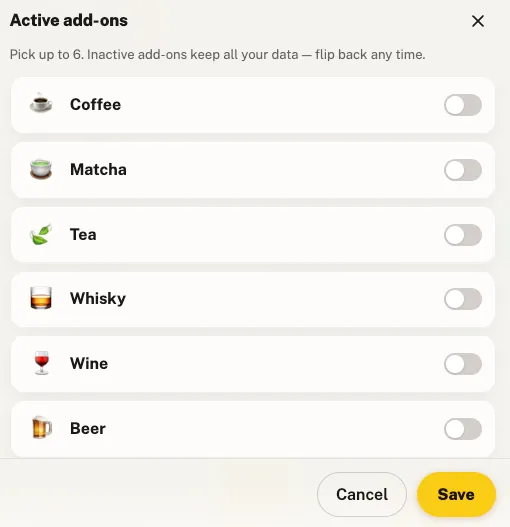
- One app for the whole shelf. Coffee, matcha, whisky, wine and beer use the same six-axis structure. Full method in how to track tea.
One honest caveat. There is no 91,000-tea catalogue: you type the tea in the first time you brew it, and there are no community notes to read. If the catalogue is why you use Steepster, that gap is the whole trade.
2. Tea blogs and TeaDB: for reading rather than logging
A meaningful share of Steepster use is reading, not writing: working out whether a specific cake or vendor is worth the money. Long-form tea blogs and video reviews do that better than a notes aggregate does, because a considered thousand-word review from someone whose palate you have come to know beats forty one-line notes averaged together.
Trade-offs: no personal record at all. This is a complement to a journal, never a replacement for one. For comparing apps rather than teas, see the best tea tracking apps.
3. A paper notebook: genuinely good for tea
Tea is the one category where paper holds up. A gongfu session is a slow, attentive thing, and a phone in the middle of it is a real intrusion; a notebook beside the tray records steep times and impressions without pulling you out of the session.
Trade-offs: unsearchable, unsortable, and unbacked-up. Many people run paper at the table and transcribe the good ones later, which is a reasonable compromise.
4. A spreadsheet: the durable option
Columns for tea, type, vendor, harvest, price per gram, water temperature, steep times and a score will outlive every website in this category. If Steepster's downtime is what worries you, this is the direct answer.
Trade-offs: no catalogue, no photos, and typing on a phone while managing a gaiwan and a timer is exactly the friction that ends journals in month three.
What should you record for each tea?
Whichever you choose, these are the fields that turn out to matter when you reread a note two years later:
- Type and cultivar: green, black, oolong, pu-erh, white, and the cultivar where the vendor gives it. "Oolong" alone spans an enormous range.
- Origin and harvest year. Spring and autumn pickings of the same tea from the same garden are different products; for pu-erh the year is most of the identity.
- Vendor and price per gram. Price per gram, not per package: it is the only way to compare a 25g sample against a 200g cake honestly.
- Brewing parameters. Leaf weight, water volume, temperature and steep time. Without these a low score tells you nothing, because you cannot distinguish a bad tea from a badly brewed one.
- Which steep you are describing. The single most useful habit in tea notes and the one most people skip.
Can you export from Steepster?
Being direct: there is no reliable one-click export, which is part of why the longevity question comes up. If you have built a large archive there, copying your notes out manually, or at minimum keeping a running spreadsheet alongside from today, is worth an evening.
Crumble's importer auto-detects only Untappd (beer) and Vivino (wine) exports; there is no tea importer. Any CSV you assemble will load once its headers are renamed to beer_name for the tea, brewery_name for the vendor, rating_score for your score and comment for the note, up to 2,000 rows at a time. The beer-shaped names are an artefact of what the importer was originally built for, and the catch matters: a file renamed this way is detected as an Untappd export, so its rows land in the Beer journal, not the Tea journal. There is no import into the tea journal today, so for a clean tea shelf the honest path is to re-log the teas you still care about and keep your old notes as an archive.
How we compared these
We keep our own tea shelf in Crumble and score sessions on the six axes, so the observations about steeps and about brewing parameters come from doing it rather than reasoning about it. Each option was measured on four questions: can you record a session or only a tea; who sees your notes; does it work in a kitchen; and what happens to a decade of notes if the service goes away. Details about Steepster come from its own public site, checked in August 2026.
When should you stay on Steepster?
If you buy a lot of tea from a lot of vendors, the catalogue and the community notes are worth more than a private journal's structure: knowing that thirty people found a particular sheng harsh saves you real money. Nothing on this list replicates that.
The sensible pattern is both: Steepster to decide what to buy, a private journal to record what happened when you brewed it. And whichever you use, keep your own copy.
Start your tea shelf today
Crumble is free and runs in any browser. Add the tea you are brewing once, log each session as another scored entry under it, and keep your own copy of every note. Matcha drinker too? See our matcha tracker app guide.
Frequently asked questions
Is Steepster still active in 2026?
Yes. Steepster is still online and its community still posts, with roughly 416,000 tasting notes covering around 91,000 teas from close to 8,900 companies. It has had visible periods of downtime over the years, which is one reason tea drinkers keep their own copy of anything they would be sorry to lose.
What is the best Steepster alternative for a private tea journal?
Crumble. It scores each brewing session on six flavour axes (sweetness, astringency, body, aroma, umami and finish) plus an overall 0 to 5 in tenth-of-a-star steps, keeps multiple steeps of the same tea as comparable sessions rather than duplicates, and is friends-only by default. The tea journal is free, like the other five tasting journals; a planned Crumble Plus tier, not on sale yet, will add an AI scan.
Can I export my Steepster notes?
There is no reliable one-click export, which is the main practical risk of a long archive there. If you want your notes elsewhere, copy them out manually or start keeping a parallel record from today. Crumble has no import into its tea journal: a CSV with its columns renamed to beer_name, brewery_name, rating_score and comment will load, but it is read as an Untappd export and the rows land in the Beer journal, not the Tea journal. Re-logging the teas you care about is the honest path.
How should I log multiple steeps of the same tea?
As separate sessions attached to the same tea, not as separate teas. Steep one and steep five of a good oolong are different drinks, and the arc across a session is the interesting part. Always note which steep a description refers to, along with leaf weight, water temperature and steep time: without those a low score cannot distinguish a bad tea from a badly brewed one.
Is there a tea app that also tracks matcha?
Crumble treats matcha as its own add-on with its own six axes (sweetness, umami, bitterness, body, aroma and aftertaste) because whisking matcha and steeping leaf tea are different processes worth scoring differently. Both sit on the same shelf as coffee, wine, beer and whisky. See our guides to tracking matcha and tea for the full method.