
The best tea brands and shops in Germany
Germany is the most misunderstood tea country in Europe, and it is misunderstood in two directions at once. Roughly 60 to 70% of all the tea traded in Europe is handled in Hamburg, which makes Germany the continent's tea infrastructure whether or not Germans drink it. And a small rural region on the North Sea coast, Ostfriesland, drinks about 300 litres per person per year, which beats every tea-growing nation on earth.
Neither fact is about German consumer culture in general. Both are worth knowing before you buy, because they explain why the German merchants below are structured the way they are.
Best tea brands and shops in Germany at a glance
The short answer: Paper & Tea in Berlin for modern, traceable tea from small farms, TeeGschwendner for a loose-leaf specialist shop you can actually walk into, and Ronnefeldt in Frankfurt for the old name you have probably already drunk in a hotel. The full list below adds the Hamburg merchants and the East Frisian blenders.
| Merchant | Based in | Known for | Buy here if |
|---|---|---|---|
| Paper & Tea (P&T) | Berlin | Direct sourcing from small farms, design-led shops | You want traceable tea without the fusty apparatus |
| TeeGschwendner | Trier | One shop in 1978, now well over a hundred | You want a specialist loose-leaf shop nearby |
| Ronnefeldt | Frankfurt | Trading since 1823, mostly through hotels | You liked the pot in a good European hotel |
Hamburg: where Europe's tea actually is
The scale is easy to miss because it is wholesale rather than retail. Germany imported around 57,000 tonnes of tea in 2015, about 83% of it directly from producing countries, and re-exported roughly 26,000 tonnes worth about 195 million euros, mostly onward into the rest of Europe.
It is physically rooted in the Speicherstadt, Hamburg's red-brick warehouse district and now a UNESCO World Heritage Site, where tea was historically the most elite branch of the trade: small quantities, high value, a small circle of buyers. The Deutscher Teeverband is headquartered there, and its 46 regular members represent just under 95% of the German tea trade, with more than a third in the Hamburg region.
The name that puts a date on it is Hälssen & Lyon, founded in January 1879 by Alfred Moritz Lyon and Gustav Vincent Hälssen, one of the first tenants of the Speicherstadt and still there, now in a fourth generation of the Ellerbrock family. It also launched the world's first decaffeinated tea. It is not a shop and you cannot buy from it as a consumer, and it is here because it explains the city.
The practical consequence for a reader anywhere in Europe: a great deal of the tea you buy from merchants in other countries physically passed through Hamburg on its way to them.
Paper & Tea: the modern one
Berlin, founded 2012 by Jens de Gruyter. P&T sources directly from small farms, with a range that reaches beyond the obvious origins into places like Korea and Kenya, and presents the whole thing in a way that owes more to a design shop than to a traditional Teeladen.
That presentation is the thing people either love or distrust, and it is worth separating from the sourcing, which is serious. If you want traceable tea without the fusty apparatus, this is the German answer.
TeeGschwendner: the shop Britain gave up
Trier, founded 1978 by Albert Gschwendner, then 22, and his wife, originally as Der Teeladen. It grew from that one shop to well over a hundred locations across Germany.
TeeGschwendner is the clearest illustration of the structural difference between German and British tea. Germany kept the loose-leaf specialist high street shop, the Teefachgeschäft, alive through exactly the decades when Britain abandoned it for the teabag. There is no real British equivalent to a national chain of specialist loose-leaf shops where you can be advised in person, and that is a genuine advantage if you are learning. If you are, note what each tin was and what you made of it; how to track tea covers what is worth writing down.
Ronnefeldt: 1823, and mostly in hotels
Frankfurt, founded 1823 by Johann Tobias Ronnefeldt. Two centuries into the trade, it is most visible today through hospitality: if you have had a decent pot of tea in a European hotel, there is a fair chance it came from them. For a home buyer that makes it reliable rather than exciting, which is a perfectly good thing to be.
Ostfriesland: 300 litres a head, the world record nobody mentions
East Frisia drinks roughly 300 litres of tea per person per year. That is a world record and it belongs to a small rural region on the North Sea coast rather than to a country, and it comfortably beats every tea-growing nation.
The ceremony is specific and it is still ordinary daily practice. A Kluntje, a lump of rock sugar, goes into the cup first, and hot tea is poured over it so that it audibly crackles. Cream is then added over the back of a spoon so it blooms upward into a cloud, the Wulkje, or little cloud. It is not stirred: you drink cream, then tea, then sweetness, in sequence. Three cups is the polite minimum, and laying your spoon in the cup is how you signal you have had enough. The tea itself is a strong, malty, Assam-dominated blend built to survive that treatment.
What Ostfriesentee actually means, and what it does not
Here are the two corrections, because English-language writing gets both of these wrong routinely.
First: "Ostfriesentee" is not a protected designation of origin. There is no PDO and no PGI. What exists is a strong trade convention that only tea assembled, blended and packed by companies based in East Frisia may be sold as Echter Ostfriesentee, genuine East Frisian tea, which in practice means three houses: Bünting, Thiele and Onno Behrends. The term is defended through individual manufacturers word marks registered at the German patent office, not through an EU designation. That is a real protection and it is a different mechanism, and calling it a PDO would put it in the same category as Oude Geuze, which it is not.
Second: the East Frisian tea ceremony is on Germany's national intangible cultural heritage register, entered on 9 December 2016, not on the international UNESCO list. It is a national recognition. The Speicherstadt in Hamburg is the UNESCO listing in this story, and the two get conflated constantly.
Three countries, three completely different tea cultures
It is worth seeing the shape of this next to its neighbours. Britain has merchants and no growing, a three-century auction history that ended in 1998, and a recent founder-led specialty revival. Our UK tea guide covers that.
Germany has industrial trade infrastructure and a folk ritual, and kept the specialist shop alive in between. Its retail sits in a third place again: franchised and independent Teefachgeschäfte rather than either London-style micro-merchants or supermarket dominance.
One caution that applies in all three countries: the Deutscher Teeverband, like its British counterpart, is a trade body and not a quality mark. Membership tells you a company is in the tea business, not that it names its gardens.
The full list, Hamburg to Ostfriesland
The three above are the ones to start with. The full list runs from Berlin's modern houses to the East Frisian blenders, and takes in the two Hamburg merchants that make the trade-hub story concrete: Tee Zwanck, founded on 29 September 1796 and the oldest tea house in the city, and Tee Maass, trading since 1887.
-
Paper & Tea (P&T)
Founded 2012 by Jens de Gruyter. Direct sourcing from small farms including less common origins, presented more like a design shop than a traditional tea merchant.
-
TeeGschwendner
Founded 1978 by Albert Gschwendner in Trier as Der Teeladen. Grew to well over a hundred specialist loose-leaf shops, the high street format Britain gave up.
-
Ronnefeldt
Founded 1823 by Johann Tobias Ronnefeldt. Two centuries in the trade and widely poured in European hotels.
-
Tee Zwanck
Hamburg's oldest tea house, founded to the day on 29 September 1796, and still a working merchant rather than a museum piece.
-
Tee Maass
A Hamburg tea merchant since 1887, trading a few streets from the Speicherstadt warehouses that handle most of Europe's tea.
-
Teehaus Bachfischer
A long-standing Bavarian tea house, and evidence that the German Teefachgeschaft tradition is a national one rather than a northern port habit.
-
Tee Kontor Kiel
A northern specialist merchant with a deep loose-leaf range, in a Baltic port city with its own trading history.
-
samova
Founded 2002. Organic and fair-trade led, with a design-forward presentation that sits closer to Berlin's modern houses than to the old Hamburg trade.
-
Paul Schrader & Co.
A Bremen house founded in 1921, from the other great German port city for coffee and tea importing, and still trading loose leaf.
-
Bunting
One of the three houses whose blends may be sold as Echter Ostfriesentee, still at its founding address 219 years on. Strong, malty, Assam-led, built for the Kluntje ritual.
-
Thiele & Freese
An East Frisian house founded in 1873 and one of the three permitted to sell Echter Ostfriesentee under the regional trade convention.
-
Onno Behrends
The third of the Echter Ostfriesentee houses, in Norden on the North Sea coast, at the centre of the region that drinks more tea per head than any country on earth.
-
Siam Tee Shop
A specialist in Thai tea, an origin almost no European merchant carries, run from a village in the Saarland rather than a trading city.
-
Halssen & Lyon
Founded January 1879 and one of the first Speicherstadt tenants, still family-held in a fourth generation. It launched the world's first decaffeinated tea. You cannot buy from it as a consumer.
View in Crumble opens the map with that name already typed into the search, so you can find the branch nearest you, see what is actually there and log it yourself. Street addresses are deliberately absent: places move, open second sites and close them again faster than a guide gets updated, so the map is the more current answer.
Write down what you drink
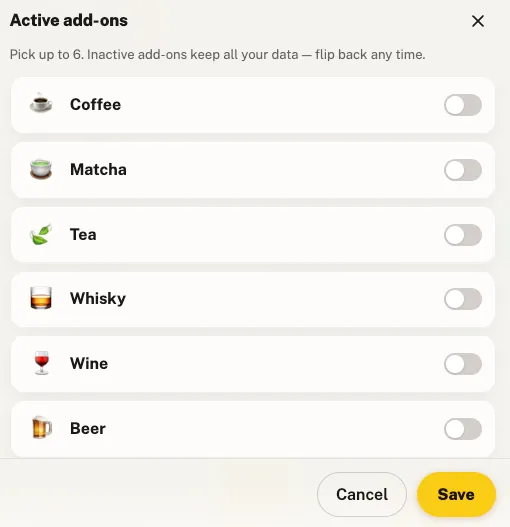
German merchants carry deeper ranges than most, and a Teefachgeschäft will happily send you home with six things you cannot afterwards tell apart from memory. Crumble's tea journal is a free add-on: one entry per tin with garden, region and harvest, then a tasting per steep scored on six axes from astringency through finish.
Matching free journals cover coffee, matcha, whisky, wine and beer, and our guide to tracking tea covers the habit itself.
Frequently asked questions
Why is Hamburg important for tea?
Because roughly 60 to 70 percent of all tea traded in Europe is handled there. Germany imported around 57,000 tonnes in 2015, about 83 percent directly from producing countries, and re-exported roughly 26,000 tonnes worth about 195 million euros. The Deutscher Teeverband is headquartered in the Speicherstadt warehouse district, and its members represent just under 95 percent of the German tea trade. Much of the tea sold by merchants in other European countries physically passed through Hamburg.
Is Ostfriesentee a protected designation of origin?
No, and this is widely misreported. There is no PDO or PGI for the term. What exists is a strong trade convention that only tea assembled, blended and packed by companies based in East Frisia may be sold as Echter Ostfriesentee, in practice three houses: Bunting, Thiele and Onno Behrends. It is defended through individual manufacturers word marks registered at the German patent office, which is a real but different mechanism.
Where do people drink the most tea in the world?
Ostfriesland, a small rural region on Germany's North Sea coast, at roughly 300 litres per person per year. That is a genuine world record and it beats every tea-growing nation. It is a regional rather than a national figure, which is why it rarely appears in country-level rankings.
How does the East Frisian tea ceremony work?
A Kluntje, a lump of rock sugar, goes into the cup first and hot tea is poured over it so it audibly crackles. Cream is added over the back of a spoon so it blooms upward into a cloud, called the Wulkje. It is not stirred, so you taste cream, then tea, then sweetness in sequence. Three cups is the polite minimum and laying your spoon in the cup signals you have finished.
Is East Frisian tea culture UNESCO listed?
Not internationally. It was entered on Germany's national register of intangible cultural heritage on 9 December 2016, which is a national recognition rather than the international UNESCO list. The UNESCO World Heritage listing in this story belongs to Hamburg's Speicherstadt warehouse district, and the two are frequently conflated.
Where should I buy loose-leaf tea in Germany?
Paper & Tea in Berlin for direct-from-farm sourcing with modern presentation, TeeGschwendner if you want a specialist shop you can walk into and be advised in, and Ronnefeldt, founded in Frankfurt in 1823, if you want a long-established house. For genuine East Frisian blends, look for Echter Ostfriesentee from Bunting, Thiele or Onno Behrends.
Why does Germany still have specialist tea shops when Britain does not?
Germany kept the Teefachgeschaft, the loose-leaf specialist high street shop, alive through exactly the decades when Britain abandoned it for the teabag. TeeGschwendner grew from one shop in Trier in 1978 to well over a hundred locations. There is no real British equivalent to a national chain of specialist loose-leaf shops with in-person advice.