
The best speciality tea merchants in the UK
Britain drinks more tea than almost anywhere and buys less of it by name than almost anywhere. The six merchants below all pass one test: they tell you which garden the tea came from, and usually which person made it. That single question sorts the British tea trade faster than any award ever has.
It also rules out a lot of famous tins, which is the point. A gift caddy with a crest on it and no origin on the back is a present, not a purchase. Where the famous names fit is covered at the bottom.
Best speciality tea merchants in the UK at a glance
The short answer: on traceability, Postcard Teas in Mayfair, which names the maker of every tea it sells. Rare Tea Company for direct-trade breadth, JING for single gardens across a large catalogue, and What-Cha for origins almost nobody else imports. The table sorts all six by who each one suits. Fortnum & Mason is not in it, for a reason explained further down: it is a department store that sells tea, not an origin merchant.
| Merchant | Where | Known for | Buy here if |
|---|---|---|---|
| Postcard Teas | Mayfair, London | The maker's name on every tea since 2008, from micro-farms | You want to know who made it |
| Rare Tea Company | London | Direct trade and speciality Malawian leaf | You want the tea Noma and Claridge's pour |
| JING Tea | London | Roughly 70 to 80 single-garden teas | You want Chinese greens and oolongs first |
| Comins Tea | Dorset and Bath | Two founders who still do the buying | You want advice in a tea house |
| What-Cha | London | Leaf from Kenya, Nepal, Vietnam, Georgia and Malawi | You want origins nobody else carries |
| Tregothnan | Near Truro, Cornwall | The only commercial-scale tea plantation in Britain | You want tea grown in Britain (check for blends) |
Postcard Teas: the one that changed what a British tea label says
Mayfair, London. Founded 2005 by Timothy d'Offay. In 2008 it began printing the maker's name and location on every tea it sold, and is widely credited as the first tea company anywhere to do it. Nearly every provenance claim the rest of the British trade now makes descends from that decision.
The sourcing is the unusual part. Postcard buys from micro-farms averaging around five acres, and in 2012 it stopped retailing plantation-grown tea altogether. That is a genuinely expensive commitment: most direct-trade merchants quietly keep the big estate names in the range because customers ask for them. It also means some famous estate teas will simply never appear on this shelf.
Expect to pay for it. Five-acre sourcing does not produce cheap tea, and the shop itself is small.
Rare Tea Company: direct trade, and the case for Malawi
London. Founded 2004 by Henrietta Lovell, who left finance to do it. Rare Tea buys directly from farmers across China, Japan, India, Nepal, Sri Lanka, Mexico and the UK. Mexico and the UK in that list are the tell: those are not catalogue origins, they are places somebody went.
The strongest outside evidence is the client list. Noma in Copenhagen, Momofuku in New York and Claridge's in London all pour it. Kitchens at that level re-specifying a supplier year after year is a harder signal than any medal.
What Rare Tea is really known for is speciality Malawian leaf, a category it did more than anyone to establish in the West. The caveat: the range is curated rather than encyclopaedic, and the founder's storytelling is a large part of the product. If you want twelve Darjeeling flushes side by side, go elsewhere.
JING Tea: single garden as the whole catalogue, not the top shelf
London. Founded 2004 by Edward Eisler. JING runs roughly 70 to 80 single-garden teas across mainland China, Japan, India and Sri Lanka. The distinction worth understanding is structural: plenty of merchants keep a single-garden premium range above a blended base range, whereas at JING single garden is the organising principle of the entire list.
It is the most hospitality-facing of the British independents, poured at The Savoy, The Berkeley and The Langham. The name is 精, meaning essence, which tells you where its heart is: Chinese greens and oolongs first.
The trade-off is that JING reads more like a luxury brand than a merchant's counter, and its traceability generally stops at the garden rather than reaching the individual smallholder the way Postcard's does.
Comins Tea: the Makaibari accident, and two founders who still do the buying
Sturminster Newton in Dorset, plus Bath. Rob and Michelle Comins began sourcing in 2006, opened the Dorset tea house in 2013 and Bath in 2016. The origin story is a real credential rather than colour: the business grew out of a Darjeeling trip and a meeting with Rajah Banerjee of the Makaibari estate, one of the most storied single estates in India.
They have been travelling to meet growers since 2007 and both founders still do the sourcing personally, which at this size means there is no buying department between you and the decision. The tea houses function as teaching rooms: brewing method gets as much attention as the leaf.
It is a two-person business, so the catalogue is modest and the shops are rural rather than London. That is a feature if you want advice and a limitation if you want depth.
What-Cha: the origins nobody else imports
London. Founded 2014. What-Cha exists to carry tea from places the trade overlooks, and the range has included leaf from Kenya, Nepal, Vietnam, Georgia and Malawi. If you have never knowingly drunk Georgian tea, this is why you might.
The thing that earns it a place here is a piece of honesty most merchants avoid: What-Cha states openly that where direct sourcing is not possible it buys through specialist regional wholesalers who work closely with producers. Almost everyone else blurs that line. It also means you should read each listing rather than assume a uniform supply chain.
It is genuinely tiny, run by the founder with his father helping pack. Stock rotates hard, good lots vanish, and the packaging is functional rather than gift-ready.
Tregothnan: Britain actually grows tea here
Near Truro, Cornwall. The Boscawen family has held the estate since 1334; the tea was planted in 1999 and the first English-grown tea sold in November 2005. Cornwall's mild, wet, acidic conditions genuinely suit camellia sinensis, and the estate's historic botanical collection included some of the first outdoor camellias in the country.
This is the only tea plantation in Britain at any commercial scale. One thing to check on the shelf: some products are blends of home-grown and imported leaf rather than pure English tea, so read which is which.
Why London stopped setting the price of tea
Britain never grew tea in any quantity, but for three centuries it priced the world's. The London Tea Auction ran from 1679 until 29 June 1998. After the East India Company lost its commercial monopoly in 1834 and tea became an open commodity, the auction moved to the commercial salerooms on Mincing Lane, which collected so many tea offices it was nicknamed the Street of Tea.
By the 1950s roughly a third of all the tea in the world was bought through London. The last lot was a single chest of Ceylon Flowery Pekoe that went for 225 pounds a kilo, with Twinings and Taylors of Harrogate bidding it up, and it was a ceremony rather than a trade: the real business had already moved to the origin-country auctions in Colombo, Mombasa and Kolkata.
What filled the domestic gap was builder's tea: strong, bagged, milky, in a mug. It is a real folk institution and it is also the thing the speciality revival defines itself against. That revival is strikingly recent and strikingly founder-led, clustering into a single decade: Rare Tea and JING in 2004, Postcard in 2005, Comins from 2006, What-Cha in 2014. Britain has no Hamburg-style trade hub and no colonial import house left, but it has the deepest bench of small origin-focused buyers in Europe.
Where does Fortnum & Mason fit?
Fortnum & Mason is the obvious absence from the six. It is a department store that sells tea rather than an origin merchant, and only its single-estate range names the garden. It belongs in any history of British tea retail, including the one above; it is a different kind of shop from the ones profiled here.
How to judge a tea merchant in thirty seconds
- Look for the garden name. "Assam" is a region the size of Ireland. "Halmari" is a specific estate. The second one tells you something.
- Look for a harvest or flush, not a best-before date. Green tea and first-flush Darjeeling are seasonal goods, and a merchant who knows when it was picked will say so. Keep that date with your tasting note; how to track tea explains why it matters.
- Check whether the cultivar is named. Nobody prints a cultivar by accident.
- Be suspicious of a crest without an origin. Heritage branding and traceability are unrelated variables.
- Watch how they describe their own supply chain. A merchant who admits which teas come via wholesalers is more trustworthy than one who implies everything is direct.
A trade body is not a quality mark, either. The UK Tea and Infusions Association is an industry association, and membership says nothing about whether a company names its gardens.
The full list, from specialist to high street
The six above name the garden and the maker. The full list below runs from the most specialist to the most mainstream, including the famous high street names, because knowing why Fortnum's and Whittard are different from Postcard Teas is more useful than pretending they do not exist.
-
Postcard Teas
Micro-farm merchant, about five acres per farm. First in the world to print the maker's name on every tea, in 2008, and stopped retailing plantation tea entirely in 2012.
View in Crumble: Postcard Teas Their site: Postcard Teas (opens in a new tab)
-
Rare Tea Company
Direct-trade merchant and the leading Western champion of speciality Malawi leaf, poured at Noma, Momofuku and Claridge's. Online and wholesale rather than a walk-in.
View in Crumble: Rare Tea Company Their site: Rare Tea Company (opens in a new tab)
-
JING Tea
Roughly 70 to 80 single-garden teas as the whole catalogue rather than a premium tier. Poured at The Savoy, The Berkeley and The Langham.
View in Crumble: JING Tea Their site: JING Tea (opens in a new tab)
-
Comins Tea
Single-estate merchant, founder-sourced since 2006, grew out of a meeting with Rajah Banerjee at the Makaibari estate. The tea houses double as teaching rooms.
View in Crumble: Comins Tea Their site: Comins Tea (opens in a new tab)
-
What-Cha
Specialist in overlooked origins including Kenya, Nepal, Vietnam, Georgia and Malawi, and unusually open about buying through regional wholesalers where direct sourcing is not possible.
View in Crumble: What-Cha Their site: What-Cha (opens in a new tab)
-
Mei Leaf
A Camden tea house with one of the deepest Chinese and Taiwanese ranges in Britain, and a serious public education effort behind it. One of the few specialists with a real shop to sit in.
-
Canton Tea
Founded 2007 in London by Jennifer Wood, now operating from Bristol. Buys seasonally, to the flush rather than to a standing blend spec, from small artisan producers.
View in Crumble: Canton Tea Their site: Canton Tea (opens in a new tab)
-
Lalani & Co
A specialist merchant built around single-estate Darjeeling and a vintage-led approach, treating flush and year the way a wine merchant treats a vintage.
-
Tregothnan
The only tea plantation in Britain at commercial scale. Planted 1999, first English tea sold November 2005. Check which products are home-grown and which are blended.
-
Waterloo Tea
A Cardiff tea house and merchant, and the strongest answer to the assumption that British speciality tea is a London business.
-
Curious Tea
A subscription-led merchant that rotates single-origin teas monthly with origin notes, which is a genuinely good way to work out what you like before committing to a caddy.
-
Newby Teas
A luxury house with a large single-origin range and serious storage and blending facilities. Presentation-forward.
-
Bird & Blend Tea Co.
A flavoured-blend house rather than an origin merchant, and the counterpoint to everything above: very good at what it does, and what it does is not single-garden tea.
-
Twinings
Trading from the same Strand address since 1706, which makes it one of the oldest continuously sited businesses in London. A historical destination more than a speciality merchant.
-
Fortnum & Mason
A department store that sells tea rather than an origin merchant. Only its single-estate range names the garden, and it belongs in any history of British tea retail.
-
Whittard of Chelsea
A high street chain at the least specialist end of this list. Convenient and widely available; not where you go for a named garden and a harvest date.
View in Crumble opens the map with that name already typed into the search, so you can find the branch nearest you, see what is actually there and log it yourself. Street addresses are deliberately absent: places move, open second sites and close them again faster than a guide gets updated, so the map is the more current answer.
Write down what you drink
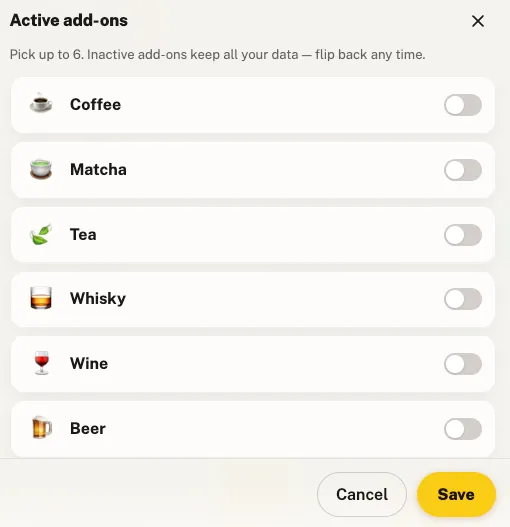
The useful habit with tea is not buying better, it is remembering. Six months on you will recall that a Nepalese black was extraordinary and not one detail that would let you buy it again: not the garden, not the flush, not the merchant. Crumble's tea journal is a free add-on: one entry per tin with garden, region and harvest, then a tasting per steep scored on six axes from astringency through finish. Twenty steeps in, the shapes start showing you your own palate, which no amount of tasting notes ever does.
Matching free journals cover coffee, matcha, whisky, wine and beer, so a shelf of tins and a shelf of bottles live in one place. Our guide to tracking tea covers the habit itself.
Frequently asked questions
Who is the best speciality tea merchant in the UK?
On traceability grounds, Postcard Teas in Mayfair. It began printing the maker's name and location on every tea in 2008, sources from micro-farms of around five acres, and stopped retailing plantation-grown tea entirely in 2012. If you want direct-trade breadth rather than micro-farm depth, Rare Tea Company; if you want single gardens across a large catalogue, JING.
Is tea actually grown in Britain?
Yes, at Tregothnan near Truro in Cornwall, which is the only plantation of commercial scale in the country. Tea was planted there in 1999 and the first English-grown tea was sold in November 2005. Cornwall's mild, wet, acidic conditions suit the plant. Check labels, because some products blend home-grown with imported leaf.
Why is Fortnum & Mason not among the six?
Because it is a department store that sells tea rather than an origin-focused merchant. Only its single-estate range names the garden and the maker, which is the test here. That says what kind of shop it is, not how good.
What should I look for on a packet of good tea?
A named garden or estate rather than just a region, a harvest or flush date rather than only a best-before, and ideally the cultivar. Region plus best-before is the commodity pattern. Also worth noting: trade association membership is not a quality certification and implies nothing about origin transparency.
When did the London Tea Auction end?
On 29 June 1998, after running since 1679. The final lot was a chest of Ceylon Flowery Pekoe that sold for 225 pounds per kilo. By then the real trade had long moved to origin-country auctions in Colombo, Mombasa and Kolkata, so the closing sale was ceremonial.
Where can I buy unusual tea origins in the UK?
What-Cha in London specialises in exactly that, having carried leaf from Kenya, Nepal, Vietnam, Georgia and Malawi. It is a very small operation and stock rotates quickly. It is also unusually open about buying through specialist regional wholesalers where direct sourcing is not possible, which is worth knowing when you read individual listings.
Is this list based on your own visits?
No. Our city guides are built from meals we logged ourselves; this one is built from published sourcing, and judged on one question: does the merchant name the garden and the maker?