
The best specialty coffee roasters in the Netherlands
The Netherlands roasts far better coffee than a country this size has any right to, and the reason is not the roasters. It is the importers. Rotterdam is the main port of entry for green coffee into Europe, and the country holds an unusual density of specialist green buyers: Trabocca, This Side Up, The Coffee Quest, Daarnhouwer.
That changes what a small roastery can do. A two-person operation in Utrecht can get competition-grade micro-lots without running its own origin travel programme, which is why Dutch lot quality runs so far ahead of Dutch roaster headcount. The sixteen below all publish enough about what is in the bag that you can buy the same coffee twice.
Best coffee roasters in the Netherlands at a glance
The short answer: on competition record, Friedhats in Amsterdam, whose co-founder came second at the 2018 World Barista Championship. For one farm at a time, Single Estate in The Hague. For the highest-scoring micro-lots, Manhattan in Rotterdam. The table sorts the eight we profile by who each one suits.
| Roaster | City | Known for | Order here if |
|---|---|---|---|
| Friedhats Coffee Roasters | Amsterdam | A world runner-up co-founder and a strong Ethiopia range | You trust the cup over the label (bags list only country and variety) |
| Manhattan Coffee Roasters | Rotterdam | 90-plus point micro-lots roasted for competitors | You want the top lots and accept high prices |
| Man Met Bril Koffie | Rotterdam | Imports around 80% of its coffee directly from farmers | You want balanced coffee that works with milk |
| Keen Coffee | Utrecht | Anaerobic ferments and rare varieties | You buy to taste a named lot |
| Single Estate Coffee Roasters | The Hague | A catalogue that is single estate by definition | You want to drink one farm at a time |
| DAK Coffee Roasters | Amsterdam | Co-ferments and experimental processing | You want to find out what a co-ferment does |
| Bocca Coffee | Amsterdam and Dronten | Dutch third wave since 2001, B Corp | You want the roaster the scene started from |
| Giraffe Coffee Roasters | Rotterdam | An 80-point floor and a farm-investment premium | You care what the premium is spent on |
Friedhats: a world championship runner-up, and a label that tells you less than you want
Amsterdam, Bos en Lommer. Opened November 2016 by Lex Wenneker and Dylan Sedgwick. Wenneker is a three-time Dutch Barista Champion, in 2015, 2016 and 2018, and came second at the World Barista Championship in 2018, held in Amsterdam, behind Agnieszka Rojewska, the first woman to take the title. That is the strongest competition record attached to any Dutch roastery.
Friedhats grew out of Headfirst Coffee Roasters, which closed in 2015 and was one of the best coffee bars in the city while it lasted. The name is an anagram of Head First. If you see Headfirst on a list of Dutch roasters, that list is a decade out of date.
The Ethiopia programme is the reason to order, with Suke Quto the usual entry point: white peach, black tea, a citric acidity that stays polite. They are also unusually straight about buying through trusted European importers as well as directly, rather than claiming total direct trade.
One thing to know before you buy on the strength of that record. Friedhats deliberately prints only two things on the bag: country and variety. No producer, no process, no altitude. It is a stated choice about not overwhelming the drinker, and the coffee justifies it, but if your reason for buying single origin is the data on the label, know that in advance.
Manhattan Coffee Roasters: built for people entering competitions
Rotterdam. Founded 2017 by Ben Morrow and Esther Maasdam, who met at the 2014 World Latte Art Championship. Manhattan buys 90-plus point micro-lots in close cooperation with producers, and roasts coffee that other people take to competitions: they have roasted for a Dutch representative at the World Brewers Cup and for a Dutch Barista Champion.
Worth being precise, because other write-ups are not: the founders own titles are Coffee Masters and latte-art titles, not World Barista Championships. The distinction matters in a scene where everyone is described as a champion.
Expect small lots, high prices and fast sell-outs. They also sell blends, so the range is not purely single origin. Ask for whatever is currently scoring highest rather than hunting a fixed name.
Man Met Bril: the one that imports its own green
Rotterdam. The claim that earns Man Met Bril its place is specific and checkable: they import around 80% of their coffee directly from farmers, and run the whole chain in-house from sourcing through roasting to their own cafés. The range runs to roughly fourteen single origins, which is a lot of direct relationships for a roastery this size.
The style is deliberately more approachable than the Amsterdam Nordic pole: balanced, built to work with milk as well as without, which is what you want from a roaster that also has to serve its own rooms all day. There is a coffee hotel in Crooswijk if you want to take the interest further than a bag.
Keen Coffee: rare varieties, and the AeroPress crowd
Utrecht, founded 2016 by two barista champions. Keen release seasonal anaerobic ferments and rare varieties, and are the main sponsor of the Dutch AeroPress Championship, which tells you which end of the scene they live in.
Their Costa Rican El Diamante lot is the one their reputation tends to rest on. Structurally they are among the best fits on this page for anyone who buys specifically to taste a named lot rather than a house style.
Single Estate Coffee Roasters: the clue is in the name
The Hague, founded 2007 by Patrick Groenewold, a chef turned coffee consultant who roasted for over a decade before opening a café. The flagship opened in September 2019 in a two-storey Jugendstil corner building.
Of every roaster here this is the purest structural fit for a single-origin guide: the entire catalogue is single estate by definition, not a premium tier sitting above a blend range. If you want to drink one farm at a time and never think about it again, start here.
DAK Coffee Roasters: the experimental end
Amsterdam, founded in summer 2019 by Louis-Philippe Boucher. DAK state their coffees are fully traceable and work only with green importers they share values with. What they are known for is the experimental end: co-ferments and unusual processing, the coffees that taste least like what people expect coffee to taste like.
That is the caveat too. If you want a clean washed Colombian for the morning, this is not the shelf. If you want to find out what a co-ferment actually does, it very much is.
Bocca: where Dutch third wave starts
Amsterdam and Dronten, founded 2001 by brothers Menno and Tewis Simons. Bocca is roughly the zero point for Dutch specialty: before it, the country went more or less straight from Douwe Egberts-scale commodity roasting to nothing.
It is a certified B Corporation, and Ethiopia is the house strength, which follows from the company it keeps. One thing repeatedly misreported elsewhere: Bocca has not been acquired. Trabocca, the green importer founded in 2003, is a sister company rather than a parent, both tracing back to Menno Simons. Trabocca supplies the large majority of Bocca's green, which is a supply relationship, not an ownership one.
Giraffe Coffee Roasters: an 80-point floor, and a premium that goes to the farm
Rotterdam, founded 2013 by Maarten van der Jagt. Giraffe follow SCA standards and buy only beans scoring 80 points or above, which is the formal threshold for specialty and a rare thing to state as policy rather than imply.
The more interesting commitment is that they pay producers an additional premium specifically earmarked for farm investment, rather than a flat above-market price. It is a small distinction that changes what the money is for.
Does it matter whether a bag comes from Amsterdam or Rotterdam?
More than you would expect: the city on the bag tells you something before you open it. Amsterdam roasts Nordic: light, fruit-forward, clarity chosen over body, which is Friedhats, DAK and White Label. Rotterdam is the competition and direct-import pole: Manhattan chasing 90-plus lots for competitors, Man Met Bril building an identity on importing its own green.
The country has almost no legacy artisan roasting tradition to build on, which is the other half of the explanation. There is no Dutch equivalent of the old Hamburg port-roasting craft lineage. Dutch coffee jumped from commodity straight to third wave with Bocca in 2001 as the hinge, and the scene has been importer-led ever since.
The national championships run as NK Koffie under SCA Nederland, hosted at Horecava in Amsterdam.
What to check before you buy
- Look for the producer or the farm, not just the country. "Ethiopia" is a nation of a hundred million people. "Suke Quto" is a place with a name attached.
- Look for a harvest year. Green coffee is a crop. A roaster who knows the harvest will print it, and one who does not may be selling last year's.
- Process tells you more than roast level. Washed, natural, honey and anaerobic will differ more in the cup than two roasters interpretations of light.
- Roast date, never best-before. Anything more than a month past roast is going backwards, and a best-before date is a way of not telling you. Note it with the roaster and lot when you open the bag; how to track specialty coffee covers what else is worth writing down.
- Decide whether you want data or a decision. Friedhats prints almost nothing and the coffee is excellent. Single Estate prints everything. Both are defensible; they suit different drinkers.
The full list, Amsterdam to Utrecht
The eight above are the ones worth a detour. Below is the full list, including the smaller neighbourhood roasteries. Each one opens in Crumble with its name already in the search, so you can find the nearest branch and see it for yourself before going.
-
Friedhats Coffee Roasters
Lex Wenneker is a three-time Dutch Barista Champion and was second at the 2018 World Barista Championship. Ethiopia-led, light and filter-forward. The roastery is appointment only; FUKU is their cafe.
View in Crumble: Friedhats Coffee Roasters Their site: Friedhats Coffee Roasters (opens in a new tab)
-
Manhattan Coffee Roasters
Founded 2017 by Esther Maasdam and Ben Morrow. Buys 90-plus point competition lots and roasts for national competitors, including the geisha that won a Dutch Barista Championship.
View in Crumble: Manhattan Coffee Roasters Their site: Manhattan Coffee Roasters (opens in a new tab)
-
Man Met Bril Koffie
Imports around 80 percent of its green directly from farmers and runs the chain from sourcing to its own cafes. Also runs a coffee hotel on the Rotte.
View in Crumble: Man Met Bril Koffie Their site: Man Met Bril Koffie (opens in a new tab)
-
Keen Coffee
Founded 2016. Seasonal rare varieties and anaerobic ferments, and main sponsor of the Dutch AeroPress Championship. Moved from Rotterdam to Utrecht in 2019.
-
Bocca Coffee
Founded 2001 by Menno and Tewis Simons and widely called the first Dutch specialty roaster. Certified B Corporation, strongest in Ethiopia. Not acquired: Trabocca is a sister company.
View in Crumble: Bocca Coffee Their site: Bocca Coffee (opens in a new tab)
-
Single Estate Coffee Roasters
The Hague, 2007. The purest single-origin fit here: the whole catalogue is single estate rather than a premium tier above a blend range.
View in Crumble: Single Estate Coffee Roasters Their site: Single Estate Coffee Roasters (opens in a new tab)
-
DAK Coffee Roasters
Summer 2019. Experimental and co-fermented lots at the funky end of light roasting.
View in Crumble: DAK Coffee Roasters Their site: DAK Coffee Roasters (opens in a new tab)
-
Giraffe Coffee Roasters
Rotterdam, 2013. Buys only at 80 points or above and pays producers an added premium earmarked for farm investment. Visitors to the roastery get a cup.
-
White Label Coffee
Founded March 2014 by Elmer Oomkens and Francesco Grassi. An Amsterdam West fixture with several sites, squarely in the light Nordic camp.
-
Stooker Roasting Company
Amsterdam Oost, opened 2015. Roastery, training academy and takeaway bar on one site, which makes it one of the easier roasteries to actually walk into.
-
Rum Baba
An independent roast-and-serve operation in Amsterdam Oost for roughly fifteen years, predating most of the city's current micro-roaster wave. Comfortable and bakery-adjacent rather than a tasting bar.
-
Monks Coffee Roasters
Founded 2016 on explicit Melbourne cafe practice, and lists on Typica, the direct-trade platform where the producer and lot are named per purchase. Antipodean espresso.
-
Back to Black
Runs its own roastery and bakery as one operation across three Amsterdam sites rather than white-labelling someone else's roast. Approachable, built for milk drinks as much as filter.
-
Hopper Coffee
Roasts in-house on a Giesen at the back of the cafe, a few batches a month. Genuinely small-batch, and you can see the machine while you queue.
-
Drupa Coffee Roasters
A micro-roastery in a Jordaan side street run by Martin and Cristina Amadio around a declared Colombia specialism. The most obscure entry here.
-
Lot Sixty One
Opened 2013 by Adam Craig and now across several Amsterdam sites. Blend-led rather than single origin, so a different proposition from the rest of this list, but too established in the city to leave out.
View in Crumble opens the map with that name already typed into the search, so you can find the branch nearest you, see what is actually there and log it yourself. Street addresses are deliberately absent: places move, open second sites and close them again faster than a guide gets updated, so the map is the more current answer.
Keep a record of what you drank
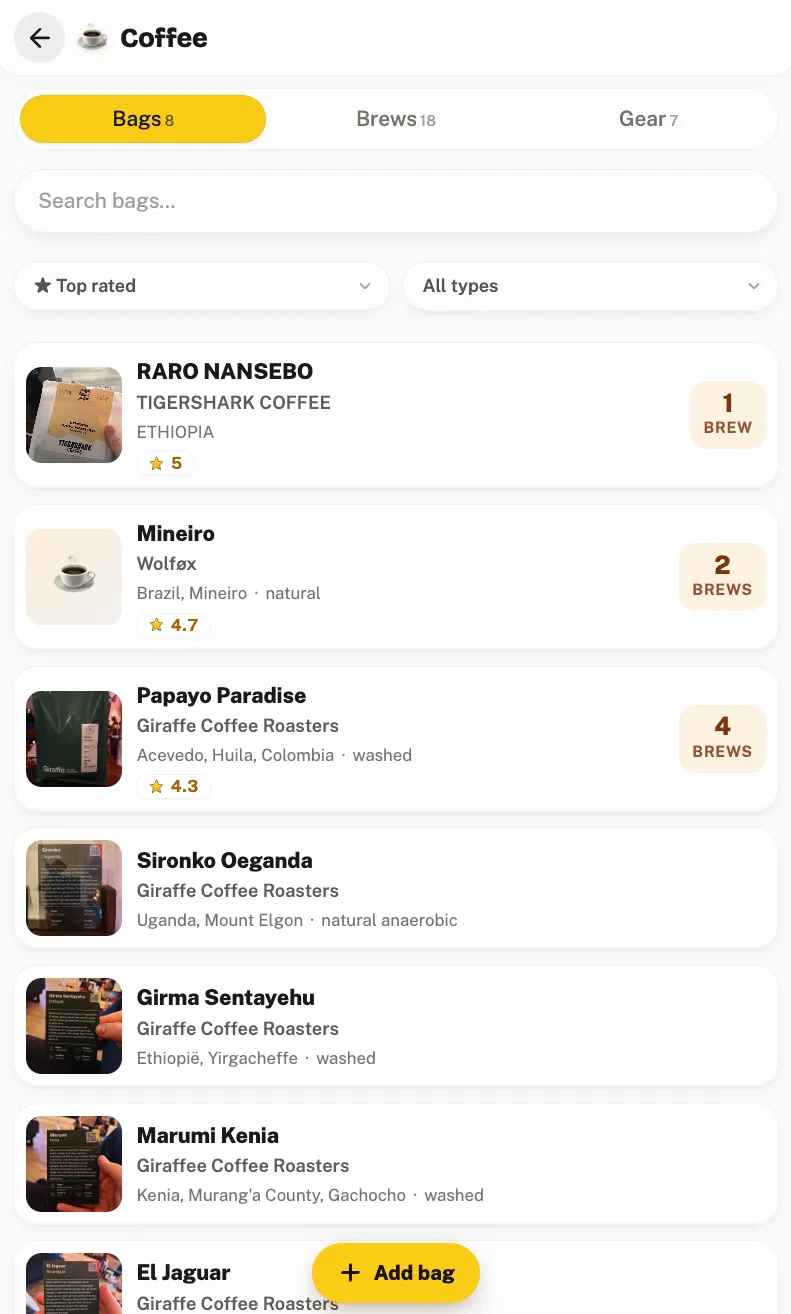
Sixteen roasters and a rotating seasonal range is more than anyone remembers unaided. Six months on you will know that one Ethiopian was extraordinary and not which roaster, which lot, or which process, which means you cannot buy it again. Crumble's coffee journal is a free add-on: one entry per bag with roaster, origin, process and roast date, then a brew log underneath it scored on six axes from acidity through aftertaste.
Matching free journals cover tea, matcha, whisky, wine and beer. Our guide to tracking specialty coffee covers the habit, and the coffee tracking apps comparison covers the alternatives honestly.
Frequently asked questions
Which is the best specialty coffee roaster in the Netherlands?
On competition record, Friedhats in Amsterdam: Lex Wenneker is a three-time Dutch Barista Champion, in 2015, 2016 and 2018, and finished second at the 2018 World Barista Championship. For pure single-origin transparency, Single Estate in The Hague is the better structural fit, because its whole catalogue is single estate rather than a premium tier above a blend range.
Why is Dutch coffee so good for such a small country?
Because the scene is importer-led rather than roaster-led. Rotterdam is the main port of entry for green coffee into Europe and the country hosts an unusual density of specialist green importers, including Trabocca, This Side Up, The Coffee Quest and Daarnhouwer. That lets a two-person roastery buy competition-grade micro-lots without running its own origin programme.
Has Bocca been acquired by Trabocca?
No. Trabocca is a sister company rather than a parent. Both trace back to Menno Simons, who founded Bocca in 2001 and Trabocca in 2003, and Trabocca supplies most of Bocca's green coffee. That is a supply relationship, not an ownership one, and it is frequently reported wrongly.
What happened to Headfirst Coffee Roasters?
It closed in 2015. Friedhats is its direct successor, founded by the same people in November 2016, and the name is an anagram of Head First. Any current guide to Dutch roasters still listing Headfirst has not been updated in a decade.
What is the difference between Amsterdam and Rotterdam roasters?
Amsterdam roasts Nordic: light, fruit-forward, clarity over body, which is Friedhats, DAK and White Label. Rotterdam is the competition and direct-import pole: Manhattan buys 90-plus point micro-lots aimed at competitors, and Man Met Bril imports around 80 percent of its green directly.
Do these roasters ship internationally?
Several are stocked by resellers across Europe and North America. For direct orders, destinations, thresholds and customs handling change often enough that the roaster's own shop page is the only source that stays current.
Is this list based on coffee you drank yourselves?
No. Our city guides are built from meals we logged ourselves; this one is built from published sourcing and competition records, and judged on whether a roaster roasts its own coffee, says where it came from, and sells single origins rather than blends.