
6 Best Restaurant Rating and Ranking Apps
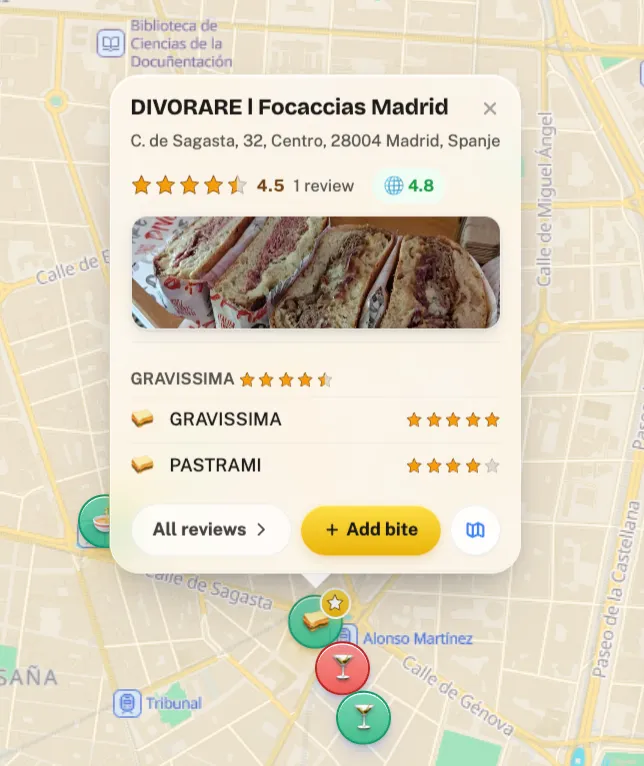
The best restaurant rating and ranking apps in 2026 split into two camps: Beli, which force-ranks every restaurant you visit through head-to-head comparisons, and absolute-rating apps like Crumble, which score each restaurant (and each dish) on a 0–5 scale with tenth-of-a-star precision. If you want the best food rating app for remembering what to order, pick the second camp.
Neither approach is "correct"; they answer different questions. A forced ranking tells you your definitive number one. An absolute rating tells you whether last night's dinner was actually good. Most roundups of the best restaurant tracking apps gloss over this split; this guide starts with it, because it decides which restaurant ranking app you'll still be using in a year.
Should you rank restaurants or rate them?
Rank-by-comparison apps never ask "how good was it?": they ask "was it better than that other place?" Every new restaurant duels against ones you've already logged until it slots into a strict order. The output is a forced-order list: a personal top-100 with no ties. This is Beli's signature mechanic, and it's genuinely satisfying: you always have a definitive answer to "what's your favorite restaurant?" The weaknesses are structural: a forced order can't call two places equally great, your number 40 silently becomes 41 whenever something slots above it, and it ranks restaurants, not dishes: it can't record that the pasta was a 5 and the dessert a 2 at the same table.
Absolute-rating apps score each place on a fixed scale: the approach Letterboxd made famous for films, translated to food (see our guide on Letterboxd for food). A 4.5 given today means the same as a 4.5 given three years ago, ties are allowed, and the scale can go one level deeper: Crumble applies its 0–5 scale in tenth-of-a-star steps per dish as well as per restaurant. The trade-off: nothing forces you to decide between your two favorites, so if you live for a strict top-10, ratings alone won't produce one.
Short version: rank if the leaderboard is the fun part, rate if the record is the point. The six apps below cover both camps.
How does Beli's ranking algorithm work?
Because so many people search for exactly this: when you log a restaurant on Beli, the app doesn't ask for a score. It asks whether you liked it more or less than a place already on your list, then repeats the question against different entries: a binary-style insertion that needs only a handful of comparisons to find the newcomer's slot. Your ordered list is then mapped onto a 0–10 scale, with each score derived from its position, and those derived scores feed Beli's recommendations and the friend-average shown on each restaurant. The clever part: you never invent a number; it falls out of your comparisons. The catch is the same thing: scores are relative to your own list, so they shift as it grows, and a 7.4 isn't comparable across people or time.
A note on sourcing: Beli does not publish its exact formula. The comparison flow and the 0–10 personal score are what the app and its App Store listing show; the insertion mechanics are how independent write-ups have described it, as of September 2026.
The picks at a glance
| App | Scoring model | Platforms | Privacy model | Price |
|---|---|---|---|---|
| Beli | Forced ranking via head-to-head comparisons (0–10 derived) | iOS, Android | Social feed, leaderboards | Free |
| Crumble | Absolute 0–5 in tenth-of-a-star steps, per restaurant and per dish | Web app (installs on iOS, Android, desktop) | Friends-only by default | Free |
| Truffle | Ratings in a social journal | iOS, Android | Friends-oriented | Free download + paid subscription |
| Yummi | Photo diary with ratings | iOS, Android | Personal diary + optional sharing | Free |
| Savor | Per-dish ratings, no venue ranking | iOS, Android | Private journal | Free |
| Google Maps | Single public star rating | Everywhere | Public reviews, private lists | Free |
1. Beli: the forced-ranking standard
Beli owns the rank-by-comparison category. The comparison flow described above produces a personal top-100, and everything else is layered on top of it: maps of everywhere you've been and want to try, a friend feed, leaderboards, streaks, and recommendations that sharpen as your list grows. The community is large and active, which matters: rankings are more fun when friends are ranking too.
Trade-offs: the forced order is the product, so you inherit its limits: no ties, no dish-level scores, and numbers that drift as your list grows. The experience is also unapologetically social and competitive; if leaderboards feel like homework, the mechanic that makes Beli great becomes friction. We've compared the alternatives in depth in our Beli alternatives guide.
2. Crumble: absolute tenth-of-a-star ratings, down to the dish
Crumble sits squarely in the rating camp: every restaurant gets a 0–5 tenth-of-a-star score, and (the part no ranking app offers) so does every dish you ordered there. Next visit, you know to reorder the ramen and skip the gyoza, because each has its own number. If you want to review the dish rather than rank the restaurant, see our food review apps guide.
- Three rating signals per place. Friends (the average of you plus people you follow), Crumble (the platform-wide average), and Public (external Foursquare data, for context), so you can weigh your circle's taste against the crowd's.
- A friends map, not a feed. Every pin is a place a real person reviewed; your friends rated spots appear on your shared map alongside your own and your wishlist.
- Private by default. Friends-only visibility, EU-hosted, GDPR-compliant, no paid ads, no data selling: strangers can't see your spots or your profile.
- Rankings without the forced order. Reviews earn XP across 30 levels, with weekly food-category challenges and country unlocks: the competitive itch, scratched without your ratings shifting underneath you.
- Nothing to install. It ships as an installable web app (PWA): open crumble.me, add to home screen, done. Native iOS/Android apps are on the roadmap.
Where it's not for you: if you specifically want a duel-based top-100 and a big public community to compete against, that's Beli's game and Beli plays it best. Crumble is deliberately small-circle.
3. Truffle: simple rating journal (iOS, Android)
Truffle pitches itself as Goodreads or Letterboxd for restaurants: a social tracker where you log where you ate, rate it, and see where friends eat. It sits in the rating camp (no forced comparisons) and keeps the feature set intentionally lean. (If the Goodreads framing clicks for you, our Goodreads for food guide unpacks it properly.)
Trade-offs: apps for iOS and Android but no web version, and ratings stop at the restaurant level: no per-dish scores.
4. Yummi: photo-first diary with ratings
Yummi comes at scoring from the camera roll: you log meals by uploading food photos, which are geotagged as "Foodprints" and organized into a calendar and a map. Ratings exist, but the photo timeline is the spine: it's a food diary that happens to score, rather than a scoring app that happens to store photos.
Trade-offs: if your question is "rank my restaurants," Yummi isn't built to answer it: there's no ordered list and the rating structure is light. It shines for memory-keeping, not for verdicts.
5. Savor: private dish-only journal (iOS, Android)
Savor takes the absolute-rating philosophy to its logical extreme: it ranks nothing and rates only dishes. Every plate gets its own entry, rating, and tasting notes in a private, searchable journal, organized automatically by cuisine, location, and date.
Trade-offs: deliberately solo; there's no friend layer, so your best-dishes list stays yours alone. And with no venue-level score, "which restaurant should we pick tonight?" takes some mental assembly.
6. Google Maps: one public star per place
The zero-setup option that's already on your phone: star a place, drop it into a saved list, leave a public review with a 1–5 star rating. For many people this is where restaurant "ranking" starts and quietly stalls.
Trade-offs: one public star per place is the whole scoring system. No tenth-of-a-star steps, no private scale of your own, no dish scores, no ordered personal list, and no friend layer beyond manually sharing list links. It's a bookmark drawer, not a ranking app: fine until your list crosses fifty places. When it does, our Google Maps lists alternative guide covers where to move them.
How we chose these apps
We build one of the apps on this list, so the method matters. Every competitor description is drawn from the app's own published materials (its website and app-store listing), not from our opinion of it, and the Beli explainer is based on Beli's own published description of the mechanic. To make the cut, an app had to (a) let you attach a personal score to restaurants you've actually visited, by ranking or rating, (b) keep a browsable record of those scores, and (c) offer a usable free tier. We included both scoring philosophies rather than crowning one, because they suit different eaters, and we say by name when a competitor is the better pick, as Beli is for duel-based top-100s.
Start rating restaurants today
Crumble is free and runs in any browser. Rate the last place you ate from 0 to 5, score each dish you ordered, and your friends ratings sit next to yours on one map. Want a list of places to try next as well? See our restaurant wishlist apps comparison.
Frequently asked questions
What app lets you rank restaurants?
It depends on what kind of ranking you want. Beli is the standard for forced ranking: every new restaurant is compared head-to-head against places you've logged until it slots into an ordered top list. Crumble takes the other approach: you rate each restaurant, and each dish, on an absolute 0–5 scale in tenth-of-a-star steps, so nothing has to outrank anything else. Truffle and Savor also use ratings rather than forced ordering.
Does Beli use an algorithm to rank restaurants?
Yes. Beli uses a comparison-based system: when you log a restaurant, the app asks whether you liked it more or less than places already on your list, narrowing down with a few head-to-head questions until the new spot slots into position. The ordered list is then translated into 0–10 scores, which power Beli's recommendations and friend averages.
Ranking or rating: which is better for tracking restaurants?
It depends on the question you want answered. Ranking (Beli) is better for "what's my number one?": a forced order guarantees a definitive top 10. Rating (Crumble, Letterboxd-style) is better for "was this place good, and what should I order there?": two restaurants can both be 4.5 stars, and each dish keeps its own score. Rankings shift every time you add a place; ratings stay comparable across years.
Can I rank restaurants privately with just my friends?
Yes. Crumble is friends-only by default: your ratings, spots, and profile are visible to the people you connect with, not to strangers: no public feed or leaderboard. Beli is built around a larger social community with leaderboards. If privacy is the deciding factor, an app that is private by default beats one where private is a setting.
Is there a free app to rank restaurants?
Yes, every app in this guide has a usable free tier. Beli, Truffle, Yummi, and Savor are free downloads, Google Maps is free everywhere, and Crumble's free tier covers restaurant and dish ratings, the wishlist, the shared friends map, and XP levels, as a web app with nothing to install.