Letterboxd for Restaurants: 6 Apps Compared
Yes, there is a Letterboxd for restaurants: apps like Crumble, Beli, and Truffle let you log every restaurant visit in a diary, rate it with tenth-of-a-star steps, keep want-to-try lists, and follow friends reviews. No single app copies Letterboxd wholesale, though; each borrows a different piece of the model, so the right pick depends on which mechanic you actually care about. Below, we translate each Letterboxd mechanic to restaurants and compare six apps on how faithfully they pull it off.
One scoping note first. This page is about rating restaurants as venues: the place itself gets the stars, the diary entry, the spot on a list. If what you want is to point Letterboxd habits at the food (logging individual meals and dishes the way you'd log films), we cover that separately in Letterboxd for food. The two overlap, but the rankings differ.
The Letterboxd mechanics, translated to restaurants
Letterboxd works because five mechanics interlock. Any credible restaurant version has to answer for each of them:
- The diary. You log every film on the day you watched it. Restaurant equivalent: log every visit, not just the memorable ones. The record is the point.
- Fractional star ratings. Letterboxd's 0.5–5 half-star scale is precise enough to mean something and quick enough to actually use. Crumble matches it and goes finer, in tenth-of-a-star steps. Restaurant equivalent: the same scale applied to places (and ideally to dishes).
- Lists. The watchlist and themed lists. Restaurant equivalent: a want-to-try wishlist and city or genre lists.
- The friends feed. Letterboxd is social but not algorithmic: you see what people you chose to follow watched. Restaurant equivalent: your friends spots and ratings, not a stranger-driven ranking.
- Reviews. From one-liners to essays, attached to the diary entry. Restaurant equivalent: your own notes on the visit, findable next time you're deciding where to book.
The candidates at a glance
| App | Closest Letterboxd mechanic | Rating style | Platforms | Price |
|---|---|---|---|---|
| Crumble | The diary + tenth-of-a-star ratings + friends-only feed | 0–5 in tenth-of-a-star steps, per dish and per place | Web app (installs on iOS, Android, desktop) | Free |
| Beli | The profile flex and social buzz | Ranked lists (personal top-100) | iOS, Android | Free |
| Truffle | Reviews and the social journal | Optional ratings and reviews, no ranking | iOS, Android | Free download + paid subscription |
| Yummi | The visual diary | Photo-first, ratings secondary | iOS, Android | Free |
| Mapstr | The watchlist (only) | No ratings: tags and bookmarks | iOS, Android | Free |
| Google Maps lists | The watchlist, zero setup | No personal scale: saved lists | Everywhere | Free |
1. Crumble: the closest mechanical match
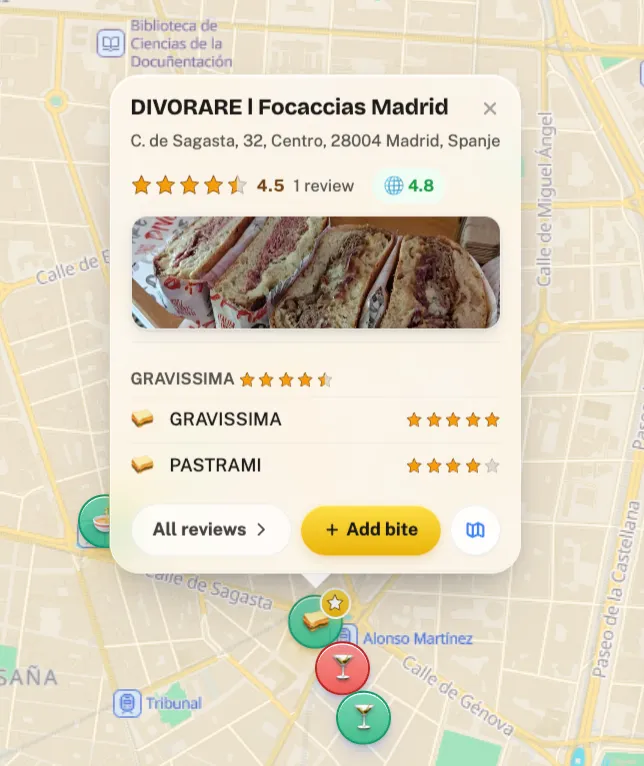
Crumble lines up with Letterboxd piece for piece more than anything else on this list. The rating scale goes finer: 0–5 stars in tenth-of-a-star increments, and Crumble applies it per dish as well as per restaurant, so your diary entry records that the tonkotsu was a 4.5 while the gyoza limped to a 2.5. The diary itself takes the form of a map: every place you review becomes a pin, and because there is no scraped points-of-interest database, the map contains only places real people actually reviewed. It fills up the way a Letterboxd profile does, one log at a time.
The social model is the part Letterboxd users tend to miss most in food apps: Crumble is friends-only by default. You see the spots and ratings of people you follow (three signals per place: your friends average, the Crumble-wide average, and public Foursquare data for context), and strangers see nothing of yours. Wishlists cover the watchlist mechanic, reviews earn XP across 30 levels for the completionists, and it all runs free in the browser as an installable web app, with EU hosting, no paid ads, and GDPR compliance.
Where it's not for you: if the part of Letterboxd you love is the crowd (big public profiles, popularity charts, discovery driven by thousands of strangers), Crumble is deliberately the opposite of that, and Beli will suit you better.
2. Beli: the profile flex, but ranked
Beli is the biggest name in restaurant tracking, and it captures the social gravity of Letterboxd: the profile that shows off your taste, the feed of friend activity, the pull of comparing lists. But mechanically it diverges on the core question: Beli doesn't do independent star ratings. Every restaurant you log is ranked against everything else you've eaten through head-to-head comparisons, producing a personal top-100. That makes it more like a leaderboard than like Letterboxd, where a quiet 3.5 can sit in your diary without fighting anything for position.
Trade-offs: the ranked model is genuinely fun if you think competitively about food, and Beli's community is the largest here. But there's no tenth-of-a-star nuance, no dish-level record, and the experience leans hard on leaderboards and streaks. If you want Beli's social energy with different mechanics, we compare the options in our Beli alternatives guide.
3. Truffle: the app that runs on this exact comparison
Truffle leans into the Letterboxd analogy harder than anyone: its own positioning is the social restaurant-tracking app where you log places, rate them, write reviews, and see where friends eat. Of the apps here it puts the most weight on the written review: if your Letterboxd habit is the paragraph, not just the stars, Truffle's journal-first framing will feel familiar, and its clean, focused design has won it a loyal following.
Trade-offs: it runs on iOS and Android but has no web version, so there is no writing reviews from a laptop, and the feature set is intentionally minimal: no dish-level ratings, no map-centric diary. A lovely journal; a narrower tracker.
4. Yummi: the diary as a camera roll
Yummi translates the diary visually: you log by photographing what you ate, and the photos become geotagged entries organized into a calendar and a map. If the thing you'd actually miss from Letterboxd is the poster grid (the wall of covers that is your history at a glance), Yummi's photo-first feed is the closest restaurant equivalent.
Trade-offs: ratings and structured reviews take a back seat to the visual timeline, so "was this place a 3 or a 4, and should we go back?" is harder to answer than "what did dinner look like in March?" It's also more food diary than venue tracker: a strength or a weakness depending on which page of this pair you should be reading.
5. Mapstr: the watchlist without the diary
Mapstr is a private place-bookmarking app: pin restaurants, bars, shops, anything, tag them freeform, share selections with friends. As a watchlist it's excellent. But it has no ratings at all (no stars, half or otherwise), so there is no diary, no "here's what I thought," no history of taste. In Letterboxd terms, it's the watchlist feature shipped as an entire app.
Trade-offs: if all you want is a beautiful private map of saved places, this is arguably the pick. If you want any part of the logging-and-rating loop that makes Letterboxd Letterboxd, it isn't here.
6. Google Maps saved lists: the zero-setup fallback
Already on your phone: star a place, drop it into "Want to go" or a custom list, share a list link with a friend. As a starting point it costs nothing and syncs everywhere, and for a handful of places it's genuinely enough.
Trade-offs: there's no personal rating scale, no diary of visits, no notes structure, and no friend feed; the Letterboxd resemblance ends at the watchlist. Most people outgrow it around the fiftieth saved star; our best restaurant tracking apps guide covers the wider field.
Which app, by the part of Letterboxd you love
- The diary: logging everything, tenth-of-a-star steps, a private record → Crumble. Same scale, per-dish depth, and the diary is a map that only your friends can see.
- The top-4 profile flex: your taste as a public artifact → Beli. Ranked lists are built for exactly that kind of showing off.
- The reviews-as-essays habit → Truffle, if you are happy writing them on your phone.
- The poster wall: history you can see → Yummi's photo feed.
- Just the watchlist → Mapstr, or Google Maps lists if you don't want another app.
And if your mental model is shelves and to-read piles rather than a film diary, the same exercise for Goodreads lands slightly differently; see Goodreads for food.
How we chose these apps
We build one of these apps ourselves, so we know the category from the inside and we carry an obvious conflict of interest. Two rules keep this list honest. First, every competitor description comes from the app's own published positioning (its website and its App Store or Play Store listing), not from our opinion of it. Second, the frame is fixed and checkable: we scored each app against the five Letterboxd mechanics named at the top (diary, tenth-of-a-star ratings, lists, friends feed, reviews), and an app made the list if it credibly delivers at least one of them for restaurants with a usable free tier. We excluded review-aggregation platforms like Yelp and TripAdvisor, because reading strangers verdicts is a different job from keeping your own diary. Where a competitor is the better pick (Beli for the ranked-list flex, Truffle for review-writing on your phone, Yummi for a visual feed), we've said so by name in its section.
Frequently asked questions
Is there a Letterboxd for restaurants?
Yes. Several apps fill the role, each borrowing a different Letterboxd mechanic. Crumble is the closest mechanical match (the same 0–5 scale in tenth-of-a-star steps, a diary of visits plotted on a map, and a friends-only audience). Beli translates the profile-flex side with ranked lists, and Truffle explicitly markets itself as a Letterboxd-style social restaurant journal on iOS and Android.
Can I rate restaurants with tenth-of-a-star steps like on Letterboxd?
Yes. Crumble uses the exact same 0–5 scale in tenth-of-a-star steps Letterboxd uses for films, and applies it per dish as well as per restaurant, so a 4.5 bowl of ramen and a 2.5 dessert at the same place both get recorded. Most other restaurant apps use whole stars, ranked lists, or no ratings at all.
Is Beli like Letterboxd?
It depends on which part of Letterboxd you mean. Beli captures the social, competitive side: a profile that shows off your taste, friend activity, leaderboards. But its core mechanic is the ranked list: every restaurant is slotted above or below the others, producing a personal top-100. That's closer to a leaderboard than to Letterboxd's independent tenth-of-a-star ratings and diary.
Can I keep my restaurant diary private?
Yes, but the apps differ a lot here. Crumble is friends-only by default: strangers cannot see your spots, reviews, or profile, and there is no public feed. Most other restaurant trackers are built around a public or semi-public community, with privacy as an opt-in setting rather than the starting point.
Does Letterboxd itself have a restaurant version?
No. Letterboxd is film-only and has not released a restaurant product. Every "Letterboxd for restaurants" is an independent app borrowing the model: a log of visits, personal ratings, lists, and a feed of what friends thought.
Start your restaurant diary today
Crumble is free, friends-only by default, and uses the 0–5 scale with tenth-of-a-star precision you already think in. It runs in the browser you have open right now. Your first diary entry takes under a minute.