
6 Best Mapstr Alternatives in 2026
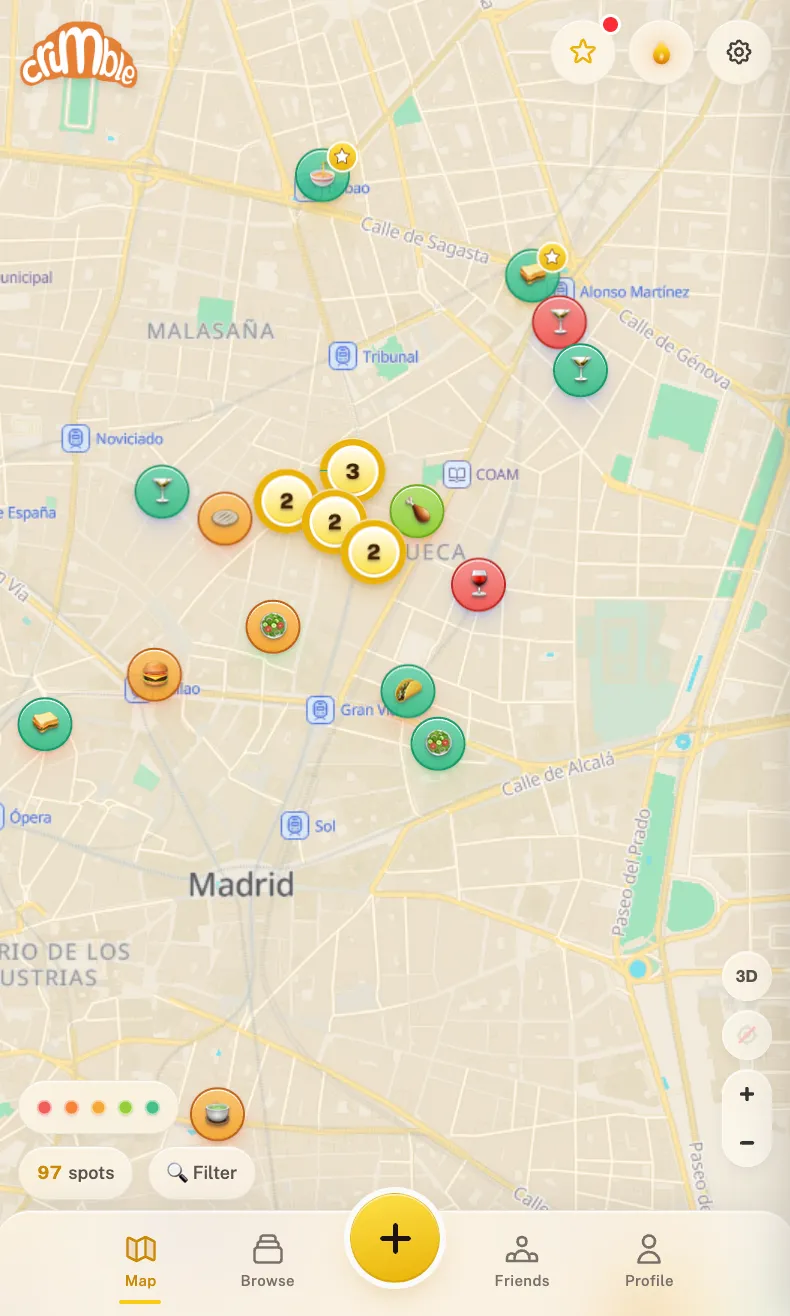
The best Mapstr alternative depends on what you save: Crumble for restaurants and dishes with friends, Google Maps for every kind of place, Wanderlog for trip planning, and Swarm for check-in history. Mapstr is a lovely private map: you pin restaurants, bars, shops, and viewpoints, tag them however you like, and share selections with friends. But its flexibility is also its ceiling: freeform tags mean no rating scale, no structured notes, no automatic split between places you've been and places you want to go, and the free tier caps out at 300 saved addresses.
This guide compares six apps like Mapstr: what each one does that Mapstr doesn't, what you give up by switching, and which kind of saver each one fits. If your pins are mostly food, there's a clear upgrade path; if they're a mix of everything, we'll be honest about when you should simply stay put.
The alternatives at a glance
| App | Best for | Platforms | Privacy model | Price |
|---|---|---|---|---|
| Crumble | Food spots: dish ratings + a friends map | Web app (installs on iOS, Android, desktop) | Friends-only by default | Free |
| Google Maps lists | Zero-setup saving of any place | Everywhere | Private lists, optional sharing | Free |
| Wanderlog | Turning saved places into trip plans | iOS, Android, web | Private trips, invited collaborators | Free (Pro tier) |
| Beli | Restaurant-only social ranking | iOS, Android | Social feed, leaderboards | Free |
| Swarm | A check-in history of everywhere you go | iOS, Android | Friends feed, private history | Free |
| Rexby | Saving spots from local travel creators | iOS, Android, web | Trips shared with invited friends | Free |
1. Crumble: best Mapstr alternative for restaurants and dishes
Crumble is what Mapstr's food pins want to grow up into. It's a friends-first food tracker: you rate the restaurants you visit (and the individual dishes you ordered there), keep a wishlist of places to try, and see your friends spots on a shared map. It's the structure Mapstr leaves you to fake with tags, built in.
What it adds over Mapstr:
- Real ratings, per dish. Instead of a "loved it" tag, every dish gets a 0–5 star rating in tenth-of-a-star steps, so next time you know to order the ramen and skip the gyoza.
- Visited vs. wishlist, automatically. Mapstr users typically maintain "been" and "to try" tags by hand. In Crumble the wishlist clears itself the moment you log a review at that place.
- A real friend layer. Your friends rated spots appear on your shared map, with three rating signals per place: your friends average, the Crumble-wide average, and public Foursquare data for context.
- Private by default. Friends-only, EU-hosted, GDPR-compliant, no paid ads, no data selling. More on this model in our guide to private restaurant list apps.
- No install, no save cap. It's a free installable web app: open it in any browser and add it to your home screen. Tracking, ratings, wishlist, and the friends map are all on the free tier.
Where it's not for you: Crumble only tracks food and drink. If half your Mapstr pins are concept stores, viewpoints, and climbing gyms, keep Mapstr or Google Maps for those: Crumble is the upgrade specifically for the eating half of your map.
2. Google Maps saved lists: best zero-setup alternative
The most obvious Mapstr alternative is already on your phone. Google Maps lets you flag any place, food or otherwise, into "Want to go", "Favorites", or custom lists, and share a list with anyone by link. It's free, has no save cap worth worrying about, and works on every platform you'll ever touch.
Trade-offs: it's a bookmark drawer, not a record. There's no personal rating scale, no notes structure, and no friend layer beyond manually sending list links. Your pins also live inside an interface built to recommend and advertise, not to remember. As a like-for-like Mapstr replacement it's the closest free match; as a memory system it has the same gaps Mapstr does.
3. Wanderlog: best for turning saved places into trip plans
Wanderlog approaches place-saving from the travel-planning side: you collect restaurants, sights, and hotels for a destination, then organize them into a day-by-day itinerary on a map, complete with routes and reservations, and invite travel companions to edit along. If your Mapstr map is really a pile of future trips, this is the tool that pile wants to become.
Trade-offs: Wanderlog is organized around trips, not around an ongoing map of your life. For remembering the taco place in your own neighborhood (or building a permanent record of everywhere you've eaten), a tracker beats an itinerary planner. Some conveniences sit behind the paid Pro tier.
4. Beli: best restaurant-only social ranking
Beli drops everything that isn't a restaurant and goes deep on ranking: instead of star-rating places in isolation, you rank each one against everywhere else you've eaten, producing a personal top list. Around that it builds maps of visited and want-to-try places, a friend feed, leaderboards, and recommendations from a genuinely large community.
Trade-offs: it's the opposite of Mapstr's quiet privacy: the experience is built around the social graph, streaks, and a public-facing feed. If that energizes you, it's the strongest social pick here. If you left Mapstr looking for structure but want to keep the small-circle feel, Crumble is the closer fit. We compare more options in our roundup of the best restaurant tracking apps.
5. Swarm: best for a check-in history of everywhere you go
Swarm, Foursquare's check-in app, answers a different question than Mapstr: not "where do I want to go?" but "where have I been?" Every check-in lands in a lifelong, searchable logbook (the café in Lisbon, the dive bar from your birthday) with streaks and mayorships layered on for fun.
Trade-offs: a check-in is a timestamp, not an opinion. There's no meaningful rating or note structure, and no forward-looking wishlist: Swarm records your past rather than planning your future. If the check-in habit is what you're after but for meals specifically, see our guide to Swarm alternatives for food check-ins.
6. Rexby: best for saving spots from local travel creators
Rexby flips the direction of the map: instead of pinning places you found, you pull in spots from guides made by local travel creators, save them to a trip, and plan with friends. It's Mapstr's "follow other people's maps" idea made the whole product, on web and mobile.
Trade-offs: Rexby is for discovering a destination through someone else's taste, not for building your own record: there's no personal rating history to grow. It pairs well with a tracker rather than replacing one.
Which one should you pick?
- Your Mapstr pins are mostly restaurants and cafés → Crumble. Dish ratings, a self-clearing wishlist, and a friends-only map are exactly the missing structure.
- You save everything: shops, viewpoints, bars, food → stay with Mapstr, or use Google Maps lists if the 300-pin cap or pricing pushes you out.
- Your saved places are really future trips → Wanderlog.
- You want a big community and love ranking restaurants → Beli.
- You want a life logbook of everywhere you've set foot → Swarm.
- You'd rather start from a local's map than a blank one → Rexby.
Whichever you choose, the app matters less than the habit: log the place while you're still there. For a system that survives the switch between apps, see how to keep track of restaurants you've been to.
How we chose these apps
We build a food tracker ourselves, which means we know this category from the inside, and that we have an obvious conflict of interest. To keep the list honest, every competitor description is drawn from the app's own published materials: its website, App Store or Play Store listing. We included an app when it (a) lets you save specific places to a map or list of your own, (b) lets you get those places back when you need them (by search, map, or trip) and (c) offers a usable free tier. We deliberately picked apps that solve different jobs, because "Mapstr alternative" means different things to different people: some want more structure for food, some want trip planning, some just want out of the save cap. Where Mapstr itself remains the better choice (mixed maps of food and non-food places), we say so plainly rather than pretending our app covers everything.
Frequently asked questions
What is the best Mapstr alternative?
It depends on what you save. If your pins are mostly restaurants, Crumble adds the structure Mapstr lacks: per-dish ratings, a visited-versus-wishlist split, and a friends-only shared map. If you save every kind of place (shops, viewpoints, bars), Google Maps saved lists are the closest free equivalent. For trip planning, Wanderlog; for check-in history, Swarm.
Is Mapstr free?
Yes, with a cap. Mapstr's free version saves up to 300 addresses with no ads. Unlimited saves and extras like the web version, map overlays, and proximity alerts require the paid Mapstr Plus subscription. If you expect to pass 300 pins, factor that into your choice.
Is Crumble better than Mapstr for restaurants?
Yes, if food is the main thing you save. Crumble rates individual dishes on a 0–5 scale with tenth-of-a-star precision, keeps visited places separate from a wishlist that clears itself when you review, and shares your map with friends only. For non-food places (shops, parks, viewpoints), Mapstr or Google Maps remains the better tool, because Crumble only tracks food and drink.
Can I share my saved places with only certain friends?
Yes. Crumble is friends-only by default: your spots and reviews are visible to the people you connect with and nobody else (there is no public feed). Mapstr and Google Maps both let you share selected lists or maps with chosen people, while Beli and Swarm are built around a broader social feed.
Do any Mapstr alternatives separate visited places from a wishlist?
Yes. This is the most common reason people leave Mapstr, where 'been' and 'want to go' are just tags you maintain by hand. Crumble makes the split structural: wishlist entries clear automatically the moment you log a review at that place. Google Maps approximates it with separate 'Want to go' and 'Favorites' lists, but you move places between them manually.
Put your food spots on a smarter map
Crumble is free, friends-only by default, and runs in the browser you already have: no save cap, no paid ads. Your first spot takes under a minute to log.