
Google Maps Lists Alternative: 6 Better Ways to Save Restaurants
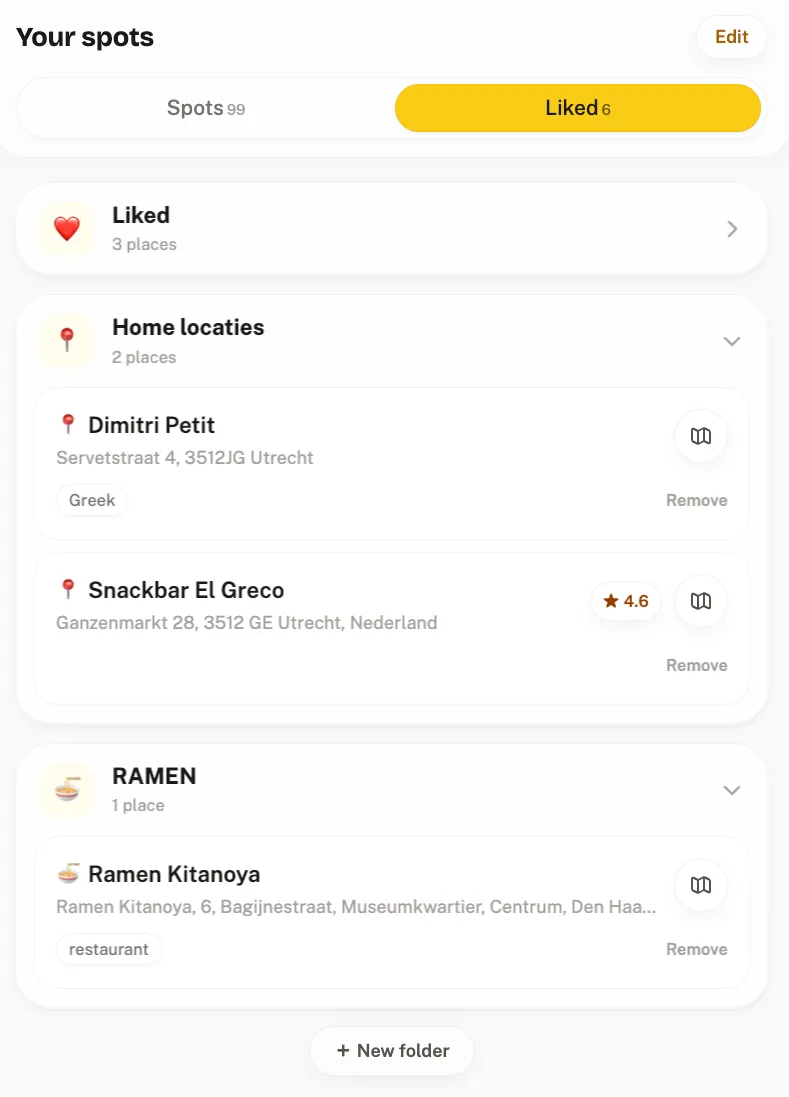
Google Maps lists are a bookmark drawer, not a record. They save a place but hold no rating, no dish notes, and no memory of whether you liked it. The fix is a food tracker: Crumble for friends-only dish ratings, Beli for ranking, Mapstr for mixed saves, Notion for full control.
Nothing is broken. Saving places to "Favourites" or "Want to go" is free, instant, and already on your phone. It is the most-used restaurant list in the world for good reason. The trouble starts at about pin number fifty, and it is always the same four problems:
- Been and want-to-go blur together. Google gives you both lists, but nothing moves a place from one to the other. You have to remember to do it, and nobody does, so "Want to go" slowly fills with restaurants you already ate at two years ago.
- There is no verdict. A pin records that you were interested. It does not record that the pasta was extraordinary and the service glacial. Six months later the pin looks identical to the one you saved from an ad.
- You cannot search what matters. "Show me everywhere I rated above a 4" and "which of these does Anna also like" are the two questions you actually ask. A list of pins answers neither.
- Sharing is one-directional. You can send someone a link to a whole list. There is no shared layer where your friends verdicts show up on your map as you walk past a place.
A list is a queue. What most people want after a few years of eating out is an archive, and those are different data structures with different jobs.
The alternatives at a glance
| Tool | Best for | Ratings | Friend layer | Price |
|---|---|---|---|---|
| Crumble | Rating dishes, shared with friends | 0–5 per dish, tenth-of-a-star | Friends-only shared map | Free |
| Beli | A ranked list of everywhere you have been | Ranked, not scored | Public feed, leaderboards | Free (paid tier) |
| Mapstr | Saving every kind of place, not just food | Freeform tags | Share selections | Free (300-address cap) |
| Truffle | A quiet phone diary | Restaurant-level notes | Shareable lists | Free (paid tier) |
| Rex | Recommendations built from your taste | Saves, not scores | Friends you follow | Free |
| Notion | Total control over the fields | Whatever you build | Share the page | Free (personal) |
| Google Maps lists | Zero setup, any kind of place | None | Send a link | Free |
1. Crumble: best if the list is mostly restaurants
Crumble is the map you already have, plus the four things it is missing. Places you have been carry a real score, the dishes carry their own, the wishlist maintains itself, and your friends verdicts sit on the same map as yours.
- A score fine enough to be useful. Restaurants and individual dishes are rated 0–5 in tenth-of-a-star steps. Next visit, your own history tells you to order the ramen and skip the gyoza, the single thing a pin can never do.
- The wishlist clears itself. Save a place, review it later, and the wishlist entry disappears on its own. The "Want to go" rot simply cannot happen.
- Three signals per place, not one star average. Your friends average, the Crumble-wide average, and public Foursquare data, so you can tell a place your friends love from a place the internet loves.
- It installs like an app, without an app store. Open it in any browser on iPhone, Android or desktop and add it to your home screen. Same account everywhere.
- Private by default. Friends-only, EU-hosted, GDPR-compliant, no ads, no data selling, GPS coordinates stripped from every uploaded photo: a different bargain from a map funded by advertising. See our guide to private restaurant list apps.
Where Google Maps wins: everything that is not food. Crumble tracks restaurants, bars and cafés and nothing else, so your hardware shop, climbing gym and favourite viewpoint should stay exactly where they are.
2. Beli: best for turning the pile into a ranking
Beli answers the question a long list makes hardest: which of these was actually best? Every new visit is compared against places you have already been, and the answers sort a personal ranking. See Beli alternatives.
Trade-offs: restaurant-level only, and built around a social feed with streaks and leaderboards. Quiet it is not.
3. Mapstr: best when food is only part of the map
If your saved pins are a genuine mix (bars, shops, viewpoints, restaurants), Mapstr is the closest like-for-like upgrade: a private map organised by tags you invent, with a nicer interface than the one Google gives you. More in Mapstr alternatives.
Trade-offs: tags are not ratings. You still get no score, no dish notes, and no automatic been-versus-want-to-go split: the same three gaps you left Google Maps to fix. The free tier stops at 300 addresses.
4. Truffle: best minimalist phone diary
Truffle is the small, quiet option: a clean restaurant diary for iOS and Android that leans on the places you already save from Instagram. Good if the Google Maps list is really an Instagram list in disguise. There is no web version, and notes stay at restaurant level. See Truffle alternatives.
5. Rex: best if the problem is choosing, not remembering
Some people's "Want to go" list is not a memory problem at all, it is a decision problem: two hundred options and no way to pick. Rex learns your taste from what you save and answers "where should I go tonight" accordingly. More in Rex alternatives.
Trade-offs: like Google Maps, it saves rather than scores, so it solves the choosing problem and leaves the remembering one open.
6. Notion: best if you want to design the fields yourself
A Notion database gives you exactly the columns you want: cuisine, price, who you went with, the dish you would reorder, a rating scale of your own design. Nothing else on this list is that flexible. We built a full template in our guide to the Notion restaurant tracker.
Trade-offs: it is a database, not a map. Adding a place takes real effort at the table, there is no proximity search when you are standing on a street corner, and a tracker you do not update is worth less than a messy pin list you do.
How to move your saved places out of Google Maps
You do not have to migrate anything, and trying to is usually what kills the switch. The approach that works:
- Leave the old lists alone. They cost nothing to keep and they stay useful as an archive of things you were once curious about.
- Start the new tracker from today. Log the next place you eat at, not the last two hundred. A month of real entries beats a backfilled list you do not trust.
- Move only the live wishlist. Skim "Want to go" for the ten or fifteen places you genuinely still intend to visit and add those. Everything older than a year is aspiration, not a plan.
- Export if you want a backup. Google Takeout will hand you your saved places as a file, which is worth doing once regardless of which app you land on.
How we compared these tools
We use Crumble daily and have several thousand dishes logged in it, so the judgements here come from living with these workflows rather than reading feature grids. Each tool was tested against the four failures listed at the top: does it separate been from want-to-go; does it record a verdict; can you search by that verdict; and do your friends opinions appear on your own map. Competitor features come from published documentation and store listings, checked in August 2026, and anything we could not verify was left out rather than guessed.
When you should just keep using Google Maps
Genuinely often. If your list holds fewer than thirty places, the problems above have not started yet and a second app is overhead you do not need. If what you save is mostly not restaurants, no food tracker will cover it. And if you only ever need "somewhere near me that is open now", Maps is better at that than anything on this list and always will be.
Switch when the list has stopped answering the question you are actually asking, which, for most people, turns out to be "was it any good?" rather than "where is it?"
Frequently asked questions
How many places can a Google Maps list hold?
A saved list holds up to 3,000 entries, which is far more than most people ever reach. The practical limit arrives long before the technical one: somewhere around fifty pins the list stops being searchable in any useful way, because pins carry no rating, no dish notes and no record of whether you already went.
What is the best alternative to Google Maps lists for restaurants?
Crumble, if the list is mostly food. It rates restaurants and individual dishes 0–5 in tenth-of-a-star steps, keeps a wishlist that clears itself when you review a place, and shows your friends rated spots on a shared friends-only map. Beli is the strongest option if you would rather rank places than score them, and Mapstr is the closest match if you save more than restaurants.
Can I export my saved places from Google Maps?
Yes. Google Takeout exports your saved places and lists as a file you can download. It is worth doing once as a backup. Most food trackers do not offer a matching import, though, so in practice people start the new app from today and keep the old lists as an archive rather than migrating everything across.
How do I separate restaurants I have visited from ones I want to try?
In Google Maps you maintain it by hand, moving places between "Want to go" and another list, which is why the two blur together over time. Crumble handles it automatically: a place stays on the wishlist until you write a review for it, at which point the wishlist entry disappears on its own and the place joins your map of visited spots.
Is there a free alternative to Google Maps lists?
Yes. Crumble is free on its core features (tracking, ratings, wishlist and the friends map) and an optional Plus tier is planned but not on sale yet. Beli, Truffle and Rex all have free tiers as of August 2026, and a personal Notion workspace is free too. Mapstr is free up to 300 saved addresses.