
4 Best Distiller Alternatives in 2026
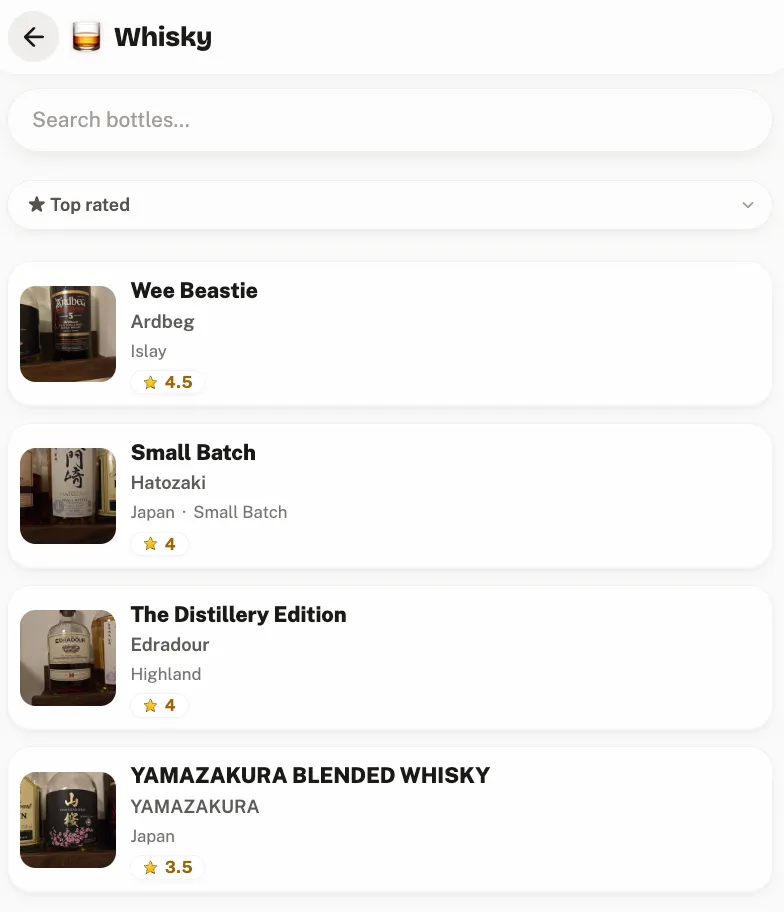
Distiller is a discovery engine: it tells you what to buy next. If what you want instead is a record of what is on your shelf and what you thought of each pour, the alternatives split three ways: Crumble for a private scored journal, Whiskybase for the deepest bottle database, Whiskey Social for the community.
Distiller holds close to 60,000 spirits with flavour profiles, expert ratings and a recommendation engine that learns what you like. Its "Flavor Profile" charts are genuinely good: a quick visual read on whether a bottle is smoky, sweet or spicy before you spend eighty euros on it. Millions of community reviews sit behind that.
The gap opens once you own the bottle. Distiller is organised around spirits that exist, not around your shelf: there is no natural home for "I opened this in March, it was tight, and by August it had come alive." That is the note that makes a whisky journal worth keeping, and it is why people search for apps like Distiller a year or two in.
The alternatives at a glance
| Tool | Best for | Bottle database | Your notes | Price |
|---|---|---|---|---|
| Crumble | A private, scored whisky journal | You add bottles yourself | Six flavour axes and a 0–5 score | Free |
| Whiskybase | The deepest bottle reference anywhere | Very large, community-built | Ratings and notes, public | Free (paid tiers) |
| Whiskey Social | A community feed for drams | Large | Ratings and posts | Free |
| Distiller | Deciding what to buy next | ~60,000 spirits | Rating + review | Free (Pro tier) |
| A spreadsheet | Total control, no features | None | Whatever you build | Free |
1. Crumble: best for a shelf you actually keep
Crumble inverts Distiller's model. Instead of a catalogue you browse, it is a shelf you build: one entry per bottle, with every dram you pour recorded underneath it over the years.
- Six flavour axes per dram (sweetness, smoke, fruit, spice, oak and finish), scored alongside an overall 0–5 rating in tenth-of-a-star steps. Same discipline as a Distiller flavour profile, except it is your palate rather than an aggregate.
- The bottle opens, changes and empties. Because sessions hang off a bottle rather than replacing each other, a dram in March and a dram in August sit side by side and you can see oxidation doing its work. No catalogue app models this.
- Bars and distilleries on the map. The whisky bar that poured you a 25-year-old you will never own is a place you can rate too, on the same map that holds your restaurants.
- Friends-only. Your shelf is visible to people you have accepted and to nobody else. EU-hosted, GDPR-compliant, no ads, no data selling.
- One app for the rest of the shelf. Wine, beer, coffee, tea and matcha use the same six-axis structure, so a whisky drinker who also buys coffee is not running five apps. Method in full: how to track whisky.
One honest caveat. There is no 60,000-bottle catalogue: you type the bottle in the first time you pour it, which takes about twenty seconds and is the price of not depending on someone else's database.
What to record for each bottle
Whichever tool you land on, the fields below are the ones that turn out to matter years later. A catalogue app fills most of them for you and loses the last two; a journal asks you to type them and keeps all of them.
- Distillery and bottler. Not the same thing: an independent bottling of the same distillate can taste nothing like the official release, and this is the single field most people wish they had recorded.
- Age, vintage and bottling year. A 12-year-old bottled in 2009 and one bottled in 2024 are different whiskies. Age alone does not identify a release.
- Cask type. Ex-bourbon, sherry butt, refill hogshead, a finish. This explains more of what is in the glass than the region does.
- ABV, and whether it is cask strength. Worth capturing because it changes how you should score; see the note on water below.
- When you opened it. The field no catalogue app has, and the one that makes re-tasting meaningful: oxidation is measured from this date.
- What you paid. Two years on, this is the only way to answer whether a bottle was worth it, and the only honest input into whether to buy it again.
One habit worth more than any of the fields: score the dram before you add water. Water changes a whisky substantially and inconsistently, so a shelf where half the scores are pre-water and half post-water cannot be ranked against itself.
2. Whiskybase: best bottle reference on the internet
Whiskybase is the reference work. Its community has catalogued an enormous number of bottlings (including independent bottlers, single casks and long-dead releases that no commercial app carries), with label photos, cask details and market values. If you collect rather than merely drink, this is the one that answers "what exactly is this bottle".
Trade-offs: it is a database and a marketplace-adjacent community before it is a personal journal, the interface is dense, and your notes live in public. We compare it directly in Whiskybase alternatives.
3. Whiskey Social: best for the community feed
If what you liked about Distiller was seeing what other people were drinking, Whiskey Social leans hardest into that: a feed of drams, ratings and conversation, closer in shape to Untappd than to a reference database.
Trade-offs: a feed is a poor archive. Posts scroll away, and there is no structured place for the same bottle re-tasted six months apart, which is the specific thing a whisky journal exists to capture.
4. A spreadsheet: still defensible for collectors
Plenty of serious collectors run a spreadsheet and nothing else: bottle, distillery, age, cask, ABV, bottling date, purchase price, current value, and a column per flavour axis. It is the only option here that will still open in twenty years, and the only one that handles the collection-value side properly.
Trade-offs: no photos, no map, no lookup, and typing on a phone with a dram in the other hand is exactly the friction that kills journals. Good as an annual export; poor as the thing you reach for at 10pm.
Can you bring your Distiller notes with you?
Partly, and it is worth being precise. Crumble's importer auto-detects only Untappd (beer) and Vivino (wine) exports; there is no whisky-shaped importer. What it does do is match column headers case-insensitively, so any CSV you can produce will load once its columns are renamed:
| Rename your column to | And it becomes |
|---|---|
beer_name | The bottle name |
brewery_name | The distillery |
beer_style | Region or style |
beer_abv | ABV |
rating_score | Your score |
comment | Your tasting note |
created_at | The date |
The headers are beer-shaped because that is the importer's original job, and that has a consequence: a file renamed this way is detected as an Untappd export, so its rows (up to 2,000 in one go) land in the Beer journal, not the Whisky journal. Scores are not rescaled either; anything above 5 is capped at 5. There is no import into the whisky journal today, so the honest path is to re-log the bottles you still care about and keep your Distiller data as an archive.
How we compared these
We keep our own whisky shelf in Crumble and have scored several hundred drams on the six axes, so the judgements about re-tasting and oxidation come from doing it rather than reasoning about it. Each alternative was measured on four things: does it record your palate or an aggregate; does the same bottle accumulate history or get overwritten; who can see your notes; and what happens to them if the company folds. Competitor features come from published material and store listings, checked in August 2026, and anything unverifiable was left out.
When to keep using Distiller
Standing in a shop in front of forty bottles you do not recognise, Distiller is the best tool on this page and it is not close: the flavour profiles and recommendations are exactly right for that moment. Nothing here replaces it for buying. The case for a journal starts after the cork comes out.
Plenty of people sensibly run both: Distiller to choose, a shelf to remember.
Frequently asked questions
What is the best alternative to the Distiller app?
It depends what you want from it. For a private journal that scores your own palate, Crumble records six flavour axes per dram (sweetness, smoke, fruit, spice, oak and finish), plus an overall 0–5 rating in tenth-of-a-star steps, with every pour from a bottle kept together over time. For the deepest bottle reference, including independent bottlings and single casks, Whiskybase is unmatched. For a community feed, Whiskey Social.
Is Crumble free for whisky?
Yes. Every drink add-on is free (whisky, wine, beer, coffee, tea and matcha), alongside the food tracking, ratings, wishlist and friends map. The optional Crumble Plus tier, planned but not on sale yet, will add an AI label scan that fills in distillery, origin and style from a photo of the bottle; the journal itself costs nothing.
Can I import my Distiller ratings into another app?
There is no direct Distiller importer in Crumble; only Untappd and Vivino exports are auto-detected. A CSV with its columns renamed to beer_name, brewery_name, rating_score and comment will load, up to 2,000 rows at once, but it is read as an Untappd export and the rows land in the Beer journal, not the Whisky journal. There is no import into the whisky journal today, so re-log the bottles you care about and keep the old data as an archive.
Which app is best for tracking a whisky collection's value?
A spreadsheet, or Whiskybase. Whiskybase tracks market values across an enormous catalogue of bottlings, which is the reason collectors use it. Crumble is a tasting journal rather than an asset register: it scores what a dram tasted like, not what the bottle is worth.
How should I score the same bottle twice?
Log it as a second session on the same bottle rather than a new entry. Whisky changes in an opened bottle (oxidation flattens some and opens others), so a dram scored in March and the same bottle in August is real information, not a duplicate. Score before adding water, and re-taste your favourites blind if you can; both habits are covered in our guide to tracking whisky.