
The best Japanese whisky distilleries
For most of its modern history, the phrase "Japanese whisky" carried no guarantee at all. Japan's liquor tax law defined it so loosely that a great deal of product sold under Japanese-looking labels was imported bulk Scotch or other foreign whisky, blended and bottled in Japan, sometimes with no Japanese distillate in the bottle whatsoever. That was legal, it was widespread, and it is why an older Japanese bottle cannot be trusted on appearance.
That changed in 2021, though less completely than most articles suggest. Below is what the standard actually requires, the two caveats that matter, and five distilleries that were never in any doubt because they have always distilled in Japan.
The short answer: Suntory's Yamazaki and Hakushu, Nikka's Yoichi and Miyagikyo, Chichibu, Mars Shinshu and Kirin's Fuji Gotemba. All five have always distilled in Japan, so the label question never applies to their own-distilled whisky (Kirin's one exception is covered below). For a first bottle, Nikka From The Barrel is the best value and easy to find; the table further down gives a starting bottle for each.
What the 2021 standard actually says
The Standards for Labeling Japanese Whisky were established by the Japan Spirits & Liqueurs Makers Association on 12 February 2021 and took effect on 1 April 2021. The core rule: a product labelled Japanese Whisky must be made from malted grain with water drawn in Japan, mashed, fermented, distilled, matured and bottled in Japan, with maturation in wood for a minimum period.
Now the two caveats, which are routinely left out.
First, it is voluntary. The standard carries no force of Japanese national law and binds only member companies of the association. A producer who is not a member can still legally sell blended imported whisky as "Japanese whisky" in Japan. The standard is an industry agreement, not a regulation, and that is a genuine difference from the Scotch Whisky Regulations 2009.
Second, there was a three-year transition. Producers already using the terms before 31 March 2021 could continue to do so on those products until 31 March 2024. Bottles predating compliance can still be sitting on shelves. In March 2025 the association added a certification logo for compliant products, which is now the quickest visual check. Look for that, or buy from distilleries whose whisky was never in question.
Best Japanese whisky distilleries at a glance
| Producer | Distilleries | Founded | Start with |
|---|---|---|---|
| Suntory | Yamazaki, Hakushu | 1923, 1973 | Distiller's Reserve, either one |
| Nikka | Yoichi, Miyagikyo | 1934, 1969 | Nikka From The Barrel |
| Chichibu | Chichibu, Saitama | 2008 | Ichiro's Malt & Grain World Blend |
| Mars | Shinshu, Nagano | 1985 | Komagatake, or Iwai Tradition |
| Kirin | Fuji Gotemba, Shizuoka | 1973 | Fuji Single Grain |
Suntory: where Japanese whisky starts
Yamazaki was founded in 1923 by Shinjiro Torii and is Japan's first malt whisky distillery. Hakushu followed in 1973, built under Keizo Saji exactly half a century later, high in the forests of Yamanashi. Both are Suntory-owned.
They are deliberately unalike. Yamazaki is sherried and incense-like, dried fruit and temple wood, with mizunara, Japanese oak, giving that sandalwood character at the top of the range. Hakushu is the opposite: green and cool, cucumber and mint, with a fine wisp of smoke through it. Drinking the two side by side is the single best introduction to what Japanese whisky can do.
Buy a Distiller's Reserve from either, both of which carry no age statement and are actually purchasable. The age-stated Yamazaki mizunara bottlings are extraordinary and priced in the thousands, which is a fact about the market rather than about the whisky.
Nikka: the last coal fires in the world
Yoichi was founded in 1934 by Masataka Taketsuru, who had studied chemistry and apprenticed in Scotland and had already built Yamazaki for Torii before leaving to do it his own way in Hokkaido. Miyagikyo was distilling from spring 1969.
The best single fact in Japanese whisky belongs to Yoichi: it is the last distillery in the world using direct coal-fired pot stills, with fires reported above 1,000C. Nobody else does this, and you can taste why it survives. Yoichi is muscular, peated and saline with a coal-smoke edge no other distillery produces. Miyagikyo is its soft, fruity, sherry-inflected counterpart, almost Speyside-like.
The headline recommendation for most readers is Nikka From The Barrel, a blend at 51.4%, which is comfortably the best value Japanese whisky on the market and easy to find. Nikka is part of Asahi Group Holdings, which first invested in 1954.
Chichibu: the most important independent in Japan
Saitama. Operations began February 2008, founded by Ichiro Akuto, grandson of the founder of the closed Hanyu distillery. Venture Whisky remains independent, and Chichibu is the most consequential independent producer in the country.
Its production signature is genuinely unusual: washbacks made of mizunara. Japanese oak is normally reserved for casks, not fermentation vessels, and using it at the fermentation stage is a real and deliberate choice. The whisky is intense and concentrated rather than old, spicy and fruity, with mizunara incense running through everything. A second distillery, Chichibu II, released its first single malt in 2025.
The problem is availability. Chichibu's own single malts are allocated and expensive, and the realistic bottle for most readers is Ichiro's Malt & Grain World Blend, which is genuinely good and genuinely buyable. Anything labelled Chichibu The First, On The Way, or a Hanyu Card Series bottle is collector territory at four figures and up.
Mars Shinshu: the nineteen-year gap
Nagano. Shinshu Distillery was founded in 1985 by Hombo Shuzo, a family shochu house from Kagoshima, and it is still independent. The detail that explains everything about Mars is this: whisky production halted in 1992 as demand collapsed and did not resume until 2011.
That nineteen-year hole is why aged Mars stock is patchy and why age-stated Komagatake from pre-1992 distillation is chased so hard. It is also a reminder that the Japanese whisky boom is recent and that the industry nearly died in between.
Komagatake is clean and cool-climate, malty with light fruit in a restrained oak frame. Buy the annual Komagatake release, or Iwai Tradition as the blended value option.
Kirin Fuji Gotemba: the grain whisky specialist
Gotemba, Shizuoka, at the foot of Mount Fuji. Opened in 1973 by Kirin-Seagram, a joint venture of Kirin Brewery, Seagram and Chivas Brothers, and now run by Kirin. The distillery sits about 620 metres up and draws its water from Mount Fuji.
What sets it apart is range under one roof. Next to a pot-still malt, Fuji Gotemba makes three different grain whiskies on three different still setups: a light column-still grain, a medium grain from a kettle still and a heavier, bourbon-style grain from a beer column and doubler. That is Seagram's grain experience and Chivas's malt experience in one building, and it makes Kirin the Japanese name to know for grain whisky.
The bottle to buy is Fuji Single Grain, which blends those three grain styles. One label check, and it is the argument of this page in miniature: Kirin Whisky Riku blends Fuji Gotemba whisky with imported whisky, so it does not qualify as Japanese whisky under the standard. Fine to drink, but check which Kirin bottle you are holding.
How to check a bottle of Japanese whisky
- Look for the certification logo. Added in March 2025, it is the fastest signal that a bottle meets the labelling standard.
- Remember the standard is voluntary. A producer outside the association is not bound by it, so the absence of a logo is not proof of anything either. It is a shortcut, not a guarantee.
- Treat pre-2024 stock with care. The transition allowed existing products to keep the old labelling until 31 March 2024, so old shelf stock can predate compliance.
- Be suspicious of a Japanese-looking brand with no named distillery. If a bottle will not tell you where it was distilled, that is usually the answer.
- Read "world blended" literally. It means whisky from several countries, blended in Japan. Ichiro's Malt & Grain World Blend, recommended above, combines Chichibu whisky with Scotch, Irish, Canadian and American whisky and says so on the label. That honesty is the point: it is a good blend, not Japanese whisky under the standard.
- Buy the blends without embarrassment. Nikka From The Barrel and Ichiro's Malt & Grain are better whisky than most of the allocated single malts people queue for, at a fraction of the price.
The full list, Hokkaido to Shizuoka
-
Suntory Yamazaki and Hakushu
Yamazaki founded 1923 by Shinjiro Torii, Japan's first malt whisky distillery; Hakushu 1973. Yamazaki is sherried and incense-led, Hakushu green and lightly smoky.
-
Nikka Yoichi and Miyagikyo
Yoichi founded 1934 by Masataka Taketsuru and the last distillery in the world using direct coal-fired pot stills. Miyagikyo distilling from 1969, soft and sherry-inflected.
View in Crumble: Nikka Yoichi and Miyagikyo Their site: Nikka Yoichi and Miyagikyo (opens in a new tab)
-
Chichibu Distillery
Saitama, operations from February 2008 under Ichiro Akuto. Independent, and uses mizunara washbacks, a genuine production signature. Intense and concentrated.
-
Mars Shinshu
Nagano, founded 1985 by Hombo Shuzo and still independent. Production halted 1992 and resumed 2011, which is why aged stock is patchy. Clean, cool-climate malt.
-
Kirin Fuji Gotemba
Gotemba, Shizuoka, opened 1973 by Kirin-Seagram at the foot of Mount Fuji. A pot-still malt plus three grain styles from three still setups. Start with Fuji Single Grain.
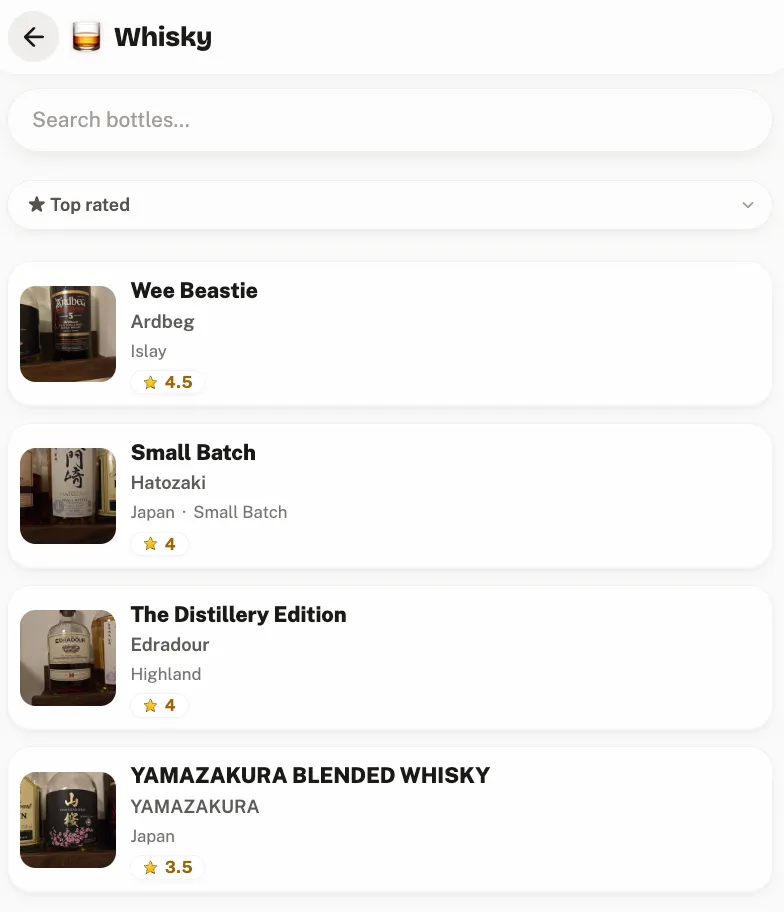
View in Crumble opens the map with that name already in the search, so you can find a bar or shop near you that pours it and log the dram yourself.
Write down what you actually drank
Japanese whisky is the category where a good record pays for itself, because the market is full of bottles that look similar and are not. Writing down the distillery, not just the brand, is the whole discipline. Crumble's whisky journal is a free add-on: a dated bottle shelf with distillery, region and cask, then a tasting per dram scored on six axes from smoke through finish.
Put a Yoichi and a Miyagikyo on the same six axes and the coal fires stop being trivia and start being a shape you can see. Matching free journals cover coffee, tea, matcha, wine and beer, and our whisky tracking guide covers the habit. The whisky tracking apps comparison covers the alternatives.
Frequently asked questions
Is all Japanese whisky actually made in Japan?
Not historically, and not guaranteed even now. Before 2021 Japan's liquor tax law was so loose that imported bulk Scotch blended and bottled in Japan could be sold as Japanese whisky, sometimes with no Japanese distillate at all. The 2021 labelling standard fixed this for member companies of the industry association, but it is voluntary and does not bind non-members.
What is the Japanese whisky labelling standard?
The Standards for Labeling Japanese Whisky, established by the Japan Spirits & Liqueurs Makers Association on 12 February 2021 and effective 1 April 2021. A product labelled Japanese Whisky must be made from malted grain using water in Japan, and mashed, fermented, distilled, matured and bottled in Japan. A certification logo was added in March 2025.
Does the 2021 standard have force of law?
No, and this is the most important caveat. It is a voluntary industry agreement that binds only member companies of the association, unlike the Scotch Whisky Regulations 2009 which are law. A non-member can still legally sell blended imported whisky as Japanese whisky in Japan.
Can old bottles still use the old labelling?
Yes. There was a three-year transition: products already using the terms before 31 March 2021 could continue until 31 March 2024. Bottles predating compliance can still be on shelves, so old stock deserves more scrutiny than new stock, not less.
What is the best value Japanese whisky?
Nikka From The Barrel, a blend bottled at 51.4 percent. It is widely available, considerably cheaper than the allocated single malts, and better than most of them. Ichiro's Malt & Grain World Blend is the other genuinely buyable bottle worth seeking out, and it is the realistic way to drink something Chichibu-associated.
What makes Yoichi different from other distilleries?
It is the last distillery in the world using direct coal-fired pot stills, with fires reported above 1,000C. That is not a marketing detail: it produces a muscular, peated, saline spirit with a coal-smoke edge nothing else has. Its sister distillery Miyagikyo is the opposite, soft and fruity and almost Speyside-like.
Which Japanese distilleries are independent?
Chichibu, run by Venture Whisky under Ichiro Akuto, is the most important independent producer in Japan. Mars Shinshu is owned by Hombo Shuzo, a family shochu house. Suntory, Nikka and Kirin's Fuji Gotemba are all group-owned, Nikka being part of Asahi Group Holdings, which first invested in 1954.