
Whiskybase Alternatives: 4 Whisky Apps for Your Own Tasting Notes
Whiskybase is a bottle database, a valuation tool and a marketplace, not a private tasting journal. If you want somewhere private to record what a dram actually tasted like, the alternatives are Crumble for a scored journal, Distiller for discovery and Whiskey Social for a community feed; if you want to buy and sell bottles elsewhere, auction sites such as Whisky Auctioneer and Catawiki cover that, and this page does not.
Whiskybase is the closest thing whisky has to a definitive catalogue. Its community has documented an enormous number of bottlings (official releases, independent bottlers, single casks, long-discontinued expressions) with label photographs, cask numbers, outturn figures and market values. If you need to identify precisely which release a bottle is, or what it is worth now, nothing else comes close and this guide is not going to pretend otherwise.
The reason people search for Whiskybase alternatives is that a catalogue answers "what is this bottle" and never answers "what did I think of it". The ratings and notes you post become part of the shared reference (private per-bottle notes need the paid Whiskybase Plus), the interface is built for reference rather than for a Tuesday evening with a glass, and there is no natural place to record that the bottle you opened in March tasted different by August.
The alternatives at a glance
| Tool | Best for | Your notes | Bottle data | Price |
|---|---|---|---|---|
| Crumble | A private scored tasting journal | Six flavour axes and a 0–5 score, friends only | You enter it | Free |
| Distiller | Deciding what to buy next | Rating + review, public | ~60,000 spirits | Free (Pro tier) |
| Whiskey Social | A community feed | Posts and ratings, public | Large | Free |
| Whiskybase | Identifying and valuing a bottle | Public; private notes with Plus | The deepest there is | Free (paid Plus) |
| A spreadsheet | Collection value you control | Yours alone | None | Free |
1. Crumble: best private tasting journal
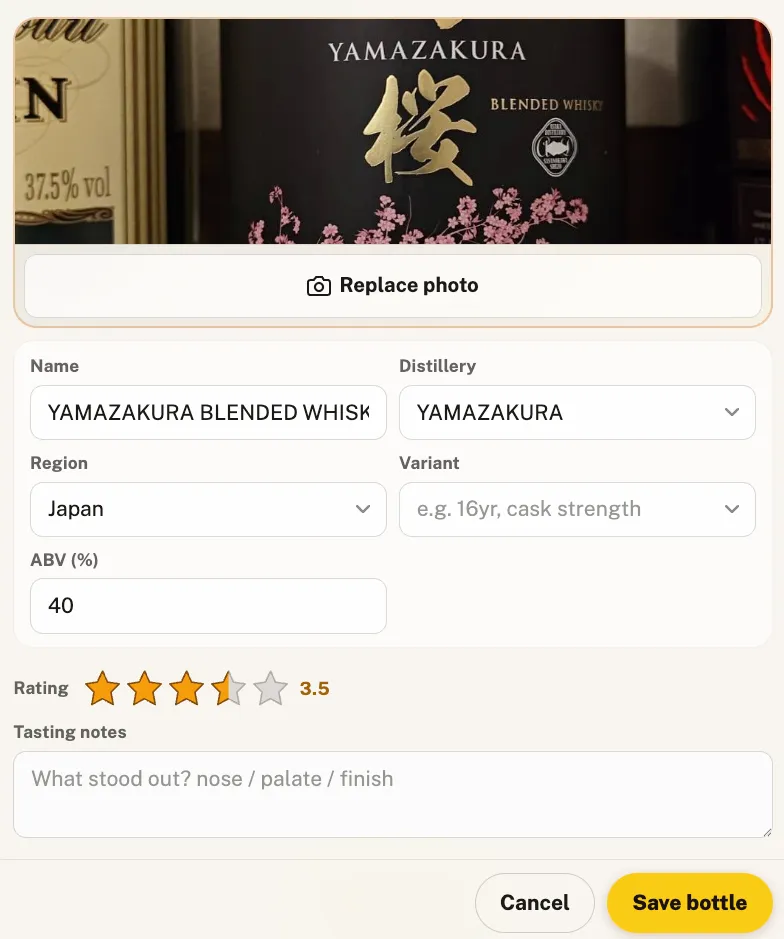
Crumble is the opposite shape to Whiskybase. Whiskybase is a catalogue that happens to accept notes; Crumble is a journal that happens to hold bottles. Nothing is public, and the unit is the pour rather than the release.
- Six flavour axes per dram (sweetness, smoke, fruit, spice, oak and finish) plus an overall 0–5 rating in tenth-of-a-star steps. Fifty-one usable positions, which is enough to rank a shelf against itself without pretending to the false precision of a 100-point scale.
- One bottle, many pours. Sessions attach to a bottle rather than replacing each other, so March and August sit side by side and oxidation becomes visible. This is the single thing a catalogue cannot model.
- Friends-only by default. Your shelf is visible to people you have accepted and to nobody else: EU-hosted, GDPR-compliant, no ads, no data selling. Whiskybase notes are public by design; these are not.
- Bars and distilleries on the map. The bar that poured you something you will never own is a place you can rate, on the same map as your restaurants.
- The rest of the shelf, same structure. Wine, beer, coffee, tea and matcha all use six axes, so you are not running five apps. Method in full: how to track whisky.
One honest caveat. There is no bottle catalogue: you type the bottling in yourself the first time you pour it, which is the trade you make for a record that is entirely yours.
2. Distiller: best for deciding what to buy
Distiller covers close to 60,000 spirits with flavour profiles and a recommendation engine that learns your taste. Where Whiskybase tells you what a bottle is, Distiller tells you whether you are likely to enjoy it, which is the more useful question in a shop.
Trade-offs: its catalogue is a fraction of Whiskybase's on independent bottlings and single casks, and it has no valuation data at all. Full comparison in Distiller alternatives.
3. Whiskey Social: best community feed
If what you actually use Whiskybase for is seeing what other enthusiasts are opening, a feed does that better than a database does. Whiskey Social is shaped closer to Untappd than to a reference work: drams, ratings, conversation.
Trade-offs: feeds are poor archives. Posts scroll away, and re-tasting the same bottle six months later has nowhere structured to live.
4. A spreadsheet: for the collection side
If you are leaving because you want valuation data you control rather than a community estimate, a spreadsheet is the honest answer. Bottle, distillery, bottler, age, cask, outturn, purchase price, current estimate. Whiskybase can seed most of those and then the file is yours.
Trade-offs: no market data updating itself, which is most of why you were on Whiskybase, and no photos. Best kept as an annual snapshot alongside whatever you use daily.
Also worth a look: Drammer
If what you want is a collection app with a bottle database, Drammer is free on iOS and Android, scans barcodes, keeps a collection and a wishlist, and exports to CSV or Excel. Our roundup of the best whisky tracking apps covers it next to the rest of the category.
Do you need a whisky catalogue or a tasting journal?
Identification is knowing what a bottle is: distillery, cask, age, outturn. Evaluation is knowing what you thought of it. The useful way to think about this whole category is that whisky needs two different records and most people try to force one tool to do both.
- Identification: which exact release is this, how many bottles were made, what does it fetch now. Objective, shared, best served by a large community database. Whiskybase wins this outright and probably always will.
- Evaluation: what did it taste like to me, on this evening, from a bottle open for five months. Subjective, personal, and actively degraded by being averaged with strangers opinions.
- They have different half-lives. Identification data is written once and stays true. Evaluation accumulates: the same bottle, scored three times across a year, is worth more than any single note about it.
Running both is entirely reasonable, and plenty of serious drinkers do: Whiskybase open in a browser tab to confirm what a bottle is, a journal on the phone to record what it did.
Can you move your Whiskybase notes?
Partly. Crumble's importer auto-detects only Untappd (beer) and Vivino (wine) exports: there is no whisky-shaped importer, and we would rather state that than imply a migration button exists. Any CSV you can produce will load once its headers are renamed, up to 2,000 rows at a time:
| Rename your column to | And it becomes |
|---|---|
beer_name | The bottling |
brewery_name | The distillery |
beer_style | Region or cask |
beer_abv | ABV |
rating_score | Your score |
comment | Your tasting note |
created_at | The date |
The beer-shaped header names are an artefact of what the importer was built for, and they have a consequence you should know first: a file renamed this way is detected as an Untappd export, so every row lands in the Beer journal, not the Whisky journal. Scores are not rescaled either; anything above 5 is capped at 5, so a 100-point score has to be converted first. For a clean whisky shelf, the honest path is to re-log the bottles you still care about and keep the old export as an archive.
How we compared these
We keep our own whisky shelf in Crumble and have scored several hundred drams on the six axes, so the observations about oxidation and re-tasting come from doing it. Each alternative was measured on four questions: whose palate does it record; does a bottle accumulate history or get overwritten; who can see your notes; and what happens if the service closes. Competitor features come from published material and store listings, checked in August 2026; anything unverifiable was left out rather than guessed.
When should you stay on Whiskybase?
If you collect, stay. Identifying an independent bottling by cask number, checking outturn, tracking what a bottle is worth before you sell or insure it: none of that is replicated anywhere on this list, and a tasting journal is not a substitute for a catalogue.
Add a journal when you notice that the note you actually want back is not "cask 4711, 264 bottles" but "this was the one that tasted like a bonfire on a beach, and I should buy it again".
Start your whisky shelf today
Crumble is free and runs in any browser. Add the bottle you are pouring tonight, score the dram on six axes, and keep Whiskybase open for the catalogue. Looking for what to pour next? Our guide to the best whisky distilleries in Scotland is a good start.
Frequently asked questions
What is the best alternative to Whiskybase?
It depends which half you use. For a private tasting journal, Crumble scores six flavour axes per dram (sweetness, smoke, fruit, spice, oak and finish) plus an overall 0 to 5 in tenth-of-a-star steps, with every pour from a bottle kept together. For discovery and buying decisions, Distiller. For a community feed, Whiskey Social. For identifying and valuing bottles, nothing replaces Whiskybase itself.
Is Whiskybase free?
Yes, joining is free and covers the database, ratings, reviews and basic collection tracking. Whiskybase Plus is the paid tier: it adds private notes on your collection bottles, up-to-date market values for your collection and price alerts. Whiskybase offered a one-month trial of Plus for €4.99 when we checked in September 2026.
Is there a Whiskybase app?
Yes. Whiskybase has apps for iOS and Android alongside the website. The app is built around the same thing as the site, looking bottles up and logging them against the shared database, so it does not change the case for a separate private journal.
Is Crumble free for whisky?
Yes. Every drink add-on is free (whisky, wine, beer, coffee, tea and matcha) as are restaurant tracking, ratings, the wishlist and the friends map. A planned Crumble Plus tier, not on sale yet, will add an AI label scan that fills in distillery, origin and style from a photo; the shelf and the tasting notes cost nothing.
Does Whiskybase track what my bottles are worth?
Yes, and that is one of its main draws: the community records auction and market values across an enormous catalogue of bottlings, and Whiskybase Plus shows up-to-date values for every bottle in your own collection. No tasting journal on this list does that, Crumble included. If collection value is why you are there, that alone is a reason to stay.
Can I import my Whiskybase collection into another app?
There is no direct Whiskybase importer in Crumble; only Untappd and Vivino exports are auto-detected. A CSV with its headers renamed to beer_name, brewery_name, rating_score and comment will load, up to 2,000 rows at a time, but it is then read as an Untappd export and the rows land in the Beer journal, not the Whisky journal. There is no import into the whisky journal today, so the honest path is to re-log the bottles you care about and keep the old export as an archive.
Are my Whiskybase tasting notes public?
Ratings and tasting notes you post are, because Whiskybase is built as a shared community reference and they sit against the bottling alongside everyone else's. Whiskybase Plus adds private notes on the bottles in your collection, visible only to you. If you want a full tasting record that only you and a few friends can see without paying, that is the gap a friends-only journal fills: Crumble's shelf is visible to accepted friends and nobody else.