
The best Scotch whisky distilleries
Almost every introduction to Scotch starts with a map and five regions, and then quietly implies that the region tells you how the whisky tastes. It does not. The regions are legal origin labels, and they are enforced seriously, but Speyside contains both the most delicate and the most heavily sherried malts in Scotland, and the Highland region is so large that as a flavour descriptor it means essentially nothing.
What does predict a distillery worth your money is a process credential you can check: who malts their own barley, who does every step on one site, who states their peat level in ppm. The six below all have one.
Best Scotch whisky distilleries at a glance
The short answer: Springbank in Campbeltown is the most admired, and the only Scottish distillery that does everything from malting to bottling on one site, but it is hard to buy. For bottles you can actually find, start with Kilchoman Machir Bay, Ardnamurchan AD/ or Arran 10. The table sorts the five we profile.
| Distillery | Where | The credential | Start with |
|---|---|---|---|
| Springbank Distillery | Campbeltown | Floor-malts all its own barley; malting to bottling on one site | Springbank 10, if you can find it |
| Kilchoman Distillery | Islay | A farm distillery that states its peat levels in ppm | Machir Bay |
| Ardnamurchan Distillery | West Highland | Peated and unpeated spirit married, at sane prices | The core AD/ release |
| Isle of Arran Distillers | Isle of Arran | The first legal distillery on Arran in 150 years | Arran 10 Year Old |
| Bruichladdich Distillery | Islay | Revived in 2000; owned by Remy Cointreau since 2012 | Port Charlotte 10 |
What are the Scotch whisky regions, really?
The Scotch Whisky Regulations 2009 give statutory force to five geographical indications: two protected localities, Campbeltown and Islay, and three protected regions, Highland, Lowland and Speyside. These are origin rules about where a whisky was distilled, and they are backed by real enforcement, including criminal law.
That makes Scotland's framework the strictest of any whisky country. It is worth holding next to the others: Japan's 2021 labelling standard is a voluntary trade agreement with no force of law, and India has no equivalent framework at all. When a Scotch label says Islay, that is a fact somebody can be prosecuted over. It still does not promise you smoke.
Campbeltown is the one worth knowing about. It once held more than thirty distilleries and was the centre of the entire malt whisky industry. Three survive.
Springbank: the only genuinely estate-bottled malt in Scotland
Campbeltown, founded 1828. Independent, owned by J&A Mitchell & Co and the Mitchell family since it was founded. The process credentials here are the strongest in Scotland.
Springbank is the only Scottish distillery that floor-malts 100% of its own barley requirement, and the only one carrying out the entire process, malting through bottling, on a single site. That makes it the only estate-bottled Scotch malt. The floor maltings ran for most of its history with a gap between 1960 and 1992.
It also runs three distinct production regimes on the same plant: Springbank itself, distilled around two and a half times and lightly peated; Longrow, double-distilled and heavily peated; and Hazelburn, triple-distilled and unpeated. Longrow takes its name from a separate Campbeltown distillery that closed in 1896.
The house style is oily, briny and faintly dirty in the best sense, the least polished major malt in Scotland and deliberately so. The availability warning is serious. Springbank is allocated, many shops sell the standard 10 Year Old by ballot, and secondary prices have multiplied. Buy at retail if you ever see it and treat the secondary market as something to avoid rather than a place to shop.
Kilchoman: Scotland's only true farm distillery
Islay, founded 2005, the first new distillery on the island in 124 years. Independent. Kilchoman runs a full field-to-bottle cycle on site and is one of only around six Scottish distilleries still operating traditional floor maltings.
The peat figures are refreshingly concrete: roughly 15 to 20% of the barley is grown in the surrounding fields and malted in-house to about 20 ppm, with the rest bought from mainland maltings at about 50 ppm. Most distilleries will not give you a number at all. The annual 100% Islay release is made entirely from barley grown on the distillery's own farm.
The style is young, bright and high-toned: citrus and vanilla under the smoke rather than the tarry heaviness of the south-shore Islays. Machir Bay is the flagship, consistently available and good value.
Ardnamurchan: the new one that is actually buyable
West Highland, founded 2014. A new build rather than a revival, owned by Adelphi Distillery Ltd, the long-established independent bottler, and independent.
Ardnamurchan does something unusual that shows in the glass: peated and unpeated spirit are married rather than kept apart, which is why it is unusually well-assembled for its age. The core AD/ release is bottled at 46.8% and non-chill-filtered.
It is also, and this matters on a page where the most admired distillery is nearly unobtainable, available at sane prices across the UK and EU. Production is small but nothing like allocated. Only the inaugural release is meaningfully scarce.
Arran: the island distillery that came back
Lochranza opened in 1995, the first legal distillery on Arran in 150 years, and the second site, Lagg, has been producing since March 2019. It remains one of Scotland's few genuinely independent distillers.
A correction worth making, because it appears in a lot of write-ups: Arran was founded by Harold Currie, formerly managing director of Chivas Brothers, with associates and later his sons, but the Curries subsequently sold to a group of private individuals. It is independent; it is not still family-owned, and saying so would be wrong.
Arran 10 Year Old is the flagship: citrus, vanilla and orchard fruit, clean and sherry-friendly. It is unusually good value for an independent distillery.
Bruichladdich: excellent whisky, and not independent
Islay, founded 1881. The revival story is a good one: closed for years, then bought on 19 December 2000 for 6.5 million pounds by private investors led by Mark Reynier and Simon Coughlin, with peated production recommencing on 29 May 2001.
What tends to go unsaid is the next chapter. Remy Cointreau acquired Bruichladdich in 2012 for 58 million pounds, and it has had a French listed-group owner ever since. It markets an independent spirit and it is not an independent company.
The whisky is very good. Unpeated it is coastal and floral; the peated lines are intensely smoky but surprisingly sweet and un-medicinal next to the south-shore Islays. Port Charlotte 10 is the best value-for-character bottle and widely stocked.
Independent bottlers, and what changed in 2024
Independent bottlers buy casks from distilleries and bottle them under their own label, often at cask strength and without chill filtration, and they are one of the best ways to taste a distillery outside its official range.
One large piece of news dates every older guide: Gordon & MacPhail announced in July 2023 that from 2024 it would stop filling new casks for independent bottling, in order to concentrate on its own distilleries, Benromach and The Cairn. Existing stock will keep appearing for decades given how much of it there is, but the buying has stopped. Cadenhead's, which is owned by the same company as Springbank, and Signatory remain the names to look for.
How to read a bottle of Scotch
- Treat the region as origin, not flavour. It is legally enforced and it tells you where, not what. Speyside spans delicate to heavily sherried.
- Look for a process fact. Own floor maltings, a stated ppm, non-chill-filtered, a bottling strength above 46%. These are checkable; "handcrafted" is not. Note them with the bottle, along with the date you opened it; how to track whisky explains why the date matters.
- Check the ownership if you care about it. Several distilleries that market an independent character have had corporate owners for over a decade.
- Non-chill-filtered and 46% or above usually means more flavour. Chill filtration removes haze and some texture with it.
- Do not buy allocated bottles on the secondary market. Springbank 10 at a multiple of retail is the same whisky it was at retail.
The full list, Campbeltown to Orkney
The five above are the ones to understand first. The full list below adds the farm distilleries and island newcomers that almost never appear on a beginner's map: a Fife farm making 20,000 litres a year around the harvest, a distillery you can sleep above on Raasay, and the second legal distillery ever built on Skye. Ownership is stated for every one.
-
Springbank Distillery
Founded 1828, independent under the Mitchell family. The only Scottish distillery floor-malting 100 percent of its own barley and doing every step, malting to bottling, on one site.
View in Crumble: Springbank Distillery Their site: Springbank Distillery (opens in a new tab)
-
Kilchoman Distillery
Founded 2005, the first new Islay distillery in 124 years, independent under the Wills family. The only Islay distillery growing barley on site and doing the full chain on the island.
View in Crumble: Kilchoman Distillery Their site: Kilchoman Distillery (opens in a new tab)
-
Ardnamurchan Distillery
Founded 2014 by independent bottler Adelphi. Peated and unpeated spirit married together, bottled at 46.8 percent non-chill-filtered, and buyable.
View in Crumble: Ardnamurchan Distillery Their site: Ardnamurchan Distillery (opens in a new tab)
-
Isle of Arran Distillers
Lochranza from 1995, the first legal Arran distillery in 150 years, plus heavily peated Lagg from 2019. Independent, though no longer owned by the founding family.
View in Crumble: Isle of Arran Distillers Their site: Isle of Arran Distillers (opens in a new tab)
-
Glenfarclas Distillery
J. & G. Grant, six generations and still family-owned: one of very few large Speyside distilleries never sold to a multinational. Direct-fired stills and the Family Casks vintage series.
-
GlenAllachie Distillery
Independent since 2017, when Billy Walker and partners bought it from Chivas Brothers. He inherited decades of mature stock with the site and released aged expressions almost immediately.
-
Daftmill Distillery
Arguably the smallest serious distillery in Scotland: a maximum of 20,000 litres of alcohol a year, distilled seasonally around the farming calendar from barley grown on the farm.
-
Nc'nean Distillery
Scotland's first organic whisky distillery by its own account, and the first UK distillery to reach net-zero carbon emissions in whisky production.
-
Isle of Raasay Distillery
The first legal distillery on Raasay, built into a restored nineteenth-century house that also holds the visitor centre and rooms. You can sleep above the stills.
-
Torabhaig Distillery
Only the second legal distillery ever built on Skye, and its entire output to date has been peated: it has never made an unpeated core release.
-
Glengyle Distillery (Kilkerran)
Reopened for production on 25 March 2004 by the Mitchells. The malt is sold as Kilkerran because the Glengyle brand name was owned elsewhere.
-
Highland Park
Edrington-owned. Malts a share of its own barley over Orkney peat, which is heather-rich and treeless, giving a genuinely different peat character from Islay.
-
Laphroaig Distillery
Suntory Global Spirits owned. One of the last Scottish distilleries still operating its own working malting floors as part of production.
-
Bruichladdich Distillery
Founded 1881, revived in 2000, and acquired by Remy Cointreau in September 2012 for 58 million pounds. Not independent, despite the positioning. Port Charlotte 10 is the value pick.
View in Crumble: Bruichladdich Distillery Their site: Bruichladdich Distillery (opens in a new tab)
-
Glen Scotia
Loch Lomond Group owned since 1996. One of only three surviving distilleries in Campbeltown, a region that once held more than thirty.
-
Benromach Distillery
Owned by Gordon & MacPhail since 1993. One of the smallest working Speyside distilleries, run by a hands-on team of three, deliberately making a lightly peated pre-1960s Speyside style.
View in Crumble opens the map with that name already typed into the search, so you can find the branch nearest you, see what is actually there and log it yourself. Street addresses are deliberately absent: places move, open second sites and close them again faster than a guide gets updated, so the map is the more current answer.
Keep a record, because the regions will not help you
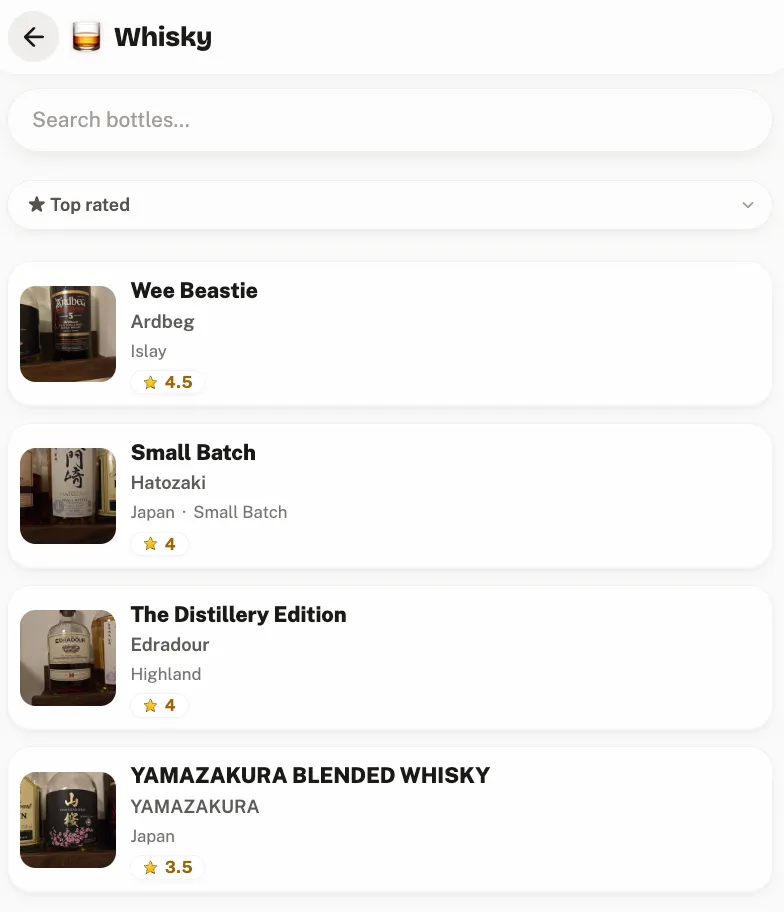
If the region does not predict the flavour, your own notes have to. That is the practical argument for writing this down: after twenty drams your own record tells you what you actually like, which no map can. Crumble's whisky journal is a free add-on: a dated bottle shelf with distillery, region and cask, then a tasting per dram scored on six axes from smoke through finish.
Put a Springbank, a Kilchoman and an Arran on the same six axes and you learn more about your own palate than any regional map will tell you. Matching free journals cover coffee, tea, matcha, wine and beer, and our whisky tracking guide covers the habit. The whisky tracking apps comparison covers the alternatives.
Frequently asked questions
Do Scotch whisky regions tell you how it tastes?
No. The Scotch Whisky Regulations 2009 give statutory force to five geographical indications, two protected localities in Campbeltown and Islay and three protected regions in Highland, Lowland and Speyside, but these are origin labels rather than flavour guarantees. Speyside contains both delicate and heavily sherried malts, and Highland is so large as to be almost meaningless as a taste descriptor.
Which Scottish distillery malts its own barley?
Springbank in Campbeltown is the only one that floor-malts 100 percent of its own barley requirement, and the only distillery in Scotland carrying out the whole process from malting to bottling on one site, which makes it the only estate-bottled Scotch malt. Kilchoman on Islay is one of only around six distilleries still running traditional floor maltings.
Is Bruichladdich independent?
No. It was revived in December 2000 when private investors led by Mark Reynier and Simon Coughlin bought it for 6.5 million pounds, but Remy Cointreau acquired it in 2012 for 58 million pounds. It has had a French listed-group owner ever since. The whisky is excellent and the independent positioning is a marketing stance rather than a fact about ownership.
What is the best Scotch to actually buy right now?
Ardnamurchan AD/ if you want the best combination of quality and availability, since it is bottled at 46.8 percent non-chill-filtered and is obtainable at sensible prices. Kilchoman Machir Bay and Arran 10 are the other two that reward you without requiring a ballot. Springbank 10 is superb and effectively allocated.
Why is Springbank so hard to buy?
Demand far exceeds a deliberately small production, so it is allocated and many retailers sell even the standard 10 Year Old by ballot. Secondary prices have multiplied. It is worth buying at retail if you see it, and not worth buying at secondary prices, because it is the same whisky either way.
What happened to Gordon and MacPhail?
It announced in July 2023 that from 2024 it would stop filling new casks for independent bottling, in order to focus on its own distilleries, Benromach and The Cairn. Its existing stock is vast and will keep appearing for decades, but the buying has stopped, which dates any older guide recommending it as a leading independent bottler. Cadenhead's and Signatory remain the names to look for.
How many distilleries are left in Campbeltown?
Three, from more than thirty that once made it the centre of the Scotch malt whisky industry. Springbank and Glengyle are owned by the same company, and Glen Scotia is the third. That collapse is why Campbeltown retains its own protected locality status despite being by far the smallest of the five.