
Best Food and Restaurant Review Apps: Rate Dishes, Review With Friends
The best food review app depends on who the review is for: Yelp, Google Maps and Tripadvisor publish your review to strangers and to the restaurant, while personal review apps such as Beli, Savor and Crumble keep it for you and your friends. If you want to remember what to order, pick an app that rates individual dishes rather than whole restaurants.
Most lists of "best restaurant review apps" mix those two jobs together, which is why the recommendations feel random. This guide separates them first, then goes into the two things almost nobody compares: reviewing the dish instead of the place, and reviewing with the people you ate with.
What kinds of food review apps are there?
There are two kinds, and they answer different questions. Public review sites ask "what should a stranger know about this business?" Personal review apps ask "what did I think, and what did my friends think?"
- Public review sites (Yelp, Google Maps, Tripadvisor). Your review is published under your name on the business page, anyone can read it, and the owner can answer it. The score you see is an average of everyone, mostly strangers.
- Personal and friends review apps (Beli, Savor, Crumble). Your reviews build your own record. They are shared with friends or kept private, and they are not addressed to the restaurant. The score you care about is yours, or your circle's.
- A small middle ground: community dish-rating apps such as Foodaholix, which rates individual dishes instead of restaurants and shares them with other local users, with a focus on the San Francisco Bay Area.
Booking apps such as OpenTable and TheFork also carry diner reviews, but they are written to help strangers choose, so they sit with the public sites here.
Neither kind is better. A public site is the right tool when you want to warn or help other diners. A personal app is the right tool when you want a record that is still useful in two years, written honestly because nobody but your friends will read it.
Which food review app should you use?
The five columns that matter, as of October 2026:
| App | Who sees your reviews | What you rate | Rating scale | Platforms | Price |
|---|---|---|---|---|---|
| Yelp | Everyone; the business can reply | The business (popular dishes are inferred from reviews) | 1 to 5 stars | iOS, Android, web | Free |
| Google Maps | Everyone, under your Google name; the owner can reply | The place | 1 to 5 stars | iOS, Android, web | Free |
| Tripadvisor | Everyone; the owner can respond | The place, with optional aspects such as food | 1 to 5 bubbles | iOS, Android, web | Free |
| Foodaholix | Other app users | Individual dishes | Not published | iOS, Android | Free |
| Beli | Friends and followers in the app | The restaurant, ranked against your others | Comparisons turned into a score out of 10 | iOS, Android | Free, in-app purchases |
| Savor | Private by default; share lists or a public profile | Individual dishes only | 1 to 10 with decimals | iPhone, Android | Free; Pro subscription optional |
| Crumble | Accepted friends by default | Each dish, plus an optional "vibe" score for the place | 0.1 to 5 in tenth-of-a-star steps | Any browser; installs on iPhone and Android | Free |
Sources: Google Maps Help ("All reviews are public", 1 to 5 stars) and Business Profile Help on public owner replies; Yelp for Business on replies; Tripadvisor's review posting guidelines; the Beli and Savor App Store listings, where Savor Pro was listed at $4.99 a month or $49.99 a year.
Should you review the restaurant or the dish?
Review the dish if the point is to know what to order next time. A single restaurant score blends a great main, a forgettable starter and a slow evening into one number, and the number cannot tell you which of the three to repeat.
Public sites know this. Yelp's Popular Dishes feature surfaces the dishes people mention most, built by machine learning from review text and photos. That tells you what a crowd talks about, not how good the dish was to you, and you cannot give a plate its own score. Google Maps and Tripadvisor stop at the place, with Tripadvisor asking for aspect ratings such as food on some reviews.
Dish-first apps flip the unit. Savor rates only dishes, on a 10-point scale with decimals, and has no restaurant score at all. Crumble rates both, but builds the restaurant score from the dishes:
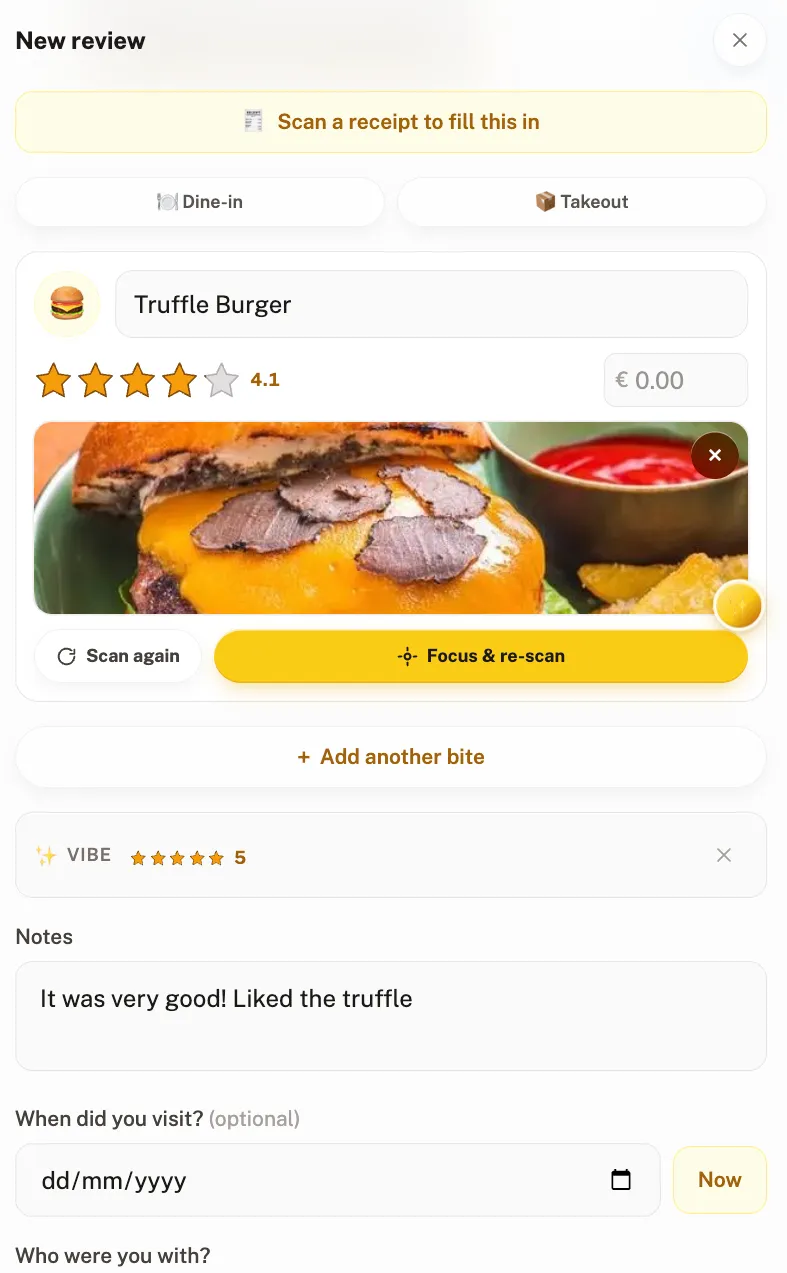
- Every dish is its own line with a name, a category and a rating from 0.1 to 5 in tenth-of-a-star steps (★ 4.2). A photo and the price are optional per dish.
- The review's overall score is the average of its dishes, so it cannot drift away from what you actually ate.
- The place gets its own optional score. "Rate the vibe" is a separate rating for the room itself, so a lovely terrace does not inflate an average pasta.
If you would rather put restaurants in order than score them, that is a different tool: our guide to restaurant ranking apps explains how Beli's comparison method works and when it beats a fixed scale.
What makes a dish review useful a year later?
Short, specific and written within a day. The reviews people actually reread answer four questions:
- What exactly was it? Use the menu name, not "the pasta". "Cacio e pepe, lunch menu" survives a menu change; "pasta" does not.
- Would you order it again? A rating plus one word (reorder, skip, share) does more work than a paragraph.
- What would you try next time? The dish at the next table is the most useful note you can leave yourself.
- Who was it good for? "Good for a group", "too rich for lunch". Context that a star average throws away.
Keep the scale honest by rating each dish against its own kind: a 4.5 croissant and a 4.5 tasting menu should both mean "as good as that thing gets around here", not that they are equal meals. If the record matters more than the review, our restaurant journal apps comparison goes deeper.
How do you review restaurants with friends?
There are three different things people mean by it, and apps support them unevenly.
Reviews only your friends can see
This is the main reason people leave public sites. On Crumble, reviews are visible to accepted friends by default; you can make a public profile or send share links for collections and trips if you want to, and every rating also counts anonymously toward a place's overall Crumble average. On Beli, the Harvard Crimson notes that individual reviews are not public feedback for the restaurant, though parts of a profile can be visible to other users (our Beli review covers the settings). Savor is private by default.
Your friends ratings next to yours
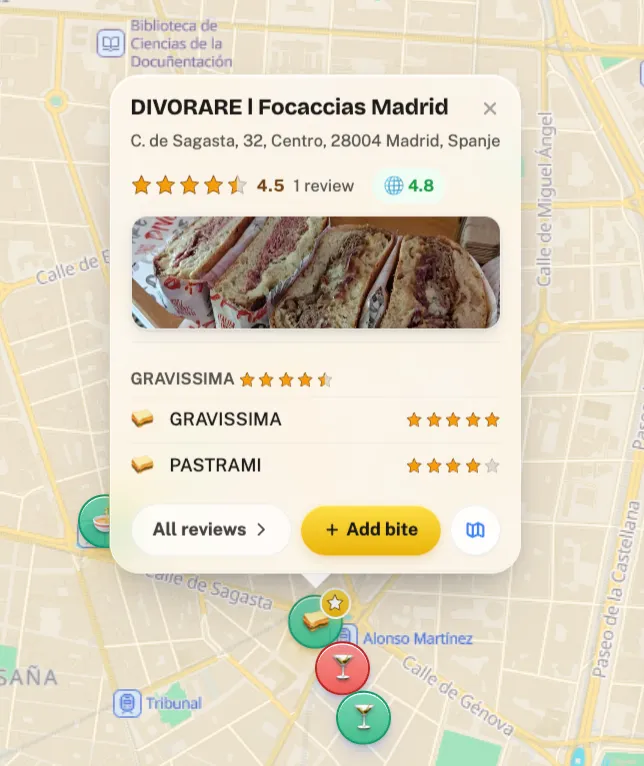
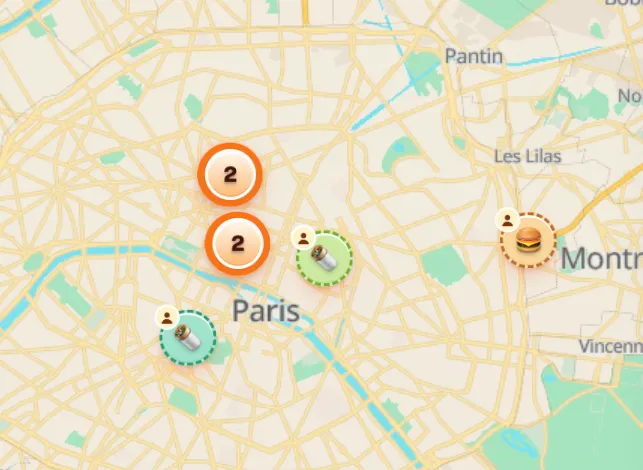
A friends review app should show the scores of people whose taste you know before the crowd's. Crumble puts your friends reviewed places on your map next to your own, and a place card shows your friends average alongside the all-user Crumble average and a public rating from Foursquare for context. Beli shows where your friends are eating and what they love and hate, per its website.
One review written together
This is the rarest of the three. On Crumble you can invite the friend you ate with as a coauthor of your review:
- Only people who are already your friends can be invited, and the invite stays pending until they act.
- Only the invited person can accept or decline it, so nobody can put a review on your record without you.
- Once accepted, the review appears on their map and counts toward their trips and XP as if they had written it.
- A coauthor can see and comment on the review but cannot edit it; the rating and the words stay the author's.
If you disagreed about the meal, write two reviews instead. The full walkthrough, including when not to coauthor, is in our guide to shared restaurant reviews. We did not find a coauthor feature in the other apps published materials.
Review your last meal, dish by dish
When is a public review site the better pick?
- You want the restaurant to hear it. Owners can reply on Yelp, Google and Tripadvisor. A personal app is not a complaints channel.
- You want to help strangers. A public review is useful to the next person who finds the place on a map. A friends-only review is not.
- You are somewhere none of your friends have been. A thousand strangers averages beat an empty friends map.
- You need opening hours, menus and booking in one place. That is directory work, and the big sites do it well.
Many people use both: a public site to find somewhere new, a personal app to record what they thought. If you are moving your own record off Yelp, our Yelp alternative guide covers that, and Beli vs Yelp compares the two models head to head.
When are Beli or Savor the better pick?
Beli is the better pick if you want a strict personal top list and a big, active community to compare it with. Its comparison flow is fun in a way a rating scale is not, and its App Store listing shows a 4.8 average from more than 17,000 ratings as of October 2026. It ranks restaurants, not dishes.
Savor is the better pick if you want a solo dish database on your phone, with photo recognition that identifies the dish for you and a finer 10-point scale. Everything is private until you share it, either list by list or through an optional public profile, and there is no restaurant score. Our Savor alternatives page compares it in detail.
Crumble fits between them: dish-level ratings like Savor, a friends circle like Beli, plus coauthored reviews, and it runs in any browser with nothing to download.
Is there a food review app like Letterboxd?
Yes. Letterboxd's formula (a private-ish diary, your own fractional score, friends activity, lists) maps closely onto personal food review apps, and "food review app like Letterboxd" is one of the most common ways people search for them. Our Letterboxd for food guide translates the features one by one, so we will not repeat it here.
Start a review record you will actually reread
Crumble is free and opens in any browser. Add the last place you ate, give each dish its own score, invite whoever was across the table, and the next time someone asks what to order there, the answer is already on your map.
Frequently asked questions
What is the best food review app?
It depends on who the review is for. To tell strangers and the restaurant what you thought, use Google Maps, Yelp or Tripadvisor. To keep your own record shared with friends, use a personal app: Beli if you like ranking restaurants, Savor for a private dish journal, or Crumble for per-dish ratings shared with friends and coauthored reviews.
Is there an app to rate individual dishes instead of restaurants?
Yes. Savor rates only dishes, on a 10-point scale with decimals. Crumble rates every dish from 0.1 to 5 in tenth-of-a-star steps and builds the restaurant score from the dish average. Foodaholix is a community app that rates dishes and shares them with other local users. Yelp, Google Maps and Tripadvisor rate the whole place.
Can I review restaurants without making it public?
Yes, with a personal review app. Crumble shows your reviews to accepted friends by default, and Savor is private by default. Google Maps says all its reviews are public and posted under your name, and Yelp and Tripadvisor reviews are public on the business page.
Is there an app to rate restaurants with friends?
Beli and Crumble are both built around friends. Beli shows where friends eat and how they ranked it. Crumble shows friends reviewed places on your map, their average next to yours, and lets you invite the friend you ate with as a coauthor so one review lands on both of your records.
Can two people write one restaurant review together?
On Crumble, yes. The author invites a friend as a coauthor; the invite stays pending until that friend accepts. Once accepted, the review appears on both maps and counts toward both people's trips. The coauthor can comment but cannot edit the rating or text.
Can restaurants see or reply to my reviews?
On Google Maps, Yelp and Tripadvisor, yes: verified owners can post a public reply under your review. Personal apps such as Beli and Crumble are built for you and your friends rather than as a feedback channel to the restaurant; Crumble reviews are friends-only by default instead of being posted on a public business page.