
Restaurant Journal Apps: 7 Dining Diaries Compared
The best restaurant journal app is Memolli if you want a private diary that works offline and exports to text, Moodle if you are on iPhone and want to rate every dish and drink, Yummi if your camera roll already is your diary, and Crumble if you want each dish rated and your journal shared with friends in any browser. Savor, Eatlist and Truffle cover narrower needs, described below.
A restaurant journal is not the same thing as a ranking app or a review site. A journal answers three questions for you, later: what did I eat there, how was it, and what should I order next time? A ranking app such as Beli turns your visits into a ranked list, and a public review site such as Yelp writes for strangers. This page compares only the apps built for the first job, on what each entry actually records.
Which restaurant journal apps are worth using in 2026?
Seven apps are built as restaurant journals and still installable in October 2026; they differ most in whether you rate the restaurant or each dish, and in who can see your entries. The table is a set, not a ranking.
| App | What an entry records | Home cooking | Platforms | Export | Who sees it | Price (Oct 2026) |
|---|---|---|---|---|---|---|
| Memolli | Restaurants, dishes and drinks, each rated; photos, notes, repeat visits, custom templates | Not listed | iPhone, iPad, Mac, Android, web | Plain text, photos | Private by default; share chosen lists | Free; Pro from $3/month |
| Moodle | Food, drinks, service and atmosphere scores; dish-by-dish and drink-by-drink ratings; photos, tags | Not listed | iPhone, iPad, Mac, Vision Pro | Not listed | Followers see your reviews in a feed | Free |
| Eatlist | Restaurant, notes on menu items, photos, visit count | Not listed | Apple devices | Not listed | Just you | Free |
| Savor | Individual dishes on a 10-point scale, location, lists | Not listed | iPhone, Android | Not listed | Private by default | Free; Pro $4.99/month |
| Yummi | Geotagged food photos, sorted on a calendar and a map | Yes | iOS, Android | Not listed | Private or shared, per post | Free |
| Truffle | Restaurants you have been to, with an optional rating | Not listed | iOS, Android | Not listed | Friends you connect with | Free; subscriptions |
| Crumble | Each dish rated 0.1 to 5 in tenths, notes, photos, visit date, place on a map | Yes | Any browser; installs on iPhone and Android | On request (GDPR) | Accepted friends by default | Free |
"Not listed" means the app's own listing does not mention it, not that we confirmed it is missing. If you want a broader roundup that includes ranking apps and place-savers like Beli, Mapstr and Google Maps, read our best restaurant tracking apps comparison instead.
We left out apps that look abandoned, such as Bap: Food & Restaurant Journal, whose last App Store update was in November 2023, and general tools like Notion or Apple Notes, which work for a few dozen entries (see the FAQ).
What should a restaurant journal app record?
A useful restaurant journal records the dish, not just the restaurant, because "this place is a 4" hides that the ramen was a 5 and the gyoza a 2.5. Beyond that, five things decide whether you will still find the journal useful in two years:
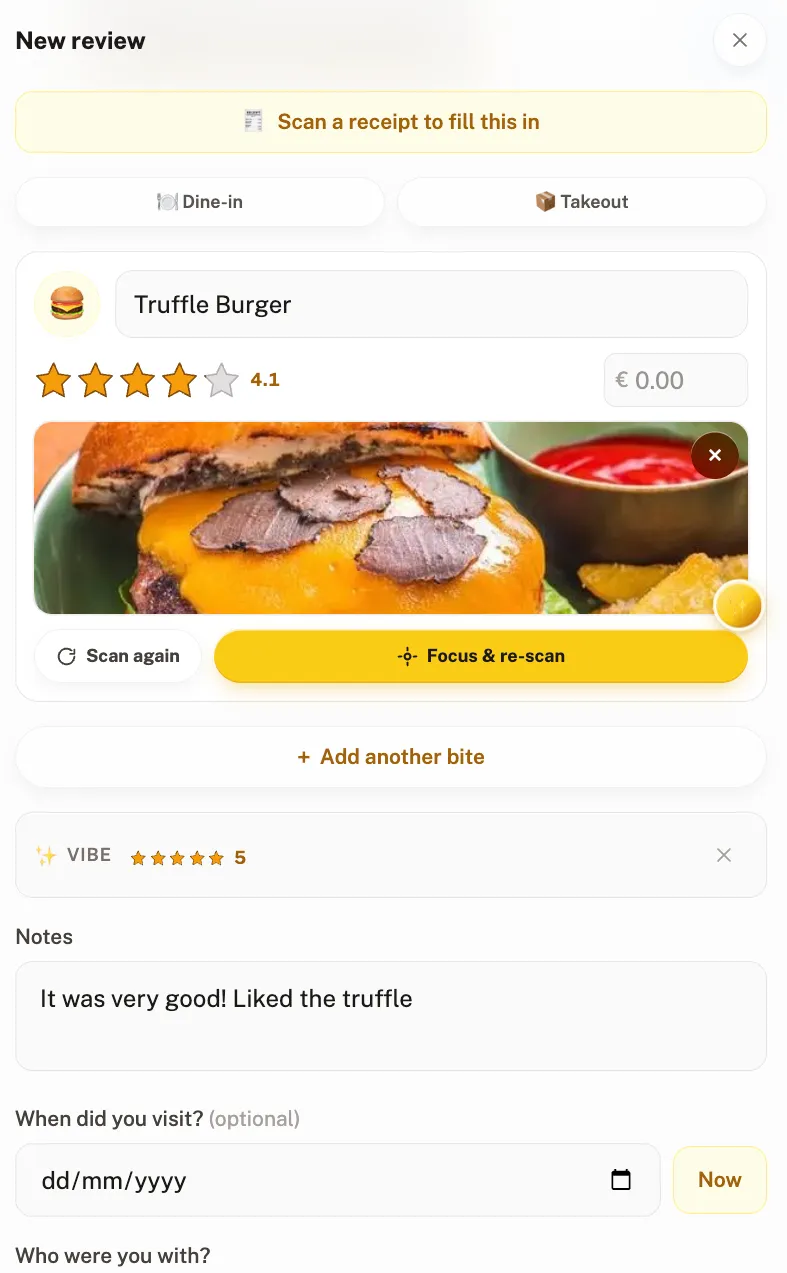
- Per-dish ratings. Memolli, Moodle, Savor and Crumble rate each dish. Eatlist keeps notes on menu items; Yummi and Truffle work at the level of the meal or the restaurant.
- A "next time" note. Memolli, Eatlist, Savor and Crumble have a notes field for exactly this; the habit of filling it in matters more than the app.
- The date and who you were with. Eatlist lets you tag dining companions; Crumble records the visit date and lets a friend co-author the review, so once they accept it appears on both your records.
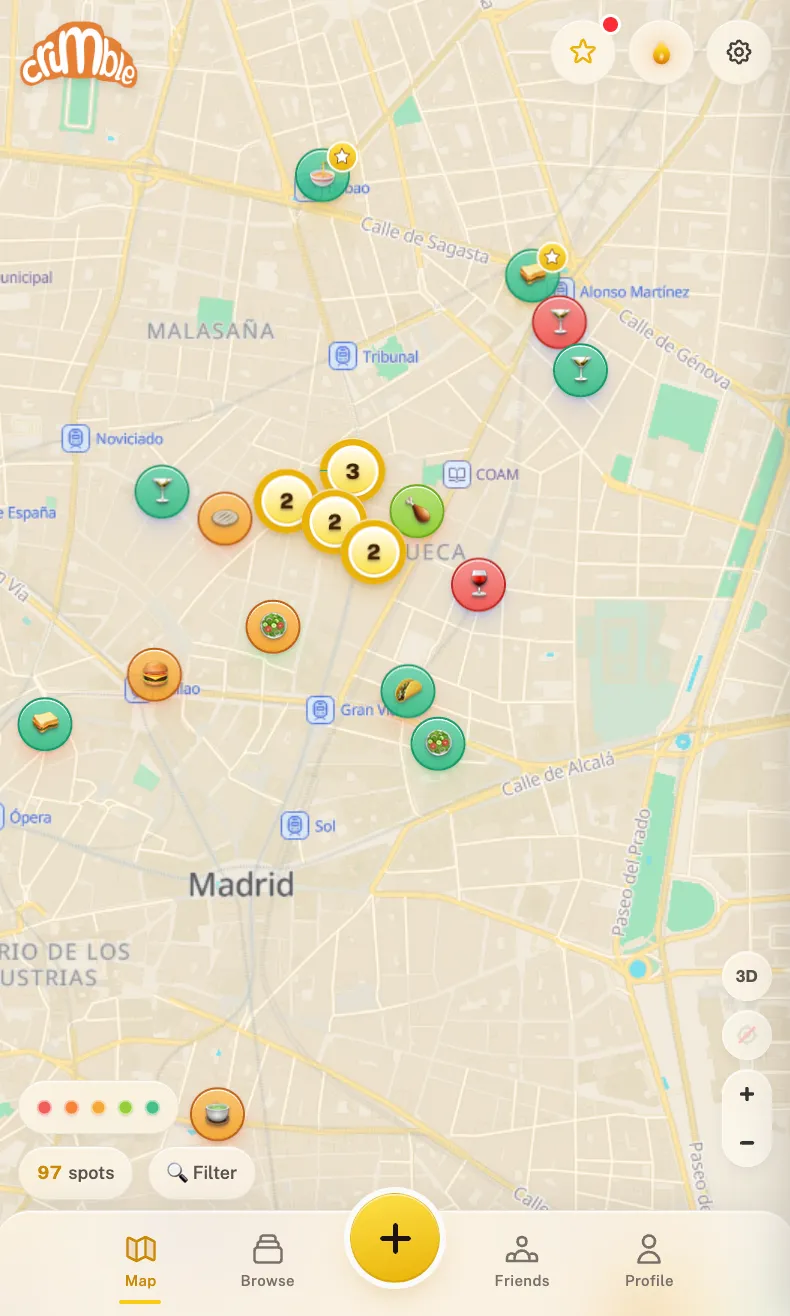
- A map. Memolli, Moodle, Eatlist, Yummi, Truffle and Crumble all put your entries on a map, which is how most people look things up on a trip.
- A way out. A journal is a long-term record. Memolli is the only one whose listing mentions a self-serve export (plain text plus photos); Crumble provides a machine-readable copy on request.
How do the restaurant journal apps compare?
Memolli: the private, offline journal
Memolli calls itself a private food and drink journal. Its App Store listing covers rating restaurants, dishes, drinks and products, recording repeat visits "to see how your opinion changes", custom review templates, use without an account or a connection, and export to plain text. It runs on iPhone, iPad, Mac, Android and the web. As of October 2026 it is free, with Pro from $3 a month or $20 to $24 a year.
Trade-offs: sharing is something you do list by list or review by review; there is no feed of everything your friends log, and the free plan caps place entries at 10 a month. If that is the gap you feel, see our Memolli alternatives.
Moodle: per-dish and per-drink ratings on iPhone
Moodle: Restaurant Journal, by Kodanka AB, rates food, drinks, service and atmosphere and calculates an overall score, with dish-by-dish and drink-by-drink ratings underneath. It has a "Want to go" list, a map of your visits, filters by score, cuisine and price, and a feed where you follow friends. As of October 2026 it is free, was last updated in September 2026, and its privacy label says the developer does not collect data.
Trade-offs: Apple devices only, and young, so its community is small.
Eatlist: the simplest personal log
Eatlist – Memorable Meals, by Cortado Labs, does exactly what it promises: search a restaurant, keep notes on the menu items you tried, add photos, count your visits, tag who you ate with, and see your restaurants and a To Try list on a map. It is free with no purchases.
Trade-offs: Apple only, sharing with friends is still listed as "coming soon", and the most recent version on the App Store dates from July 2024. Fine for a personal list; a risk for a ten-year journal.
Savor: dishes first, on a 10-point scale
Savor tracks individual dishes rather than restaurants, with a "10-point precision rating system", custom lists and location tagging, private by default. As of October 2026 it is free on iPhone and Android, with Savor Pro at $4.99 a month or $49.99 a year on the App Store. Our Savor alternatives page covers it in more depth.
Trade-offs: the restaurant itself takes a back seat to the dish, and it has no web version.
Yummi: the photo diary
Yummi builds your journal from photos: its App Store listing says you upload food photos "new or old" and it tags each by time and place, then shows them on a calendar or a map. It covers home-cooked meals, every post has a privacy toggle, and you can follow friends and foodies. It is free on iOS and Android.
Trade-offs: the photo is the entry, so "what to order next time" depends on what you add beyond the picture. More in our Yummi alternatives.
Truffle: a social tracker that can be a journal
Truffle describes itself as "the social restaurant tracking app" that you can also use as a journal for yourself, with "no pressure to post photos, write reviews". It shows your places and your friends on one map, and its Google Play listing mentions importing from Google Maps, Notes, spreadsheets and Yelp. Free, with optional subscriptions as of October 2026.
Trade-offs: it records where you went more than what you ate.
How does Crumble work as a restaurant journal?
In Crumble each journal entry is a review of one visit: the place, every dish you ordered with its own rating from 0.1 to 5 in tenth-of-a-star steps (★ 4.2), notes, photos, and the date you actually went.
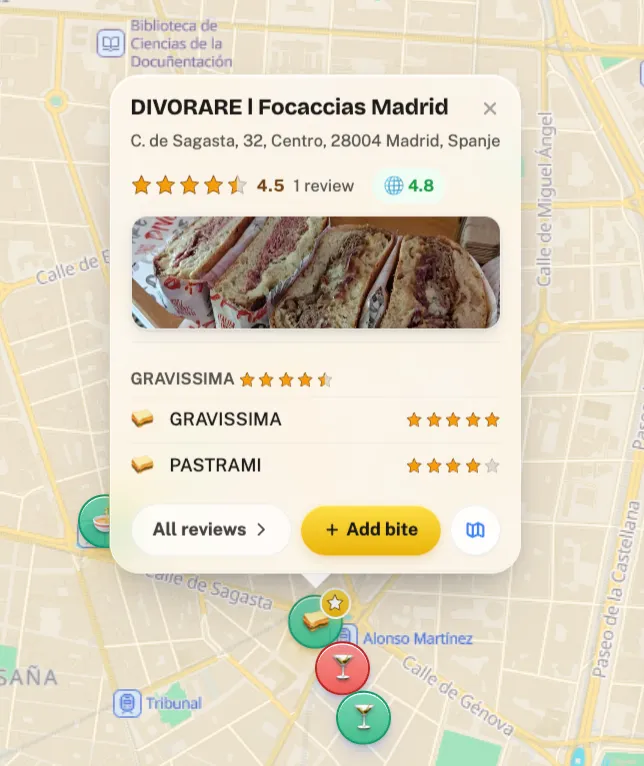
- Per dish, not per restaurant. The spot card shows each dish you have rated there, so the "what do I order" answer is one tap away.
- Restaurants and home cooking together. Search a place, drop a pin for a stall without a listing, or log a home-cooked dish; your home location stays visible only to you. For a kitchen-first log, see our home cooking journal apps.
- A map and a travels view. Every place you reviewed is a pin, and every country and city you have eaten in is collected for you.
- Friends, not the internet. Reviews are visible to accepted friends by default, and their places show on your map. You can choose a public profile or share a link to a collection, and every rating also counts anonymously toward a place's overall Crumble average.
- Want-to-try list. A wishlist with folders; a place clears itself from it when you review it.
Crumble is free and runs in any browser, installing to the home screen on iPhone and Android; a native iOS app is in development. There are no ad networks or ad trackers and your data is not sold; free maps can show pins marked "Sponsored", which never change a rating or search order. There is no self-serve export yet, but you can request a machine-readable copy of your data at any time under GDPR. If keeping the journal away from strangers is the point, our private restaurant list apps guide goes deeper on privacy settings.
When is another journal the better choice?
- You eat where there is no signal, or want nothing in an account → Memolli works offline and without signing up. Crumble needs a connection.
- You want a self-serve export button → Memolli exports to plain text whenever you like.
- You are all-in on Apple and want to rate service and atmosphere as well as each dish → Moodle.
- Your photos already tell the story → Yummi turns a camera roll into a dated food map faster than writing entries.
- You care about dishes across cities more than restaurants → Savor is built around exactly that.
- You want a ranked list, not a diary → that is Beli's job; see our restaurant ranking apps.
- You want to review for friends or the public rather than keep a diary → see our food and restaurant review apps guide.
Crumble is the better fit when you want a dish-level journal you can open in any browser and share with the people you eat with.
How do you keep a restaurant journal you'll actually use?
Write each entry for the person reading it next year: you, standing outside the same restaurant, deciding what to order. That changes what goes in:
- One line per dish, with a score. "Cacio e pepe 4.6, a bit salty" is more useful than a paragraph about the evening.
- A "next time" sentence. "Order the special, skip dessert, book the terrace." This is the line you will reread most.
- Log the bad meals too. A 2.0 entry saves you from going back; a journal of only favourites forgets why you stopped going.
- Note the occasion and the company. A birthday, a first date, a work lunch. It is what makes rereading the journal enjoyable rather than just practical.
- Reread before you go back. Open the entry on the walk there. A journal you never reopen is just data entry.
For the habit itself (when to log, the 30-second rule, keeping "been" and "want to try" apart), our guide on how to keep track of restaurants covers it in detail. If what you want is a food journal for mindful or non-diet eating rather than for restaurants, read food journal apps without calories; if you lost an old history in Google Maps Timeline, start with our restaurant history app guide. Prefer a spreadsheet? See the Google Sheets restaurant tracker template.
Frequently asked questions
What is the difference between a restaurant journal app and a restaurant tracker?
Mostly emphasis. A tracker records where you have been and want to go; a journal also records what you ate, how each dish was and what to order next time. Memolli, Moodle, Savor and Crumble lean toward the journal side because they rate individual dishes.
Is there a free restaurant journal app?
Yes. As of October 2026 Moodle, Eatlist, Yummi and Crumble are free, and Memolli, Savor and Truffle are free to start with optional paid tiers.
Which restaurant diary app works on Android?
Memolli, Savor, Yummi and Truffle have Android apps. Crumble runs in Chrome or any other Android browser and installs to the home screen. Moodle and Eatlist are Apple only.
Can I export my restaurant journal?
Memolli exports your reviews to plain text and lets you download your photos. Crumble provides a machine-readable copy of your data on request under GDPR. The other apps here do not mention an export in their listings, so check before you build a long history in them.
Which restaurant journal app is the most private?
Memolli can run without an account and keeps everything on your device until you sign up for sync. Eatlist is a personal list with no sharing. Crumble shares only with accepted friends by default, and Yummi lets you set each post to private.
Can a restaurant journal include home-cooked meals?
Yummi and Crumble both accept home cooking. In Crumble a home-cooked dish gets the same rating, note and photo as a restaurant dish, and the location is visible only to you.
Is a Notes app or spreadsheet good enough as a restaurant journal?
For a few dozen entries, yes. It gets harder once you want to search by city, see places on a map or rate several dishes per visit, which is where a dedicated journal app saves time.
Your next meal out is the first entry
Pick the journal that fits how you eat and log tonight's dinner: the dishes, a score each, and one line for next time.