
The best Japanese matcha brands and producers
Start with the thing most matcha pages will not tell you. "Ceremonial grade" is not a grade. There is no definition of it in Japanese agricultural regulation, no body that certifies it, and no production standard behind it. It was coined by Western importers, and any brand can print it on any tin of green powder without lying, because there is nothing to lie about.
What does carry information is who grew and milled the tea. The houses below are the real thing, most of them centuries old, and below them is a five-point test you can run on any tin in about ten seconds.
Best Japanese matcha brands at a glance
The short answer: Marukyu Koyamaen in Uji is the benchmark, with the strongest record at Japan's National Tea Competition, and Ippodo in Kyoto is the house you can most easily buy from abroad. Buy Marukyu only from the house or an authorised retailer: it is among the most counterfeited matcha brands online.
| House | Where | Known for | Buy here if |
|---|---|---|---|
| Marukyu Koyamaen | Uji, Kyoto | Founded around 1704; first prizes at the National Tea Competition | You want the benchmark and can wait for stock |
| Ippodo Tea | Kyoto | Founded 1717, with a global store | You want refined matcha you can order from abroad |
| Horii Shichimeien | Uji | Keeps old Uji tencha cultivars alive | You care about historic cultivars |
| Kanbayashi Shunsho Honten | Uji | Founded around 1560, supplied tea to the shogunate | You want the longest lineage |
Marukyu Koyamaen: the benchmark, and the one people fake
Ogura district, Uji, Kyoto. Founded around 1704 by Koyama Kyujiro, who began cultivating and processing tea there in the Genroku era. Family-held for over three centuries.
Its standing rests on an unmatched record at Japan's National Tea Competition, where it has taken first prize many times over since the 1960s. No other house has a record like it. The named grades are the ones the rest of the market is measured against, Kinrin, Wako and Isuzu among them.
Two warnings. The higher grades have been chronically sold out since 2024. And Marukyu Koyamaen is among the most counterfeited and resold matcha brands on international marketplaces: a listing well below the house's own price, or with no harvest date, is a warning sign rather than a bargain. Buy from the house or an authorised retailer.
Ippodo: the best-documented house, and the one you can actually buy from
Central Kyoto. Founded 1717 by Rihei Watanabe, originally trading as a shop called Omiya. In 1846 it was renamed Ippodo (一保堂), meaning roughly "preserve one", a name given to it by Prince Yamashina.
Worth being precise, because this gets inflated constantly: that is a patronage connection, not an imperial appointment. It is a real and unusual piece of provenance and it is not a warrant. Ippodo's matcha is refined and restrained rather than aggressively umami-heavy, with Ummon and Sayaka the usual entry points.
Practically, Ippodo is the most accessible house here: it runs a global store and a dedicated North American operation. It also has explicit purchase limits currently in force, and stock sells out quickly after restocking, which is the most direct evidence you will find that the shortage below is real rather than narrative.
Horii Shichimeien: the machine everybody else's tencha goes through
Uji. Founded 1879, Meiji 12, with a claimed lineage back to the Muromachi period. Horii makes the strongest historic-cultivar-stewardship case of any house on this page, maintaining old Uji tencha cultivars that would otherwise have disappeared.
The detail worth knowing is industrial rather than romantic. In 1924 the third-generation head, Chojiro Horii, developed the Horii-style tencha dryer, and Japanese tencha processing machinery is generally described as descending from that design. If so, almost every tin of matcha you have ever drunk passed through a machine that traces back to this family.
Kanbayashi Shunsho: tea for the shogunate
Uji. Founded around 1560, in the Eiroku era, and now fifteen generations in. The Kanbayashi name is tied to the Edo-period Gomotsu Ochashi system, under which designated houses supplied tea to the shogunate. That is the single strongest documented credential of its kind here, and it is the reason the name carries weight in Japan in a way it does not abroad.
Uji, Nishio, Yame, Kagoshima: what actually differs
Uji, in Kyoto Prefecture, is the historic centre and still the prestige name. It is where the shading techniques and the great houses come from, and its matcha is typically the most structured: deep umami with the bitterness held in balance rather than sanded off.
Nishio, in Aichi, is the volume centre and produces a large share of Japan's matcha. It is a coastal river-delta city, which is worth saying because at least one widely copied source places it at altitude, and it is not. The style tends to be milder and sweeter, which makes it popular for lattes and baking.
Yame, in Fukuoka, is small, southern and highly regarded, known for concentrated sweetness and thick body. Kagoshima is the modern industrial story: mechanised, newer, and now the largest tencha-producing prefecture in the country, having overtaken Kyoto.
One caution on the label. "Uji matcha" is a looser designation than most readers assume: it does not require that all the leaf was grown in Uji. Treat it as a style and a processing lineage rather than a guarantee of a single origin.
How to tell if matcha is good: a five-point test for any tin
- Is the producer named? Not the brand that packed it, the house that made it. If the tin names only the seller, you are buying a label.
- Is the region named? Uji, Nishio, Yame or Kagoshima. "Japan" is not a region.
- Is there a harvest date, not just a best-before? This is the strongest single signal. Matcha is a crop, it oxidises fast, and a seller who knows the harvest will say so. Keep it in your notes along with the date you open the tin; how to track matcha explains why the opening date matters.
- Is a cultivar named? Nobody prints a cultivar by accident. Its presence is evidence of a real supply chain behind the tin.
- Is the grade the house's own? Named in-house grades mean something within that house's range. "Ceremonial grade" means nothing anywhere, because nobody defines or certifies it.
Price per gram is the sanity check on all five. Genuine competition-grade matcha from a Uji house is expensive, and a tin priced like supermarket green tea powder is supermarket green tea powder, whatever the tin says.
Is there really a matcha shortage?
The scarcity is real, and it is narrower than most coverage suggests. It is a shortage of tencha, the shade-grown leaf that gets milled into matcha, rather than of Japanese green tea in general. The Global Japanese Tea Association has described it as the first matcha shortage in history, beginning in autumn 2024.
What follows is visible rather than speculative: tencha auction prices have roughly doubled into 2026, Japanese shops have imposed purchase limits of a tin per customer, and houses including Ippodo have published dated supply and price notices. Growers in regions that historically made sencha have been converting to tencha because it now earns more at auction.
The reason it will not resolve quickly is structural. A new tea field takes roughly five to seven years to reach matcha-grade production, and Japan lost close to 53,000 tea farmers to retirement between 2000 and 2020. Demand can double in a year; supply cannot.
You will see more dramatic figures circulating: a 220 percent price rise, a 40 percent collapse in Uji yields, month-by-month forecasts through 2026. Each traces back to a seller's own marketing rather than to a grower body or a price report, and a scarcity story is exactly the kind of claim that benefits the person making it.
The full list, Uji to Shizuoka
The four above are the ones to understand first. The full list adds the Uji houses you can actually walk into, a Nishio producer, an Osaka house and a Shizuoka one, because a matcha list that is entirely Uji is telling you about prestige rather than about tea.
-
Marukyu Koyamaen
Founded around 1704. The strongest record at Japan's National Tea Competition and the benchmark for umami-forward Uji matcha. Chronically sold out at the higher grades.
View in Crumble: Marukyu Koyamaen Their site: Marukyu Koyamaen (opens in a new tab)
-
Ippodo Tea
Founded 1717 by Rihei Watanabe. Refined and restrained, the best-documented house here and the most accessible internationally. Purchase limits currently in force.
View in Crumble: Ippodo Tea Their site: Ippodo Tea (opens in a new tab)
-
Yamamasa Koyamaen
A revered Uji producer, deeply umami-led and prized by tea schools. A different house from Marukyu Koyamaen, despite the shared name.
-
Horii Shichimeien
Founded 1879. Steward of historic Uji tencha cultivars, and originator of the 1924 Horii-style tencha dryer that Japanese tencha machinery descends from.
View in Crumble: Horii Shichimeien Their site: Horii Shichimeien (opens in a new tab)
-
Kanbayashi Shunsho Honten
Founded around 1560 and fifteen generations on. Tied to the Edo-period Gomotsu Ochashi system supplying tea to the shogunate. No direct international channel; resellers only.
-
Nakamura Tokichi Honten
One of the most visitable serious houses in Uji, with a tea room attached, which makes it the practical answer for anyone actually travelling there rather than ordering.
-
Tsujirihei Honten
A historic Uji house with its own tea room, and one of the names that makes Uji a destination rather than just a label on a tin.
-
Fukujuen
A large and long-established Kyoto house running a hands-on Uji workshop where you can grind your own tencha, which is the clearest way to understand what stone milling actually does.
-
Hekisuien
An Uji-region producer with heritage reported to 1867, focused on selecting, ageing and blending matcha and gyokuro rather than on scale. Reaches the West mainly through specialist retailers.
-
Aoi Seicha
The Nishio house with a competition record on paper: first place in the Tencha division of the National Tea Competition in 1955. Runs limited factory tours.
-
Tsuboichi Seicha Honpo
A Sakai house whose selection is overseen by certified Japanese tea appraisers, and an unusual chance to drink serious matcha in Osaka rather than Kyoto.
-
Hamasaen
A Shizuoka producer rather than an Uji one, which is the point of including it: Shizuoka is Japan's largest tea prefecture overall and is rarely represented on matcha lists.
View in Crumble opens the map with that name already typed into the search, so you can find the branch nearest you, see what is actually there and log it yourself. Street addresses are deliberately absent: places move, open second sites and close them again faster than a guide gets updated, so the map is the more current answer.
Write down the tin, not just the bowl
Matcha punishes forgetfulness more than any other drink here, because it flattens within weeks of opening. The same tin genuinely tastes worse in week six than week one, so a note that says "aroma 3" is useless without the date attached to it.
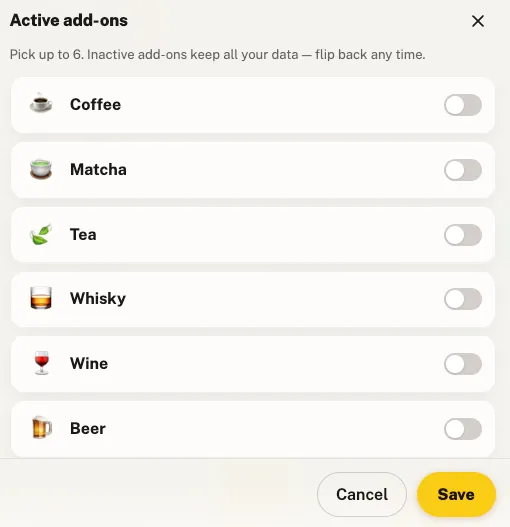
Crumble's matcha journal is a free add-on: one entry per tin with producer, region, grade and the date you opened it, then a bowl logged against that tin and scored on six axes including umami. It is the only way to tell "this tin is not as good" apart from "this tin is older". Matching free journals cover tea, coffee, whisky, wine and beer, and our matcha tracking guide covers the habit.
Frequently asked questions
What does ceremonial grade matcha actually mean?
Legally, nothing. There is no definition of it in Japanese agricultural regulation, no certifying body and no production standard behind it. The term was coined by Western importers and any seller can print it on any tin without making a false claim. What carries real information is a named producer, a named region, a cultivar and a harvest date. A house's own internal grade names mean something within that house's range.
Which is the best matcha producer in Japan?
Marukyu Koyamaen in Uji has the strongest competition record, having taken first prize at Japan's National Tea Competition many times since the 1960s, and its grades are the benchmark others are measured against. Ippodo in Kyoto, founded 1717, is the most accessible outside Japan because it runs a global store, though it currently has purchase limits in place.
Where is matcha produced in Japan?
Mainly in four regions. Uji in Kyoto Prefecture is the historic centre, where the great houses and the shading techniques come from. Nishio in Aichi is the volume centre and tends toward a milder style. Yame in Fukuoka is small and highly regarded. Kagoshima is the modern, mechanised producer and now the largest tencha-producing prefecture, having overtaken Kyoto. Shizuoka, Japan's largest tea prefecture overall, also makes matcha but rarely appears on matcha lists.
Why is there a matcha shortage in 2026?
It is specifically a shortage of tencha, the shade-grown leaf milled into matcha. The Global Japanese Tea Association has described it as the first in history, beginning in autumn 2024. Tencha auction prices have roughly doubled into 2026 and Japanese shops have limited customers to one tin. It will not resolve quickly because a new tea field takes about five to seven years to reach matcha-grade production and Japan lost close to 53,000 tea farmers to retirement between 2000 and 2020.
What is the difference between Uji and Nishio matcha?
Uji in Kyoto Prefecture is the historic centre and the prestige name, and its matcha tends to be the most structured, with deep umami held in balance against bitterness. Nishio in Aichi is the volume centre, a coastal river-delta area, and tends toward a milder, sweeter style that suits lattes and baking. Yame in Fukuoka is small and concentrated; Kagoshima is the modern mechanised producer and is now the largest tencha prefecture.
Does Uji matcha have to be grown in Uji?
No, and this surprises most buyers. The Uji designation is looser than it sounds and does not require that all the leaf was grown there. Treat it as indicating a style and a processing lineage rather than guaranteeing a single origin.
How can I tell if matcha is fake or resold?
Check the harvest date, the named producer and the price per gram together. Marukyu Koyamaen in particular is heavily counterfeited and resold on international marketplaces, and a listing priced well below the house's own shop, or carrying no harvest date at all, is a warning sign rather than a deal. Buy from the house or an authorised retailer.
Which matcha should I actually buy right now?
Ippodo is the practical answer: it runs a global store, and Ummon and Sayaka are the usual entry points, though purchase limits are in force and restocks sell out fast. Marukyu Koyamaen's higher grades have been chronically sold out since 2024, so if you see them at a normal price from an authorised retailer, buy; if you see them cheap on a marketplace, do not. Whatever you buy, look for a harvest date on the tin.