
Food Passport App: Track Every Country You Eat In
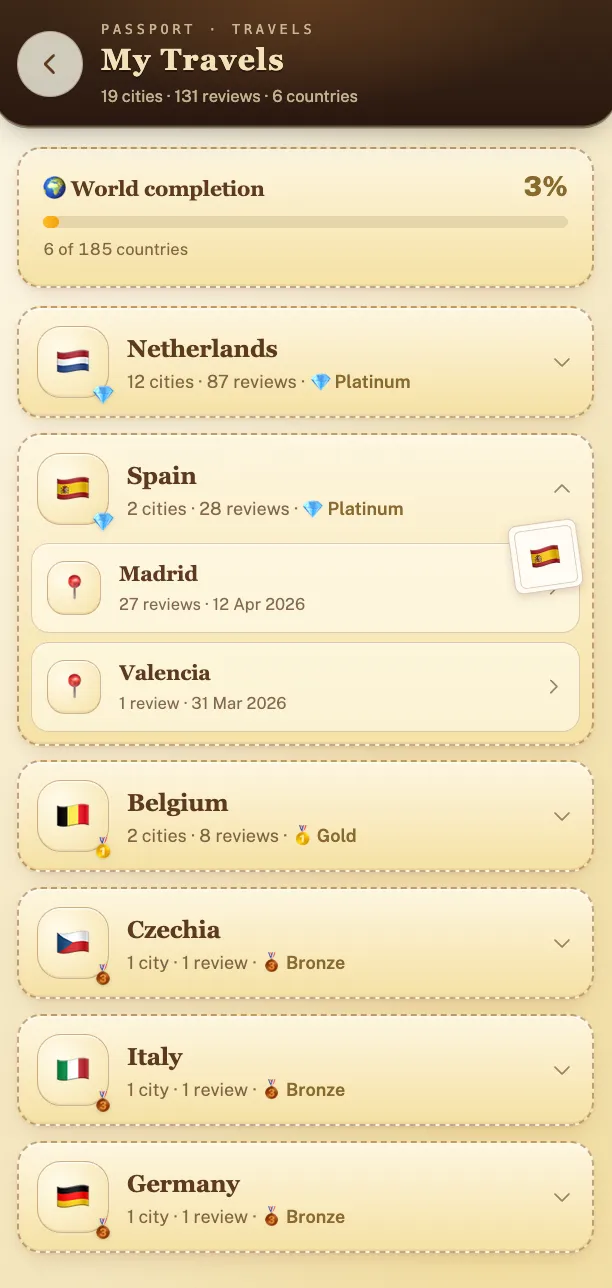
A travel map tells you where you have been. That is a low bar: an airport transfer counts, and so does a country you drove across. A food passport is a stricter and more interesting record, because a country only counts once you have sat down and eaten something there worth writing down.
This is how a food passport app works, what unlocks a flag, and why the rule that a flag cannot be minted from your kitchen is the whole thing that makes it mean anything.
What a food passport app is
It is a collection of countries and cities, earned rather than ticked. In Crumble you do not add a country to your passport. You review a meal, and the country the meal happened in unlocks itself, worth 50 XP the first time.
The distinction from a check-in app matters. A check-in records that you stood somewhere. A review records that you ate something and had an opinion about it, which is a considerably higher bar and produces a record you would actually want to look at in ten years.
Cities are tracked the same way alongside countries, so the passport is legible at both scales: eleven countries reads well, and the forty cities underneath is where the actual memory lives.
How a country unlocks
- You review a dish at a place with real coordinates.
- Those coordinates are reverse geocoded to a country code, which is then cached on the spot so the same lookup never runs twice.
- If it is a country you have not eaten in before, the flag is added to your passport and you get 50 XP.
- If you have already unlocked it, the review still earns its normal 25 XP. Countries are one-time.
That is the whole mechanism, and it means the passport is a byproduct of eating rather than a thing you maintain. There is no separate step to remember and nothing to backfill.
Why your kitchen cannot unlock a country
A home-made review earns XP and holds your streak exactly like any other. It does not unlock a country flag, and that exclusion is deliberate rather than an oversight.
The reason is that a home-made entry carries your home location and no venue identity, so if it could mint a flag then the passport would record where you live rather than where you travelled. Cooking Thai food in Rotterdam is not eating in Thailand, and a passport that cannot tell those apart is a passport worth nothing.
There is a second guard behind it. There is a daily cap on how many country unlocks can award XP, and it exists because coordinates come from the client: without the cap, someone spoofing locations could mint 50 XP per invented country and walk the whole leaderboard in an afternoon. Over the cap the flag is still recorded, because your passport should reflect where you ate. Only the points are withheld.
It is a small thing and it is the difference between a record and a scoreboard you can cheat.
A passport against a pin map
| Pin map | Food passport | |
|---|---|---|
| What earns an entry | Dropping a pin | Eating and rating a meal |
| Airport layover counts | Yes | No |
| Tells you what was good | No | Yes, per dish |
| Effort to maintain | Manual | None, it is a byproduct |
| Meaning in ten years | A shape | A record you can read |
The honest case for the pin map is that it is complete: everywhere you went is on it. The case for the passport is that completeness was never the interesting property. You do not want to know that you passed through 30 countries. You want to know where the good bowl of noodles was.
What sits alongside it
Countries and cities are the base layer. On top of it, trips group the meals of one journey together, and a completed trip is worth 100 XP. Trips deliberately exclude home-made entries, for the same reason flags do: a trip is somewhere you went.
Collections are the manual counterpart, a named set of your own reviews that can span any number of cities and countries, so "Honeymoon 2026" can hold four countries in one shareable thing. The passport is automatic and the collection is curated, and most people want both.
At the end of the year all of it feeds a recap, which is where the passport stops being a collection and starts being a story about your year of eating.
Starting one
The awkward truth of any passport app is that it starts empty and the first entries feel thin. The fix is not to backfill from memory, which produces a record you cannot trust, but to start now and let a year pass. Our guide to tracking food on your travels covers the method on the road, and Polarsteps for food covers how this compares to trip-shaped travel journals.
Frequently asked questions
What is a food passport app?
One that records the countries and cities you have eaten in, unlocked by reviewing a meal rather than by checking in or ticking a list. In Crumble a country flag is added automatically the first time you review a dish there, and it is worth 50 XP. Cities are tracked alongside countries.
How do you unlock a country in Crumble?
Review a dish at a place with real coordinates. Those coordinates are reverse geocoded to a country code and cached on the spot, and if it is a country you have not eaten in before the flag is added and you earn 50 XP. Countries unlock once; later reviews there still earn the normal 25 XP for the review itself.
Does cooking at home unlock a country?
No, and that is deliberate. A home-made entry carries your home location and no venue, so allowing it would make the passport record where you live rather than where you travelled. Home cooking still earns XP and keeps your streak, it just cannot mint a flag.
Can you fake a country by spoofing your location?
You can record a flag, but you cannot farm the points. There is a daily cap on how many country unlocks award XP, specifically because coordinates come from the client and without it a spoofed location would be worth 50 XP a time. Over the cap the flag is still added to your passport and the XP is withheld.
How is a food passport different from a travel map?
A travel map counts anywhere you have been, including an airport transfer or a country you drove across. A food passport only counts places you sat down and ate something you rated, so it is a shorter list and a far more useful one: it tells you what was good, not merely that you were there.
What is the difference between a passport and a collection?
The passport is automatic and geographic: countries and cities unlock as you eat in them. A collection is curated and manual, a named set of your own reviews that can span any number of places, so something like "Honeymoon 2026" can hold four countries in one shareable set. Most people end up using both.