
A Wanderlog Alternative for Tracking Food
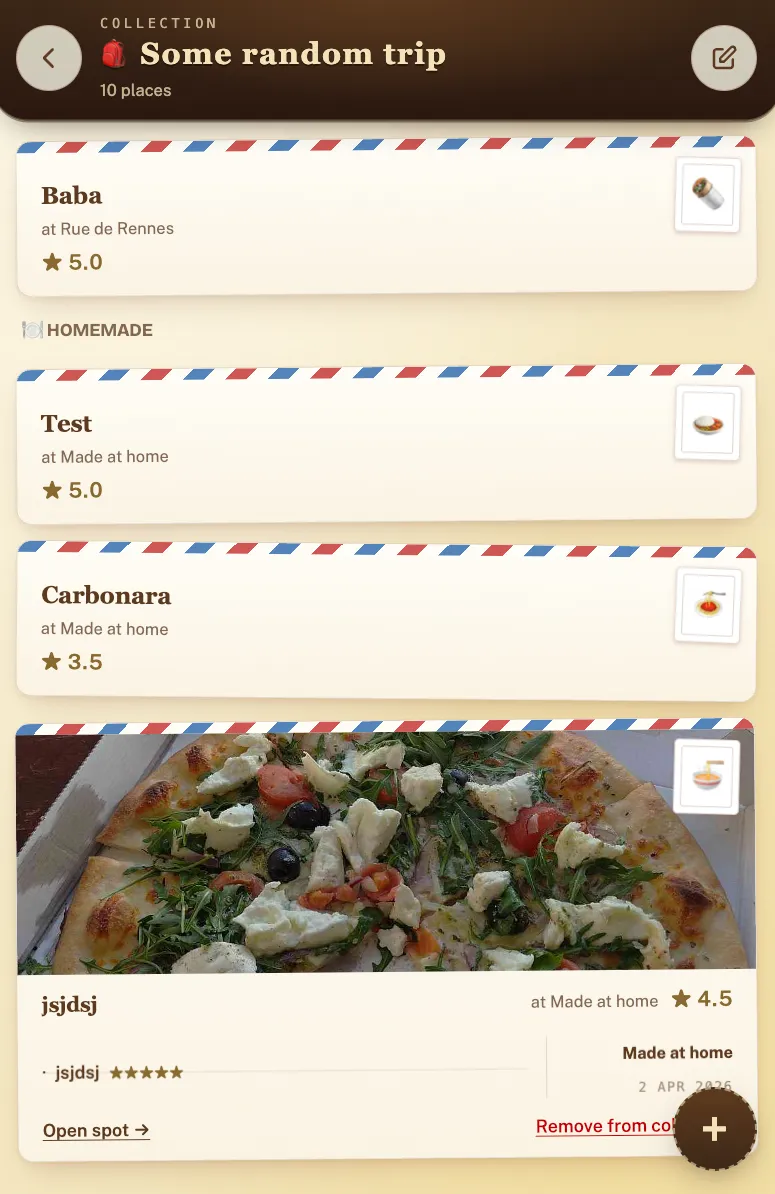
Let us start with the part most "alternative" pages skip: Wanderlog is genuinely good at what it does, and its free tier is more generous than it has any commercial reason to be. Unlimited trips, unlimited places, live collaboration with the people you are travelling with, an itinerary and a map side by side. If you are planning ten days in Portugal with three friends, it is a strong tool and this page is not going to pretend otherwise.
People still search for a Wanderlog alternative, though, and when you read what they actually want, it is usually not a better itinerary builder. It is that they wanted somewhere to keep the food (the places they ate, what they ordered, what was worth going back for) and a trip planner turns out to be the wrong shape for that. This guide is about that mismatch: what Wanderlog is built around, why the food part slips through, and what to use instead or alongside.
The real difference: the trip vs the place
Every organising tool has a unit: the thing everything else hangs off. For Wanderlog that unit is the trip. You create Lisbon 2026, and inside it go days, pins, reservations, flights and notes. That is exactly right for planning, because a trip genuinely is a bounded thing with a start and an end.
The consequence is that a trip ends. When you get home, the document is complete in the way a finished project is complete: technically still there, practically closed. Two years later, when someone asks where to eat in Lisbon, the answer is inside a trip you have to remember existed, scroll through, and mentally separate: which of these forty pins did we actually go to, and which were the maybes?
A food tracker uses a different unit: the place, and the visit attached to it. There is no container to close. Lisbon and your own neighbourhood live on the same map, sorted by where you are rather than by which document you filed them in. The question it answers well is not "what is the plan?" but "what did we like, and is any of it near me?", and that second question keeps being asked for years after the trip is over.
What Wanderlog does better
Straight, because these matter and no food tracker matches them:
- Day-by-day itineraries. Ordering stops within a day, seeing travel time between them, moving a block when a museum turns out to be shut. That is planning work, and Wanderlog does it properly.
- Live collaborative planning. Several people editing one trip at once, in the free tier. For a group holiday this is the whole product, and it is the feature most alternatives get wrong.
- Everything else in a trip. Flights, hotels, reservation numbers, the rental-car confirmation. A trip is not only food, and a food app should not pretend to hold your boarding passes.
- Route optimisation and offline maps on the paid tier, which is the right home for them: offline access matters most exactly when you are abroad without data.
Wanderlog Pro sat somewhere in the region of $40–50 a year through 2026 depending on platform and promotion, adding AI planning, route optimisation, offline access and flight tracking. Check the current price before deciding; the free tier is the one most people stay on, and reasonably so.
Where the trip-shaped model breaks for food
- Saving is not the same as rating. A pin records intent. It does not record what happened. Six months on, a Wanderlog trip cannot tell you whether the place was excellent or a mistake, because the tool never asked you afterwards: planning tools ask before, not after.
- Your home city has no trip. Most of your eating happens where you live, and there is no natural container for it. People end up making a fake trip called "Amsterdam" that never ends, which works, and also tells you the model is being bent.
- Went and wanted are the same pin. The distinction that matters most in food (been here versus want to go) is not a first-class thing in a planner, because during planning everything is a "want to go". After the trip, nothing separates them again.
- The dish is nowhere. The single most useful thing you can record about a meal is what to order next time. In a planner that is a free-text note on a pin, if you remember to write it, which nobody does at the table.
- No cumulative record. Twelve trips means twelve documents. There is no "every place I have rated above 4", no map of your whole eating history, no way to see that you have now eaten in nineteen cities.
Wanderlog vs a food tracker, side by side
| Wanderlog | Crumble | |
|---|---|---|
| Organising unit | The trip | The place and the visit |
| Best at | Planning a trip before you go | Remembering what you ate after |
| Rating | Not the point | Six-word notes and a 0–5 score |
| Been vs want to go | One pin type | Two states; the wishlist clears itself |
| Home city | Needs a fake trip | Same map as everywhere else |
| Dish notes | Free-text note, if you remember | A field, prompted every time |
| Friends | Co-editors on one trip | Their whole map, all the time |
| After the trip | Document closes | Nothing closes |
| Flights, hotels | Yes | No, use Wanderlog |
| Price | Free tier; Pro roughly $40–50/yr | Free |
What to do with the trips you already have
You do not need to migrate anything mechanically, and you should not try. The useful move is a one-hour pass over your finished trips, done once:
- Ignore everything you did not visit. Half the pins in any planned trip are options that never happened. They were useful during planning and they are noise now: they were never a record of anything.
- For the places you did go to, write the score and the dish while you still remember. Be honest about age: if you cannot recall the meal, the entry is not worth creating. A vague four-star from 2023 is worse than no entry, because it will mislead you later.
- Do not recreate the itinerary. The order you visited things in mattered for four days and has not mattered since. Carrying it over is work that buys you nothing.
- Leave the trip in Wanderlog. Nothing is gained by deleting it, and the flight numbers and hotel bookings genuinely belong there rather than in a food app.
What you end up with is far fewer entries than the trips contained, which feels like loss and is actually the whole point. A record of forty maybes is worse than a record of twelve certainties: the first one you have to re-evaluate every time you open it, and the second one you can trust.
The honest recommendation: use both
This is not a page arguing you should delete Wanderlog. The two tools have almost no overlap once you see the unit difference, and the sensible setup for anyone who travels and cares about food is to run them together.
Before the trip, plan in Wanderlog: days, transport, hotels, the shape of the week. During and after, log the food where it will still be findable in three years: a score, the dish, whether you would go back. That way the plan gets thrown away when the trip ends, which is correct, and the record does not, which is the point.
Crumble is free and built entirely for that second half: trips group your reviews without hiding them, a food passport counts the countries and cities as you go, and everything stays on one map. Our guide to tracking food on your travels covers the workflow properly, and if you also keep a pile of pins in Maps, Google Maps lists is the companion page.
For the wider comparison (Mapstr, Beli, Swarm and the rest), see our roundup of the best restaurant tracking apps, or the Mapstr alternative page if a map of pins is closer to what you have now. If your travel notes currently live in a spreadsheet, the Google Sheets template is worth reading before you build another one.
Frequently asked questions
What is the best Wanderlog alternative?
It depends what you wanted Wanderlog for. For planning trips day by day with other people, there is no strong reason to leave: the free tier is unusually generous. For remembering the food afterwards, you want a tool organised around places rather than trips, so that your home city and every past trip sit on one map and each place carries a rating and a dish note. The two do different jobs and most people are best served running both.
Is Wanderlog free?
Yes, and genuinely so: the free tier covers unlimited trips, unlimited saved places, itineraries, maps and live collaboration. Wanderlog Pro was in the region of $40–50 a year through 2026 depending on platform and promotion, adding AI planning, route optimisation, offline maps and flight tracking. Most people stay on the free tier.
Can you use Wanderlog to track restaurants you have been to?
You can save them, but the model works against you. A pin records that you intended to go, not what happened, and the tool never asks you afterwards how it was. There is also no split between been and want-to-go, no rating, and no place for your home city other than a trip that never ends. It records plans well and visits poorly.
Wanderlog vs Google Maps lists for a trip?
Wanderlog wins clearly for planning: days, ordering, travel time between stops and real-time collaboration are all things Maps lists cannot do. Maps lists win only on already being on your phone. Neither is built to tell you, two years later, which of the saved places you actually went to and whether they were any good.
Do I have to choose between a trip planner and a food tracker?
No, and choosing is usually the mistake. Their units do not overlap: a planner is organised around a trip that ends, a food tracker around places that accumulate. Plan the trip in the planner, log the meals in the tracker, and let the plan expire while the record stays. That is one job each rather than two half-jobs.