
Food Journal Apps Without Calories (Mindful & Non-Diet)
The best food journal apps without calories are See How You Eat, AteMate and Food Diary: Diet & Health Log if you want to notice when and how you eat, Treatly if you want a joyful log of treats, and Crumble if you want to remember the dishes you loved on a map you share with friends. None of them make you weigh portions or count calories.
This guide is for mindful, non-diet journaling: noticing hunger, mood and regular meals, or simply enjoying food, without a single number. Most "food diary" apps are calorie counters with a friendlier name; within a minute you are searching a database for "chicken breast, grilled, 100 g". If what you really want is a log of restaurants and dishes to come back to, our best food diary apps roundup compares restaurant-memory trackers like Beli, Truffle and Memolli instead.
Which food journal apps don't count calories?
| App | Best for | Calories | Platforms | Price (Oct 2026) |
|---|---|---|---|---|
| See How You Eat | Photo diary for regular, mindful eating; share logs with a coach | Absent | iPhone, iPad, Apple Watch, Android | Free download, premium subscription |
| AteMate | Food, mood, sleep and movement journal with an AI coach | Optional, not targets | iOS, Android | Free trial, then subscription |
| Your Food Journal | Food groups, hunger scale and reflections | Absent | Apple devices only | Free, optional Premium |
| Food Diary: Diet & Health Log | Quick log of meals, mood, meds, water and activity | Not counted | Android | Free, in-app purchases |
| Treatly | A happy photo log of coffee, boba and desserts | Absent | iPhone (also Mac, Vision) | Free, one-time Pro upgrade |
| Yummi | Photo timeline of meals on a calendar and map | Not tracked | iOS, Android | Free |
| Crumble | Remembering dishes, restaurants and home cooking with friends | Absent | Any browser; installs to the home screen on iPhone and Android | Free |
"Absent" means the app has no calorie or macro numbers at all; "not counted" means the app never asks you to count them; "optional" means they exist but are not pushed on you. If even the possibility of numbers is a problem for you, stick to the "absent" rows.
What kind of calorie-free food journal do you want?
There are two kinds of calorie-free food journal: mindful eating journals that track patterns such as timing, hunger and mood, and food memory journals that record the dishes and places you want to remember.
- Noticing patterns. When and how regularly you eat, how meals relate to mood, or a simple log to share with a dietitian. That is a mindful eating journal: See How You Eat, AteMate, Your Food Journal, Food Diary: Diet & Health Log.
- Enjoying and remembering food. Good meals to look back on, what you ordered, what to cook again. That is a food memory journal: Crumble, Yummi, Treatly.
- A specific obsession. Coffee, sweet treats, wine. A narrow journal keeps the log fun instead of dutiful.
Still deciding between a calorie counter and something else? Our food tracker app guide covers that split, with MyFitnessPal as the straightforward pick for nutrition goals.
Which food journal apps are best for mindful eating?
See How You Eat, AteMate, Your Food Journal and Food Diary: Diet & Health Log are the best calorie-free apps for mindful eating: they track when you eat, how hungry you were and how you felt, not how much.
See How You Eat: photo logging in two taps
See How You Eat is built specifically around "no calorie counting". You photograph a meal and it lands on a visual timeline of your day, so you see how regularly you ate and what your plate looked like. It adds meal reminders, water tracking and 14-day challenges, and can export your log as a PDF for a coach, dietitian or doctor.
Trade-offs: a health-habits tool, not a memory book: no place for "order the spicy ramen next time". Many features sit behind a subscription.
AteMate: food, mood and the rest of your day
AteMate, previously called Ate, is a photo journal that records how you felt alongside what you ate, and widens out to sleep, movement and hydration. An AI coach reads your journal and points out patterns. In its own FAQ, calories and macros are "optional learning tools, not daily targets", so numbers are available but not the default.
Trade-offs: if you want zero calorie information in the app at all, the optional numbers may be one click too close. After a free trial it is a subscription.
Your Food Journal: food groups and hunger cues
Your Food Journal swaps calories for food-group tags (protein, carbs, vegetables and so on), a hunger scale and a daily free-text journal, with a calendar of past meals (the free edition shows the last week; full history is Premium). It runs on iPhone, iPad and Mac, and is free with an optional Premium subscription.
Trade-offs: Apple only, and food-group logging can still feel like homework.
Food Diary: Diet & Health Log: meals, mood and meds in a few taps
Food Diary: Diet & Health Log, by HAMMANTech, describes itself as a way to track "meals, mood, meds, and more" without "the hassle of counting calories or macros". You log meals alongside mood, medication, water and activity, create your own categories, set a gentle reminder, and share your log with a healthcare provider, family or friends by email or message. As of October 2026 it is free on Android with in-app purchases, and its Google Play listing was last updated in September 2026.
Trade-offs: its listing is on Google Play, so this is an Android pick, and it is a health log rather than a place to enjoy food or look back on good meals.
Which food journal apps help you remember meals you loved?
Treatly and Yummi are photo-first diaries for remembering food rather than measuring it; Crumble, covered in its own section below, adds a rating and a note for each dish.
Treatly: a treat diary that is meant to be fun
Treatly is a photo journal for sweet treats and drinks: coffee, boba, ice cream, pastries. It cuts your photo out into a sticker, puts it on a monthly calendar, and lets you add a rating, note, place and price. Its App Store listing says it is "deliberately not a health tracker": no nutrition info and no calorie counts. A friends-only feed lets you see and comment on friends treats. As of October 2026 it is free on iPhone with a one-time Pro upgrade.
Trade-offs: iPhone only (no Android), and it is about treats, not your main meals.
Yummi: a photo timeline of everything you eat
Yummi turns your food photos into geotagged "Foodprints" laid out on a calendar and a map. It covers home-cooked meals, drinks and groceries as well as restaurants, and has no nutrition tracking. It also lets you follow other foodies and get recommendations, so it leans more social and discovery-driven than a quiet diary.
Trade-offs: ratings and "what should I order next time" take a back seat to the photos. More in our Yummi alternative guide.
How does Crumble work as a calorie-free food journal?
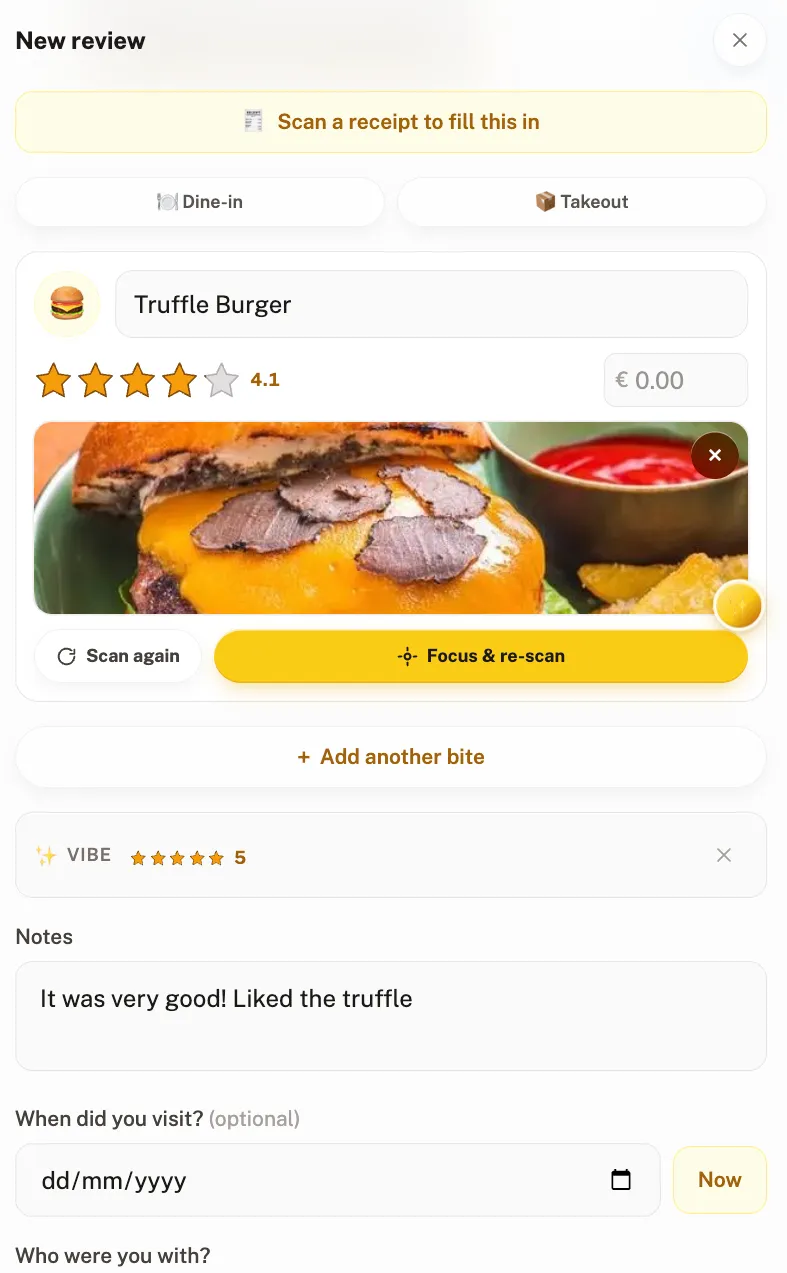
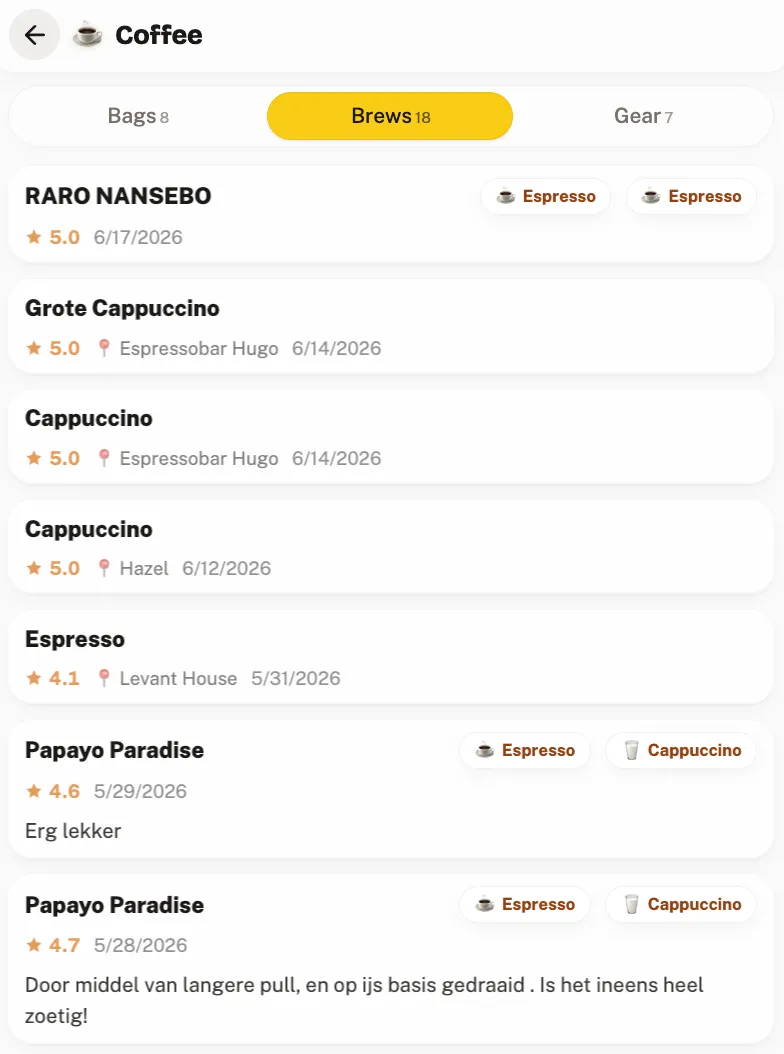
Crumble was never a nutrition app, so there is no calorie field to hide. Every entry is about the food as an experience: where you ate it, what the dish was, how good it was, and what you want to remember.
- Per-dish ratings, not daily totals. Rate each dish from 0 to 5 in tenth-of-a-star steps (★ 4.2), with a note and a photo. Next time you know to order the ramen and skip the gyoza.
- Restaurants and home cooking in one place. Search a place, drop a pin for a spot without a listing, or log a home-cooked dish. Your home location stays visible only to you.
- A map instead of a calorie graph. Your journal is a map of everywhere you've eaten, plus a travels view of every country and city. Looking back feels like flipping through a trip, not a report card.
- No numbers to switch off. There is no calorie, macro or portion field anywhere in Crumble, and nothing asks you to weigh your food. The app does have XP and levels for logging; if a score feels like pressure, the "Show levels and XP" switch in your profile settings hides them. Reviews are visible only to accepted friends, unless you share a link yourself.
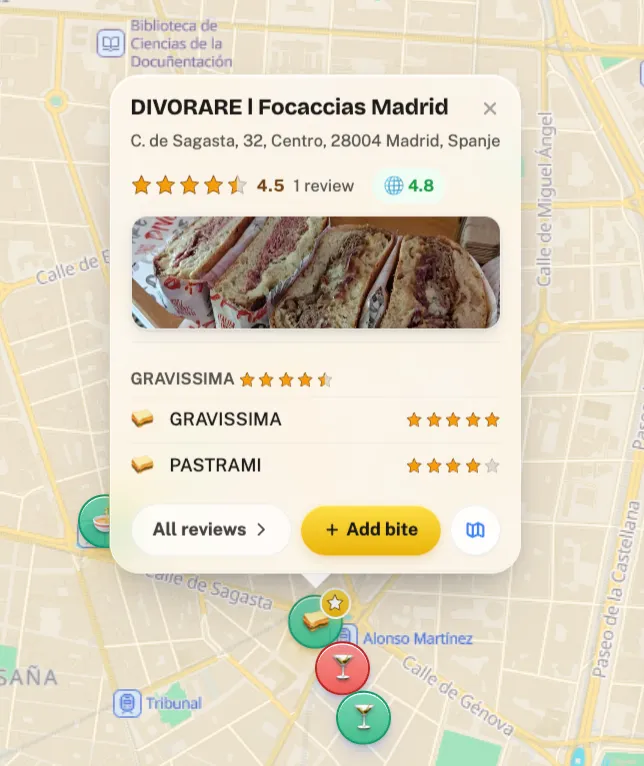
Crumble is free and runs in any browser as a Progressive Web App: open it on your iPhone or Android phone and add it to your home screen. A native iOS app is in development.
If home cooking is the main thing you want to record, we have a dedicated comparison of home cooking journal apps and a practical guide to tracking what you cook without it turning into a chore.
When is another app the better pick?
- You want to work on eating regularly or share a log with a professional → See How You Eat. Crumble is about the food itself, not when or how regularly you eat.
- You want to connect food with mood, sleep and energy → AteMate. Crumble records how good a dish was, not how you felt afterwards.
- You are on Android and want a plain log of meals, mood and medication to show a doctor → Food Diary: Diet & Health Log.
- You mainly want to celebrate desserts and drinks, on iPhone → Treatly is cuter and more focused.
- You want a photo timeline that also covers drinks and groceries → Yummi.
- You want to remember great dishes and places, and share them with friends → Crumble.
Is a calorie-free food journal a good idea if you're recovering from an eating disorder?
Only your care team can answer that for you, so ask them first and follow their advice over any app's, including ours. We are a food app, not clinicians. For some people a food record is part of treatment; for others any logging is unhelpful for a while. If your team does suggest a journal, apps with no numbers at all (the "absent" rows above) are a different experience from apps where calories are merely switched off. And if a feature makes you anxious, that is the feature to turn off, or the app to delete.
Some care teams use apps designed for treatment, such as Recovery Record, which links a client's entries with their clinician. That is a decision to make with your team, not from a list like this one. If you are worried about your eating and do not have support yet, NEDA in the US and Beat in the UK offer information and help finding support.
Can a food journal help with intuitive eating?
A food journal can support intuitive eating if it records how you felt rather than how much you ate. Intuitive Eating is a non-diet framework created by two dietitians, Evelyn Tribole and Elyse Resch, in 1995; its ten principles include "Honor Your Hunger", "Feel Your Fullness" and "Discover the Satisfaction Factor".
None of the apps here is an intuitive eating program, and an app cannot teach the approach for you; a dietitian trained in it can. What an app can do is give you somewhere calm to write things down: a hunger note in Your Food Journal, a mood entry in AteMate or Food Diary: Diet & Health Log, or in Crumble a rating and a line about which dish genuinely satisfied you.
How do you keep a food journal without counting calories?
- Decide what the journal is for. Patterns, memories or a hobby. One sentence is enough, and it tells you what to log.
- Log the meals that matter, not every bite. Restaurant meals, dishes you want to cook again, the coffee that surprised you. Logging every input is calorie-counter behaviour and burns the habit out.
- Write one useful sentence. "Ask for it less sweet", "double the garlic next time". It beats a photo when you come back to it.
- Log before you leave the table. Thirty seconds while waiting for the bill beats reconstructing it next week.
How we chose these apps
We included an app if it is a food journal you can use today, has no calorie or macro numbers or keeps them strictly optional, and is free to download or try. Descriptions come from each app's own website or store listing as of October 2026. We left out calorie counters with a "hide calories" setting, because portion sizes and daily totals are still their core.
Older and look-alike apps we left out
FoodyLife was one of the first no-numbers food diaries on iPhone, but its App Store listing shows no update since 2019, so we no longer recommend building a habit on it. We also checked newer apps with "food journal" in the name, such as Eaten, and dropped the ones that turned out to be calorie trackers.
Frequently asked questions
Is there a food journal app with no calories at all?
Yes. See How You Eat, Your Food Journal, Treatly and Crumble show no calorie or macro numbers anywhere. Food Diary: Diet & Health Log does not ask you to count calories, AteMate has calories and macros as optional extras, and Yummi simply does not track nutrition.
What is the best free food journal app without calorie counting?
For remembering what you ate at restaurants and at home, Crumble is free with no paywall on journaling. Yummi is free too. See How You Eat and Your Food Journal are free to download, with paid premium features.
Can I use a photo food diary instead of writing everything down?
Yes. See How You Eat, AteMate, Treatly and Yummi are all photo-first: you snap the plate and the app files it by date. Crumble takes photos too, but adds a rating and a note per dish so the entry is useful when you want to order or cook it again.
Can I just hide calories in a calorie-counting app instead?
Some calorie counters let you hide or de-emphasise numbers, but they remain nutrition databases built around portion sizes and daily totals. If you want to get away from counting, an app that never had calories in the first place is usually a calmer experience.
Is there an intuitive eating app without calories?
Not one that replaces a trained dietitian, but several calorie-free journals fit the approach. Your Food Journal has a hunger scale, AteMate and Food Diary: Diet & Health Log record mood next to meals, and Crumble lets you note which dishes genuinely satisfied you. None of them asks for portions or totals.
Is a food journal without calories okay for eating disorder recovery?
Ask your treatment team before you start; their guidance comes first. Some people in recovery keep food records as part of treatment and others are advised not to log at all for a while. If you have no support yet, NEDA in the US and Beat in the UK can help you find it.
Can I track home-cooked meals and restaurants in the same food journal?
Yes. Crumble, Yummi and the mindful eating journals all accept home cooking. In Crumble a home-cooked dish gets the same rating, note and photo as a restaurant dish, and your home location is visible only to you.
Start a food journal that isn't about numbers
No targets, no totals, no grams. Write down one dish you loved this week, from a restaurant or your own kitchen, and see how it reads a month from now.