
The best specialty coffee roasters in the UK
Two things about British specialty coffee surprise people. The first is that a lot of the best of it is deliberately nowhere near London: Cornwall, Bath, Somerset, West Yorkshire and Bristol all hold roasters that could have set up in the capital and chose not to.
The second is how the market sorts itself. German roasters compete on published price transparency. British ones compete on competition record, and national championship pedigree is the credential that goes on the shelf. It is a different culture, and it explains why the list below reads the way it does.
Best coffee roasters in the UK at a glance
The short answer: Square Mile in London set the national style and was founded by two 2007 world champions. Origin in Cornwall is the long-running direct-trade B Corp, and Colonna in Bath is the pick if you brew precisely. The table sorts the five we profile by who each one suits, and the full list below covers the rest of the country.
| Roaster | Where | Known for | Order here if |
|---|---|---|---|
| Square Mile Coffee Roasters | London | Founded 2008 by two 2007 world champions | You want the British reference: light, clean, filter-forward |
| Origin Coffee | Helston, Cornwall | B Corp and direct trade, roasting since 2004 | Sourcing ethics decide what you buy |
| Colonna Coffee | Bath | Extraction science from a three-time UK Barista Champion | You weigh your doses and want to know why |
| Assembly Coffee | London | Roast profiles tuned per client; UK Barista Champion 2022 | You drink in good London cafes |
| Ozone Coffee Roasters | London | Took over Has Bean, retired as a brand in 2024 | You used to order from Has Bean |
Square Mile: two world championships in one year, then a company
London, founded 2008 by James Hoffmann and Anette Moldvaer. The founding credential is remarkable and worth stating carefully: Hoffmann was 2007 World Barista Champion and Moldvaer was 2007 World Cup Tasters Champion. Two world titles, in different disciplines, in the same year, and then a roastery built by both of them.
Square Mile was one of the first wholesale specialty coffee companies in London and is the closest thing the British scene has to a founding institution. Its house style became the national reference point: light, clean, modern and filter-forward, which is what most British specialty still measures itself against.
Origin: Cornwall, and a B Corp that means it
Helston, Cornwall, founded 2004 by Tom Sobey. Origin is the clearest example of the British pattern of building serious coffee a long way from London, and at twenty years old it predates most of the roasters people think of as established.
It is a certified B Corporation operating a direct trade model, working with producers directly rather than through the spot market. That certification is the British scene's default ethical credential in the way a published price list is the German one, and it is worth understanding the difference: B Corp certifies the whole company against a standard; a German transparency report shows you one specific number. They are not substitutes, and a buyer who cares should want both.
Colonna: coffee as extraction science
Bath. Colonna is inseparable from Maxwell Colonna-Dashwood, and the record is exceptional: UK Barista Champion in 2012, 2014 and 2015, a three-time World Barista Championship finalist, and fifth in the world at the 2015 championship in Seattle on 13 April 2015.
What makes Colonna worth ordering rather than just admiring is that the competition background shows in the approach. The roastery is analytical and precision-led, extraction-science-forward rather than romantic, and has done serious published work on water chemistry and its effect on extraction. If you are the kind of drinker who owns a refractometer, or would like to be, this is your roaster.
Assembly: a different roast for every customer
London. A certified B Corporation, and Claire Wallace of Assembly won the UK Barista Championship in 2022.
The distinctive thing about Assembly is operational: it is expressive and profile-led, tuning roasts per client rather than imposing one house curve on every coffee. That is harder than it sounds and it is why the company is so visible in good London cafes. For a home buyer it means the range varies more than most, which is a feature if you like variety and a nuisance if you want the same bag every month.
What happened to Has Bean? Ozone, and a retired brand
London. Ozone matters for the coffee and for what it represents. The UK is the most consolidated of the European markets at independent-roaster level, and the clearest single case is this one.
Ozone acquired Has Bean Coffee on 29 June 2018. Has Bean was one of the most loved independent roasters in Britain, and it was labelled "Hasbean by Ozone" from late 2023 and fully retired as a brand on 26 March 2024. Has Bean founder Steve Leighton joined Ozone along with Dale Harris and Chris Glover-Price.
We are spelling this out because Has Bean still appears on current "best UK coffee roasters" lists, published this year, recommending a brand that no longer exists. If you have been meaning to order from them, that is why you cannot.
How do UK roasters prove they are good?
Mostly with a trophy and a training room. The British scene is competition- and education-led. National championship pedigree is what roasters put on the shelf, and the founding institution was built by two world champions in 2008. Roasters here are as likely to run training courses and publish brewing method as they are to publish sourcing economics.
Germany went the other way, competing on published price transparency, with one Hamburg roaster publishing its own purchase contracts and staff wages. Neither is better, but they answer different questions. A championship tells you the people know what good tastes like. A published invoice tells you what the farmer was paid. Our German roasters guide covers that side.
The national championships, the UK Barista Championship and the UK Brewers Cup, run under SCA UK. Recent winners include Claire Wallace of Assembly in 2022 and Ian Kissick of Formative Coffee in 2023.
What to check before you buy
- Look past London. Cornwall, Bath, Bristol and West Yorkshire hold roasters the equal of anything in the capital, often with better value because the rent is not in the bag.
- Treat a championship claim as checkable. Titles, years and the competitor's name should all be findable. A roaster describing itself as the home of champions without naming them is telling you less than it sounds.
- B Corp and price transparency are not the same thing. One certifies the company against a broad standard, the other shows you what a specific producer was paid.
- Check the roast date, not the best-before. Same rule everywhere, and still the one most often ignored. Logging it per bag is the first step in how to track specialty coffee.
- Check the list you are reading is current. British specialty has consolidated fast. If a guide still recommends Has Bean, it has not been updated since March 2024.
The full list, Cornwall to Sheffield
The five above are the ones to understand first. Below is the full list, and it is where the geography really shows: Cornwall, Somerset, Bristol, Leeds, Sheffield, Wiltshire, Kent and Herefordshire all appear, and a roaster in Ross-on-Wye has been at it since 1999.
-
Square Mile Coffee Roasters
Founded 2008 by James Hoffmann, 2007 World Barista Champion, and Anette Moldvaer, 2007 World Cup Tasters Champion. The light, clean, filter-forward British reference point.
View in Crumble: Square Mile Coffee Roasters Their site: Square Mile Coffee Roasters (opens in a new tab)
-
Origin Coffee
Founded 2004 by Tom Sobey. Certified B Corporation running a direct trade model, and one of the few roasteries here you can sit in, with QC and training rooms on site.
View in Crumble: Origin Coffee Their site: Origin Coffee (opens in a new tab)
-
Colonna Coffee
Maxwell Colonna-Dashwood was UK Barista Champion in 2012, 2014 and 2015, a three-time World Barista Championship finalist and fifth in the world in 2015. Analytical and extraction-led.
View in Crumble: Colonna Coffee Their site: Colonna Coffee (opens in a new tab)
-
Assembly Coffee
Certified B Corporation, and Claire Wallace won the UK Barista Championship in 2022. Profile-led, tuning roasts per client rather than to one house curve.
View in Crumble: Assembly Coffee Their site: Assembly Coffee (opens in a new tab)
-
Ozone Coffee Roasters
Acquired Has Bean on 29 June 2018 and retired the brand on 26 March 2024, the clearest case of consolidation in British specialty coffee.
View in Crumble: Ozone Coffee Roasters Their site: Ozone Coffee Roasters (opens in a new tab)
-
Dark Woods Coffee
A certified B Corporation roasting in a Victorian mill on the edge of the Pennines, and the strongest argument that serious British coffee is a northern business too.
-
North Star Coffee Roasters
In 2021 became the first UK coffee company to move to home-compostable packaging, and certified B Corp in 2022.
-
Round Hill Roastery
A long-standing Somerset roastery and one of the names that made the case for buying British coffee from outside a city at all.
-
Extract Coffee Roasters
Has run continuously from the same Bristol base since 2007, nearly two decades of independent trading, and has been voted best speciality roaster in the UK.
-
Redemption Roasters
Built the world's first prison-based coffee roastery, inside HMYOI Aylesbury at the Ministry of Justice's invitation, then scaled into HMP The Mount. Training aimed at reducing reoffending.
-
Girls Who Grind Coffee
Buys 100 percent of its green coffee from women producers: one absolute sourcing rule, and far harder to run than a slogan.
-
Curve Coffee Roasters
A fully traceable supply chain built on long-term direct relationships with smallholders, with a named published origin list rather than rotating anonymous lots.
-
Foundry Coffee Roasters
In November 2019 it put cafe and roastery in one room on the River Don, so you can watch the roast that fills your cup.
-
James Gourmet Coffee
Roasting specialty coffee since 1999, which predates essentially the entire modern UK scene including Square Mile, and still independent from one Herefordshire unit.
-
Workshop Coffee
A founding name of London specialty that was divested in 2023, acquired in January 2024 and closed its last retail site that September, before relaunching in Belgravia in February 2026.
-
Kiss the Hippo
Founded 2018 and carbon-negative by its own account. Its UK Barista Championship wins are company-stated rather than listed by SCA UK.
View in Crumble opens the map with that name already typed into the search, so you can find the branch nearest you, see what is actually there and log it yourself. Street addresses are deliberately absent: places move, open second sites and close them again faster than a guide gets updated, so the map is the more current answer.
Keep a record of what you drank
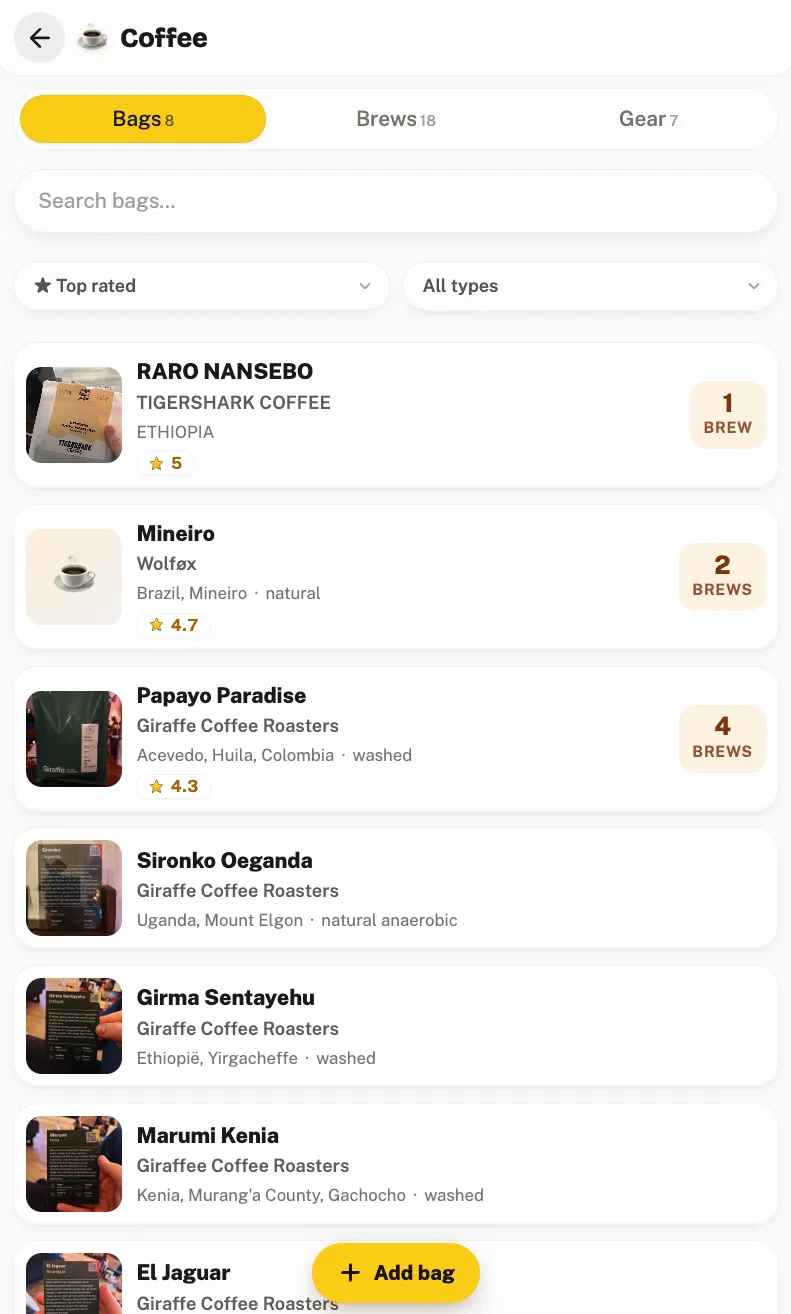
British roasters rotate seasonal single origins hard, and the good lots are gone in weeks. Six months on you will remember that a Kenyan was extraordinary and not which roaster or which farm, which means you cannot order it again. Crumble's coffee journal is a free add-on: one entry per bag with roaster, origin, process and roast date, then each brew scored underneath on six axes from acidity through aftertaste.
Matching free journals cover tea, matcha, whisky, wine and beer. Our guide to tracking specialty coffee covers the habit, and the coffee tracking apps comparison covers the alternatives.
Frequently asked questions
What happened to Has Bean Coffee?
It no longer exists. Ozone Coffee Roasters acquired Has Bean on 29 June 2018, the coffee was labelled Hasbean by Ozone from late 2023, and the brand was fully retired on 26 March 2024. Founder Steve Leighton joined Ozone. It still appears on current best-of lists, which is a good test of whether a guide has been updated.
Which is the best specialty coffee roaster in the UK?
Square Mile in London is the founding institution, built in 2008 by James Hoffmann, the 2007 World Barista Champion, and Anette Moldvaer, the 2007 World Cup Tasters Champion. For precision and extraction science, Colonna in Bath, whose founder took the UK Barista Championship in 2012, 2014 and 2015. For direct trade with a B Corp behind it, Origin in Cornwall.
Why are the best British roasters not in London?
Partly cost and partly deliberate choice. Origin is in Helston in Cornwall, Colonna in Bath, and there are serious roasters in Bristol, Somerset and West Yorkshire. Unlike the Netherlands, where the scene splits between Amsterdam and Rotterdam, British specialty is genuinely spread across the country and some of the best value is outside the capital.
How is British specialty coffee different from German?
The credential is different. Britain is competition- and education-led, so roasters advertise national championship pedigree and run training. Germany is transparency-led, so roasters publish price data, and one Hamburg roaster publishes its own purchase contracts and staff wages. Britain's default ethical credential is B Corp certification, which certifies the company rather than disclosing a specific price.
Who won the UK Barista Championship recently?
Claire Wallace of Assembly Coffee took it in 2022 and Ian Kissick of Formative Coffee in 2023. Both are listed by SCA UK, which runs the competition.
Why are some famous London roasters not on this list?
Because fame is not the criterion. The roasters here roast their own coffee, say where it came from, and hold a credential you can check: a championship the competition body lists, or published sourcing. Several very well known names trade largely on reputation and volume.
Is this list based on coffee you drank yourselves?
No. Our city guides are built from meals we logged ourselves; this one is built from competition records and published sourcing, and judged on whether a roaster roasts its own coffee and tells you where it came from.