
The best specialty coffee roasters in the USA
American specialty coffee is really two markets, and the line between them is ownership. The names that defined US third wave in the 2000s are now almost all owned by large food and investment groups. Below them sits an independent tier where the credential is either a competition record or a published transparency report.
That second tier is the interesting one, and it is also where the most decorated American roaster of the past decade sits: not in Portland, Brooklyn or the Bay Area, but in Rogers, Arkansas.
Best coffee roasters in the USA at a glance
The short answer: Onyx Coffee Lab in Rogers, Arkansas is the most decorated American roaster of the past decade. Sey in Brooklyn runs one of the best green-buying programmes in the country, and Counter Culture in Durham publishes the sourcing data everyone else copied. The table sorts the six we profile by who each one suits. Stumptown, Intelligentsia, Blue Bottle and La Colombe are missing on purpose: all four are corporate-owned, and the ownership table below shows who owns them.
| Roaster | City | Known for | Order here if |
|---|---|---|---|
| Onyx Coffee Lab | Rogers, Arkansas | Andrea Allen, 2020 US Barista Champion and 2021 world runner-up | You want the competition benchmark |
| Sey Coffee | Brooklyn, New York | Green sourcing, and a very light, bright house style | You want clean single origins, not chocolatey espresso |
| Counter Culture Coffee | Durham, North Carolina | The first coffee transparency report, in 2009 | You want published sourcing data |
| George Howell Coffee | Acton, Massachusetts | Founded by the man who conceived Cup of Excellence | You want to taste why US specialty went light |
| Black & White Coffee Roasters | Raleigh, North Carolina | Founded by the 2016 and 2017 US Barista Champions | You want the coffee and do not mind it is no longer independent |
| Prodigal Coffee | Boulder, Colorado | Scott Rao's roastery, founded 2021 | You want roasting theory in a cup |
Who owns Stumptown, Intelligentsia, Blue Bottle and La Colombe?
None of these are on the list below, and this is why. Peet's, owned by JAB Holding, bought both Stumptown and Intelligentsia in 2015. Nestlé took a majority stake in Blue Bottle in 2017. Chobani bought La Colombe for roughly 900 million dollars in 2023.
| Brand | Owner | Year |
|---|---|---|
| Stumptown | Peet's (JAB Holding) | 2015 |
| Intelligentsia | Peet's (JAB Holding) | 2015 |
| Blue Bottle | Nestlé (majority stake) | 2017 |
| La Colombe | Chobani | 2023 |
| Black & White | FairWave Specialty Coffee Collective | 2025 |
None of that makes the coffee bad. It does mean that the four brands most Americans name when asked about specialty coffee are corporate-owned, and that a guide recommending them as independent alternatives to Starbucks is describing a market that stopped existing around a decade ago.
The newer development is that consolidation has reached the second tier. In April 2025, FairWave Specialty Coffee Collective acquired Black & White Coffee Roasters, one of the most respected independents in the country. The coffee is still excellent, so it stays on the list, with the new ownership noted.
Onyx Coffee Lab: the best in America, from Arkansas
Rogers, Arkansas, founded 2012 by Jon and Andrea Allen. Onyx has become the most decorated American roaster of the past decade, and the location is genuinely part of the story: American specialty excellence is not concentrated on the coasts the way people assume.
The record is specific. Andrea Allen was 2020 US Barista Champion and finished runner-up at the 2021 World Barista Championship. That is the highest a US competitor has placed in recent memory and it is attached to a roastery you can order from directly.
Sey Coffee: the green buying is the point
Brooklyn, New York. Sey is widely regarded as running one of the finest green coffee sourcing programmes in the United States, and it was named Food & Wine's Best Coffee Shop in America in 2019. The house style is very light, clean, bright and single-origin-led, and they lean into it harder than almost anyone in the country.
That is also the caveat. If you want a comforting chocolatey espresso, Sey is not it, and is not trying to be.
Counter Culture: the company that invented the transparency report
Durham, North Carolina, founded 1995. Counter Culture is the reason coffee transparency reports exist.
It created the first coffee transparency report in 2009 and has published one every year since, and it was the first coffee company to publish FOB prices. That practice is now standard among serious roasters worldwide, and the German scene we write about separately has since taken it further than anyone. It started here.
Counter Culture is also a training-led company, with education centres in multiple cities, which puts it closer to the British model than to most American roasters.
George Howell: the man who built Cup of Excellence
Acton, Massachusetts, roasting from early 2004. The credential here is larger than a roastery. George Howell conceived and co-founded Cup of Excellence in 1999, the competition and auction system that transformed how exceptional coffee lots are discovered and priced worldwide, and which is the reason producers of outstanding coffee can now be paid something like what their work is worth.
He is also known for arguing publicly against very dark roasting, at a time when that was the dominant American style, and the roastery reflects that position. If you want to understand why American specialty went light, this is where a lot of the argument came from.
Black & White: two national champions, and an acquisition
Raleigh, North Carolina, founded 2017 by Kyle Ramage and Lem Butler. The founding credential is unusually neat: Lem Butler was US Barista Champion in 2016 and Kyle Ramage in 2017, back-to-back national champions who then started a roastery together.
The ownership has changed. FairWave Specialty Coffee Collective acquired Black & White in April 2025, and Lem Butler departed. The coffee remains very good and the company is no longer independent. If you have read a US roaster guide in the last year that lists Black & White among the independents, that is the fact it is missing.
Prodigal: the theory made into coffee
Boulder, Colorado, founded 2021 by Scott Rao and Mark Benedetto. Rao is probably the most influential writer on roasting and brewing technique of the last twenty years, and Prodigal is what happens when that body of theory gets its own roastery.
It is the newest name here by some distance and the most technically opinionated. Worth ordering if you have read the books, and worth ordering if you have not and want to taste what all the argument is about.
What to check before you buy
- Check the ownership if independence matters to you. In the US this is the fastest-moving fact in coffee. Four of the best-known names went corporate between 2015 and 2023, and the second tier started going in 2025.
- Look for the transparency report. America invented the format. A roaster who publishes FOB prices is telling you something a tasting note cannot.
- Treat competition records as checkable. Name, title and year should all be findable. Onyx and Black & White both pass easily.
- Look past the coastal cities. The most decorated American roaster of the decade is in Rogers, Arkansas.
- Roast date, not best-before. Still the single most useful thing on a bag. It is also the first thing worth logging, as our guide on how to track specialty coffee explains.
The full list, Arkansas to Maine
The six above are the ones to understand first. The full list below is where the geography argument becomes undeniable: Arkansas, Maine, Michigan, South Carolina, Wisconsin, and a nationally followed roastery in a Wisconsin village of about two hundred people.
-
Onyx Coffee Lab
Founded 2012 by Jon and Andrea Allen. Andrea Allen was 2020 US Barista Champion and runner-up at the 2021 World Barista Championship. The HQ, The 1907, is a former wholesale grocery and is visitable.
View in Crumble: Onyx Coffee Lab Their site: Onyx Coffee Lab (opens in a new tab)
-
Sey Coffee
One of the finest green sourcing programmes in the United States, named Food & Wine's Best Coffee Shop in America in 2019. Very light and single-origin-led.
View in Crumble: Sey Coffee Their site: Sey Coffee (opens in a new tab)
-
Counter Culture Coffee
Founded 1995. Created the first coffee transparency report in 2009 and was the first company to publish FOB prices, a practice the rest of the world copied.
View in Crumble: Counter Culture Coffee Their site: Counter Culture Coffee (opens in a new tab)
-
George Howell Coffee
Roasting from early 2004. George Howell conceived and co-founded Cup of Excellence in 1999, changing how exceptional lots are discovered and priced worldwide.
View in Crumble: George Howell Coffee Their site: George Howell Coffee (opens in a new tab)
-
Black & White Coffee Roasters
Founded 2017 by back-to-back US Barista Champions Kyle Ramage and Lem Butler. Acquired by FairWave in April 2025 and Butler departed.
View in Crumble: Black & White Coffee Roasters Their site: Black & White Coffee Roasters (opens in a new tab)
-
Prodigal Coffee
Founded 2021 by Scott Rao and Mark Benedetto. The most technically opinionated roastery in the country, from the most influential writer on roasting technique.
-
Passenger Coffee
Roastery and coffee bar in Lancaster, and one of the clearest cases of a nationally respected roaster built well away from a coastal coffee city.
-
Coava Coffee Roasters
The Grand Avenue flagship has roasted in the same room as the bar since 2010, and for years housed the entire roasting operation.
-
Heart Coffee Roasters
Still owned and operated by founders Rebekah and Wille Yli-Luoma seventeen years on, with no acquisition and no group behind it.
-
Tandem Coffee Roasters
Both founders came out of Blue Bottle before opening in Maine, and it has run from the same city for fourteen years.
-
Madcap Coffee
An acquirer rather than a target: Madcap bought Blue Boat Coffee of Leland, Michigan in 2021, expanding under its own ownership while peers were selling to groups.
-
Methodical Coffee
Went from multiroaster cafe to a 39,500 square foot manufactory in under a decade.
-
Metric Coffee
Co-founder Xavier Alexander was Roasting Manager at Intelligentsia, and the pair rebuilt a 1961 Probat UG15 from the inside out before opening. It is still the house roaster.
-
Kuma Coffee
A four-person operation buying direct from origin and paying above Fair Trade prices, with a sourcing relationship tracing to the founder's family move to Kenya in 1995.
-
Little Wolf Coffee
Keeps a small fixed green list and states outright that it will not use roast manipulation to mask a lot.
-
Ruby Coffee Roasters
Runs a nationally followed specialty roastery from a village of roughly 200 people, with roasting, QC and shipping in one building near the Tomorrow River.
View in Crumble opens the map with that name already typed into the search, so you can find the branch nearest you, see what is actually there and log it yourself. Street addresses are deliberately absent: places move, open second sites and close them again faster than a guide gets updated, so the map is the more current answer.
Keep a record of what you drank
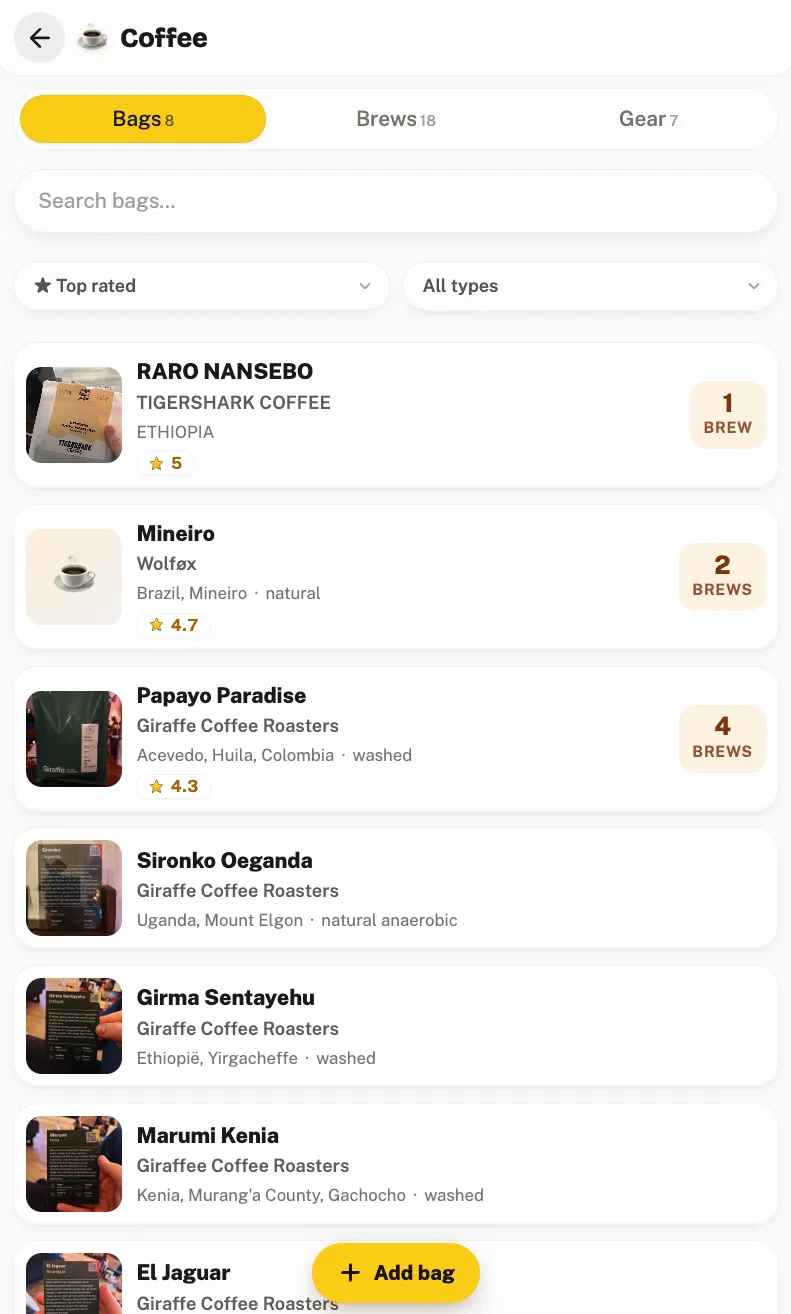
American roasters rotate seasonal micro-lots faster than almost anyone, and with six roasters and a shifting range the only way to buy well twice is to have written down what you liked. Crumble's coffee journal is a free add-on: one entry per bag with roaster, origin, process and roast date, then each brew scored on six axes from acidity through aftertaste.
Matching free journals cover tea, matcha, whisky, wine and beer. Our guide to tracking specialty coffee covers the habit, and the coffee tracking apps comparison covers the alternatives.
Frequently asked questions
Who owns Stumptown, Intelligentsia and Blue Bottle?
Peet's, which is owned by JAB Holding, bought both Stumptown and Intelligentsia in 2015. Nestle took a majority stake in Blue Bottle in 2017. Chobani bought La Colombe for roughly 900 million dollars in 2023. All four are corporate-owned, which is why none of them appear on this list of independents.
Which is the best specialty coffee roaster in America?
Onyx Coffee Lab in Rogers, Arkansas has the strongest recent record: Andrea Allen was 2020 US Barista Champion and runner-up at the 2021 World Barista Championship. Sey in Brooklyn is widely regarded as having one of the finest green sourcing programmes in the country, and Counter Culture invented the transparency report the rest of the industry copied.
Is Black and White Coffee Roasters still independent?
No. FairWave Specialty Coffee Collective acquired Black & White in April 2025 and co-founder Lem Butler departed. It was founded in 2017 by Kyle Ramage and Lem Butler, who were US Barista Champions in 2017 and 2016 respectively. The coffee is still very good; the independence is gone, and most guides have not caught up.
Who invented the coffee transparency report?
Counter Culture Coffee in Durham, North Carolina, which created the first one in 2009 and has published annually since, and was also the first coffee company to publish FOB prices. The practice is now standard among serious roasters worldwide, and German roasters have since taken it considerably further.
What is Cup of Excellence and who started it?
It is the competition and auction system that identifies exceptional coffee lots and sells them at auction, which transformed how outstanding coffee is discovered and priced. George Howell conceived and co-founded it in 1999. He roasts in Acton, Massachusetts and is also known for having argued against very dark roasting when that was the dominant American style.
Why is the best American roaster in Arkansas?
Because American specialty excellence is more geographically dispersed than the coastal-city reputation suggests. Onyx Coffee Lab in Rogers, Arkansas has been the most decorated US roaster of the past decade. The same pattern holds in Britain, where much of the best roasting is in Cornwall and Bath rather than London.
Does corporate ownership make the coffee worse?
Not automatically. Black & White was acquired in April 2025 and the coffee is still excellent. What ownership changes is who the buying decisions ultimately answer to, and it is the fact most often out of date in American coffee writing.